The EdTech CAC Crisis: Buying More Leads Won't Save You
CRM software for education industry that cuts your real cost per enrolled student: speed-to-lead, less leakage, cost per enrollment by source. Rs 499 up.

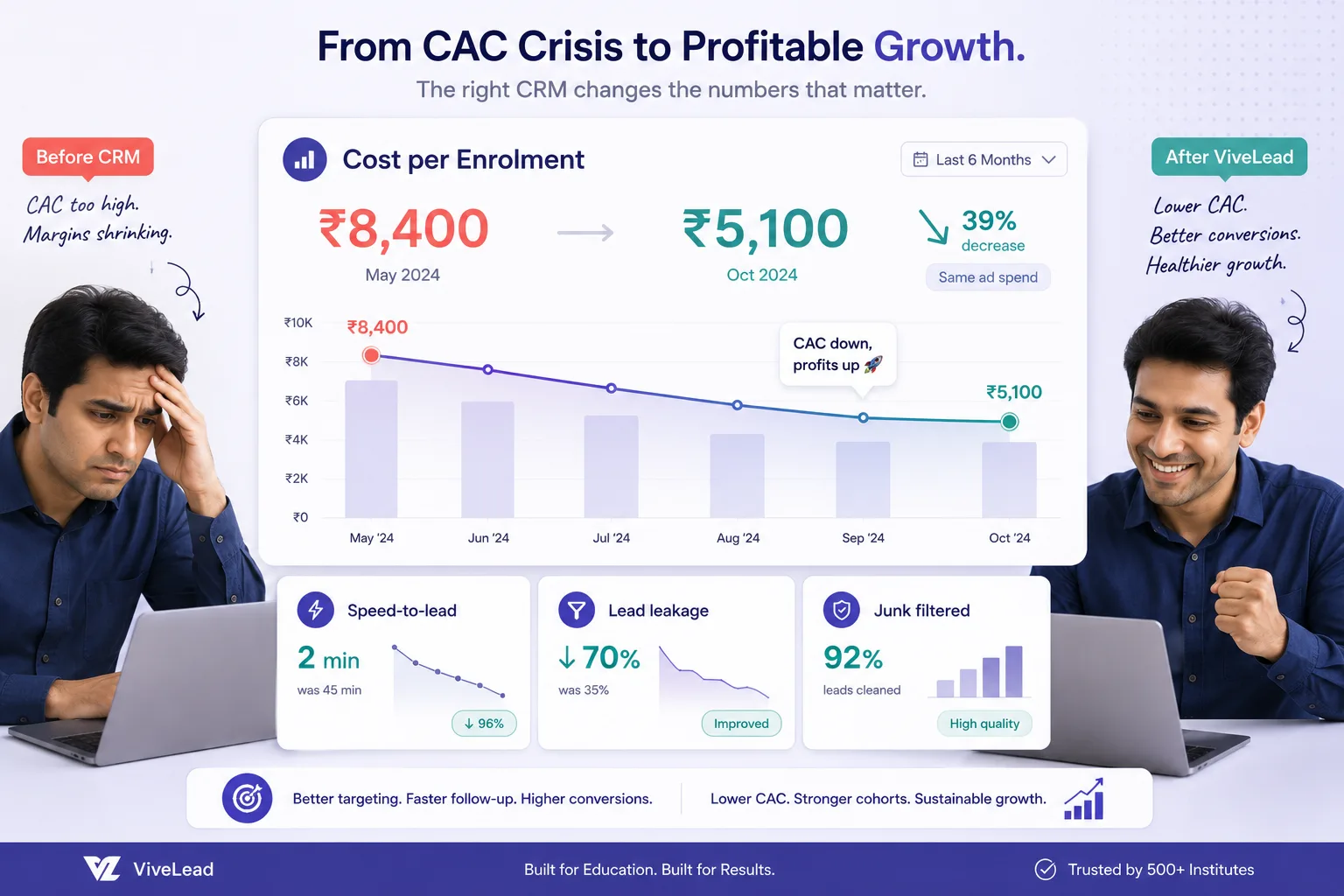
Your cost per enrolled student went up again this quarter, and you did not change a thing. Same ads, same counsellors, same fees. The number just crept up. It is creeping up across Indian EdTech for two reasons that have nothing to do with how good your coaching is. On one side, clicks got pricier: AI-driven bidding wars, more than 4,500 EdTech brands fighting for the same parent, and zero-click search swallowing free traffic. On the other side, parents got warier. After the Byju’s collapse, a real Fear of Getting Scammed now sits between your ad and the enquiry, and the same lead converts worse than it did two years ago.
Here is the line your accountant will not say out loud. You cannot out-spend a CAC crisis. The cheapest student you will ever enroll is the lead you already paid for and did not let die. This blog is not a feature tour. It is about your real cost per enrolled student, why it is climbing, and the four leaks quietly inflating it after the click.
The CAC math nobody does, and what CRM software for education industry teams should track
Open your ad dashboard. It shows you cost per lead. That is the number everyone watches, and it is the wrong one. Cost per lead is commonly cited around Rs 50 to Rs 300 for broad enquiries, and it can run to Rs 5,000 or more for high-intent test-prep and study-abroad segments (labelled ranges, public pricing 2026). But cost per lead is not what hurts your bank account. What hurts is cost per enrolled student, and almost nobody computes it by source.
Watch the arithmetic. This is an illustrative example, and your numbers will differ.
- Cost per lead: Rs 200.
- Lead-to-enrollment rate: 5 percent (education benchmarks commonly sit around 3 to 5 percent, per Reshape, Element451, and Unbounce ranges).
- Effective acquisition cost: Rs 200 divided by 5 percent equals Rs 4,000 per enrolled student.
Now hold ad spend completely flat and only fix the leakage so conversion climbs to 10 percent.
- Cost per lead: still Rs 200.
- Lead-to-enrollment rate: 10 percent.
- Effective acquisition cost: Rs 2,000 per enrolled student.
You just halved your acquisition cost without buying a single extra click, touching the creative, or lowering your fees. That is the entire thesis. The lever is conversion, not cheaper clicks.
If you need the cautionary anchor, it is the company that taught the sector this the hard way. By reported public figures, Byju’s spent roughly Rs 8,029 crore on advertising across FY16 to FY22, with FY22 ad spend alone near Rs 4,134.94 crore, up 84 percent year on year, close to 69 percent of operating revenue (Inc42). One widely reported estimate pegged the FIFA World Cup sponsorship at an acquisition cost near Rs 2,51,831 per user (Inc42 and afaqs, an extreme illustrative figure). The takeaway is not a dig. It is unit economics: you cannot out-spend bad conversion. The math always wins.
The benchmark every owner already knows, and the gap that hurts
You already know the rough shape of healthy numbers. Around 5 to 15 percent of leads should enroll. Return on ad spend “should” land somewhere around 3 to 5 times (per common Meta-ads and EdTech marketing guides). The pain is not ignorance of the benchmark. The pain is the gap between a low cost per lead and a low conversion rate, and that gap lives entirely after the click. Even the ad-optimization guides admit it: if cost per lead is acceptable but conversions are low, the fix is the sales follow-up process, not the campaign. The problem is rarely the ads. It is what happens in the eight minutes, eight hours, and eight days after the lead lands.
This is where the right CRM earns its keep, and it earns it through four specific leaks.
Leak number one: speed. The lead you ignore for an hour is enrolling somewhere else
The single most expensive habit in Indian admissions is the slow first reply. The data is brutal and it is older and better-sourced than most people think. An MIT study by Dr. James Oldroyd, the Lead Response Management Study of 2007 (run with InsideSales.com across 6 companies, more than 15,000 leads, and over 100,000 call attempts), found that contacting a lead within 5 minutes versus 30 minutes makes you about 100 times more likely to reach them and about 21 times more likely to qualify them. This study is often misattributed to a 2011 Harvard Business Review piece; the original work is MIT Sloan, which is worth knowing if you are quoting it in a budget conversation.
Translate the odds into rupees. Every hour a coaching lead sits unassigned in a sheet, the ad money you already spent to acquire it is decaying. A parent who fills one demo form fills three more in the same hour. Reply after two or three hours and the honest reality is they are already talking to another institute, often already booked for a demo. You did not lose that student on price or quality. You lost them on latency. The Rs 200 you paid for that click is just gone, and it quietly drove your effective CAC up.
The CRM job here is mechanical. ViveLead auto-creates the lead the instant a Meta lead ad, a website form, or a WhatsApp enquiry lands, so there is no copy-paste lag and no Monday-morning backlog. Plain capture from website forms is on Starter at Rs 499 per user per month, and Meta lead ads from Professional at Rs 999. The instant automated WhatsApp confirmation, the one that hits the parent’s phone in seconds while you are still asleep, needs WhatsApp plus workflow automations, which are on Professional at Rs 999. To be exact: Starter does not include WhatsApp, so do not expect an auto-WhatsApp reply on the Rs 499 plan. The auto-reply lives on Rs 499.
Leak number two: leads dying on personal phones, and walking out the door
Most leads do not leak in one dramatic moment. They leak through small gaps. The form lands but enters the CRM late. The lead sits in a spreadsheet before anyone assigns it. The counsellor opens the chat and asks the parent the same three questions the parent already answered on the form, which quietly kills trust. A WhatsApp follow-up gets missed because it is buried under personal chats. The lead gets tagged “not interested” when the truth is “not yet followed up.” Each gap is small. Together they are where your acquisition budget goes to die.
Then there is the fear every institute owner has lived: my best counsellor left and took the leads, and worse, took the WhatsApp number the parents had been chatting on. Here is the part nobody tells you plainly. Under Section 27 of the Indian Contract Act 1872, post-employment non-competes are largely void and unenforceable in India. Courts have repeatedly read Section 27 against blanket restraints, and even in customer-database disputes like Navigators Logistics versus Kashif Qureshi, the protection is narrow and hard to enforce in practice. The practical reality is you cannot legally chain a counsellor to your firm, and you cannot easily stop them from leaving.
So stop trying to win that battle legally and win it operationally instead. The only durable defence is that the lead never lived on the counsellor’s personal phone in the first place. Every conversation runs through a shared team inbox that belongs to the institute, not the individual. ViveLead does this with the WhatsApp shared team inbox over the official Meta WhatsApp Business Cloud API, where you connect your own WhatsApp Business account, on Professional at Rs 999. When a counsellor leaves, the chat history, the pipeline, and the parent relationship stay with you.
For the phone calls reps make from their own handsets, ViveLead’s Android app does SIM call logging with recording, so a call made from the rep’s own phone SIM is tied back to the lead automatically, with the recording attached. That is how you keep visibility on remote and field counsellors who call from a personal Android phone. To be precise about what this is and is not: it is the Android app logging SIM calls with recording. It is not iOS, which restricts call-log access, and it is not an auto-dialer. The point is simple. The lead, the chat, and the call all belong to the institute, not to whoever happens to be holding the phone this month.
Leak number three: you know cost per lead, you need cost per enrollment by source
This is the most under-served pain in the whole sector and the actual heart of CAC. You can see leads coming in and money going out, but you cannot answer the one question that matters: which campaign produced enrolled students, versus which one just produced cheap leads that never converted? Your ad dashboard gives you cost per lead by source. It cannot give you cost per enrollment by source, because it never sees who paid the fees.
Why does this single report change your spend more than any creative tweak? Because once you can see it, you stop funding the campaign that brings 200 cheap leads that never enroll and you double down on the one that brings 40 leads that do. Same total budget, far lower effective CAC, because every rupee now flows toward enrollments instead of vanity lead volume. This is how you lower acquisition cost without writing a single new ad.
In ViveLead, the lead source is tagged at creation, and the reports, including source-wise conversion and funnel drop-off, surface which source actually closes, on every plan from Starter at Rs 499. Lead scoring into hot, warm, and cold buckets and lead distribution rules are on Professional at Rs 999, so the strong leads get routed fast and the weak sources stop eating counsellor hours. For most institutes, those reports are already enough to kill a losing campaign and feed a winning one.
Leak number four: warm leads that die of silence
Reframe the word “not interested.” Most leads tagged that way are not uninterested. They were just never properly followed up. By one vendor’s estimate, around 20 to 40 percent of serious enquiries never convert simply because there is no proper tracking and follow-up (TeleCRM, a vendor source, framed as illustrative, not an audited stat). One third-party case study reported a structured follow-up process lifting attempt-to-enrollment to about 18 percent (Vertex Global Services; results vary). Treat both as directional, not as guarantees. The pattern they point at is real: silence kills warm leads, and silence is fixable.
The fix is an automated cadence so a warm lead is never waiting on a counsellor to remember it. In ViveLead this runs on workflow automations plus follow-ups and lead scoring, on Professional at Rs 999. I am keeping this section short on purpose, because the actual day-by-day cadence, the demo confirmations, the reminder timing, the fee-and-seat-hold follow-up, is a whole playbook on its own. We wrote that one separately: see the 7-day demo-to-enrollment cadence for Indian coaching institutes for the step-by-step.
What this costs versus what enterprise costs
Most education CRMs bury the price behind a “contact us” form, which is its own kind of tell. Here is a real table. Every figure is a labelled range from public pricing as of 2026, GST extra unless stated, and subject to change.
| Tool | Indicative price (per user/month unless noted) | Notable cost mechanics |
|---|---|---|
| ViveLead Starter | Rs 499 | Core CRM, website lead capture and source-wise reports. No WhatsApp or Meta lead ads. |
| ViveLead Professional | Rs 999 | WhatsApp (official Meta API, no markup), Meta lead ads, automations. |
| ViveLead Business | Rs 1,699 | Adds Twilio calling and the AI agents. |
| LeadSquared | Sales Pro Rs 2,500, Sales Super Rs 5,000 | Billed annually upfront, plus 18 percent GST, plus metered add-ons that can add 10 to 50 percent. A 20-rep team on Pro lands near Rs 59,000/month before add-ons. |
| Meritto (Collegedunia) | Per-application, “contact us” | Application-based pricing can punish a strong admission season precisely when volumes spike. |
| TeleCRM | Rs 799 annual, Rs 1,099 quarterly | WhatsApp API setup is a one-time Rs 1,999, and Chat Sync is a +Rs 200/user add-on. |
| Zoho CRM | ~Rs 800 to Rs 1,400 | Cheap base, but heavier configuration and WhatsApp is typically a bolt-on. |
| HubSpot / Salesforce (Pro) | ~Rs 7,500+ | USD-priced, not WhatsApp-first, built for a different buyer. |
One honesty paragraph on the WhatsApp line, because it is where hidden cost loves to hide. WhatsApp BSPs typically charge a monthly platform fee on top of Meta’s per-message charge, and often a markup on that per-message rate too. Approximate public 2026 platform fees: AiSensy around Rs 1,500/month, Interakt around Rs 999/month, Wati around Rs 2,199/month and up. ViveLead does it differently. You connect your own WhatsApp Business account over the official Meta Cloud API, and Meta bills your account directly per message under the per-message model live since July 2025 (roughly Rs 0.8631 per marketing message, around Rs 0.115 per utility message, Meta’s published India rates). ViveLead adds no markup on Meta’s rate, and the inbox, templates, and broadcasts are bundled into the Rs 999 Professional plan. To be exact about the claim: Meta still charges your WABA. We are not saying WhatsApp is free. We are saying there is no ViveLead markup and no separate platform fee on top.
Where ViveLead does not fit
I would rather you read this than feel mis-sold later. ViveLead is a CRM. It is not a learning management system, not your fee or ERP or student information system, and not a full marketing-automation suite. It captures your Meta, website, and WhatsApp leads, routes them, makes the team fast and accountable, and shows you which source actually enrolls. It integrates with the rest of your stack; it does not replace your LMS or your SIS.
So who should not buy us? If you are a 500-rep, multi-city behemoth with a dedicated RevOps team and a student information system already locked into your back office, an enterprise platform like LeadSquared or Meritto may genuinely fit you better, and that is fine. But if you are a 1 to 30 user institute watching your cost per enrolled student climb, the honest objection most owners voice is “we tried LeadSquared, it took weeks to set up, and the team never actually adopted it.” Intake season does not wait weeks. A Rs 499 to Rs 999 tool the team will actually use beats a Rs 2,500 to Rs 7,500 one they abandon by month two. Adoption is the whole game, because a CRM nobody opens lowers exactly zero of your acquisition cost.
The first move this week
You cannot buy your way out of a CAC crisis, so stop trying. Reply to enquiries in minutes, not hours. Get every lead and chat off personal phones and onto a shared inbox the institute owns. Then spend your next rupee only on the campaign that actually enrolls students, not the one that brings the cheapest clicks. That is four levers, and all four lower the only number that matters: cost per enrolled student.
ViveLead runs a 3-day free trial with no credit card. The capture lever and the source-wise conversion reports start on Starter at Rs 499. WhatsApp and automations, the speed and follow-up levers, are on Professional at Rs 999. Set it up in days, point it at this intake season, and watch where the leaks actually are. If you want a walkthrough on your own admissions workflow first, book a short demo and we will map it to your funnel before you commit a rupee.
CRM for the Education Industry: FAQs
Acquisition cost, speed-to-lead, counsellor leakage, cost per enrolled student, and ViveLead pricing for Indian coaching and EdTech teams
Lower your cost per enrolled student
Capture, route, and follow up every lead on ViveLead Professional at Rs 999/user/month. No credit card required.
Continue Reading

EdTech CRM Software India 2026: Real Prices and Hidden Costs
EdTech CRM software for Indian institutes, compared on all-in price, who pays Meta for WhatsApp, demo-gating, DPDP and …

5 Fatal Flaws Found in the Best EdTech CRM Tools | ViveLead
5 fatal flaws in the 'best EdTech CRM' tools: USD pricing, bolt-on WhatsApp, slow setup, hidden costs, siloed back …

Stop Using Your EdTech CRM Like an Excel Sheet | ViveLead
Most coaching institutes use their EdTech CRM like a spreadsheet. The admissions-specific way to capture, nurture, …