EdTech Lead to Enrollment: The 7-Day Funnel (India 2026)
Move a coaching enquiry from demo booking to enrollment in 7 days: the follow-up cadence, counsellor productivity, and demo show-up tactics that convert.

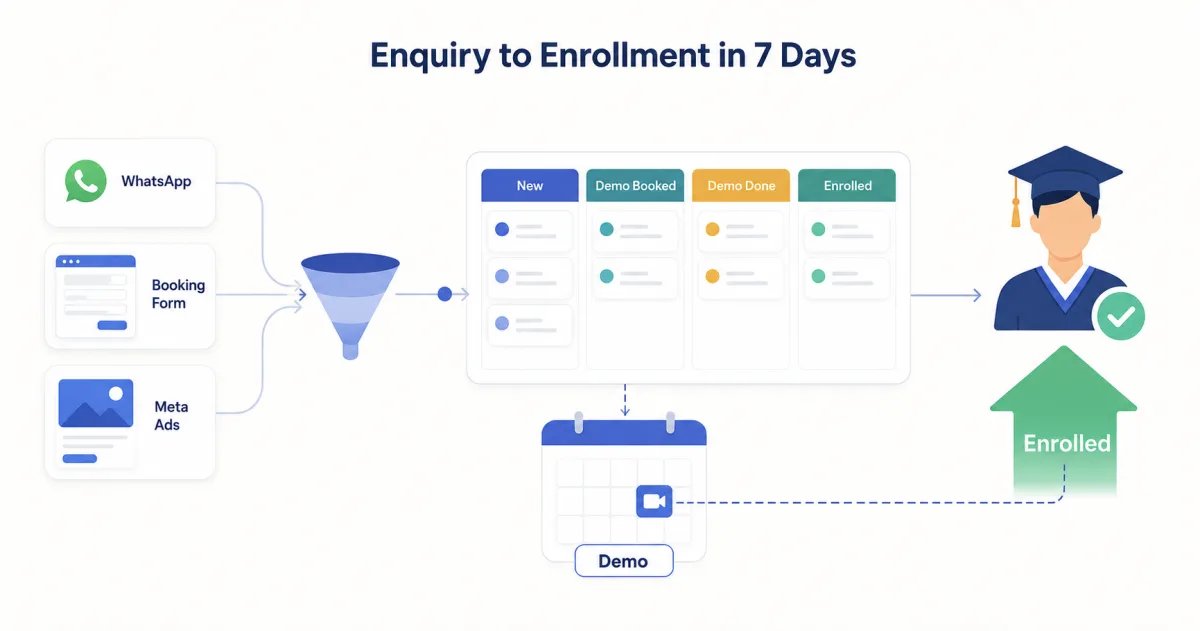
The 7-day window most coaching institutes miss
A parent in Jaipur fills your demo booking form at 9pm on a Sunday. By the time your counsellor opens the inquiry on Monday morning, the parent has already filled three more forms on three competitor sites. By Wednesday, two of those competitors have already done a demo call. By the time you reach out on Thursday, the seat is gone.
This is not a counsellor problem. It is a system problem. The institutes that win in 2026 are not the ones with the best teachers, the best website, or the lowest fees. They are the ones who can move a fresh lead from enquiry to enrolled in under 7 days, consistently, without it depending on which counsellor was on shift.
This playbook is how to build that system. Specifically for Indian coaching institutes, JEE/NEET training centres, K-12 tuition chains, and online course providers selling into the same market.
Where leads actually come from in 2026 (and why most CRMs get this wrong)
Most coaching institute owners we talk to still think their leads come from “the website”. They don’t. Here is the realistic split for a mid-sized institute today.
- WhatsApp inbound (parent saw an Instagram ad, tapped “Send Message”, landed in your WhatsApp Business inbox): 30 to 40 percent.
- Demo booking form on your site or landing page: 20 to 25 percent.
- Meta Lead Ads (Facebook and Instagram form ads): 15 to 20 percent.
- Referrals and walk-ins at your branches: 10 to 15 percent.
- Google Ads, organic search, JustDial, Sulekha: the remaining 10 to 20 percent.
The mistake most CRMs make is treating these as five separate inboxes. Your counsellor opens WhatsApp on their phone, a separate Meta Business Suite tab for ad leads, an Excel sheet for walk-ins, and a Google Form spreadsheet for demo bookings. Nobody can tell you what your total enquiry volume was last week, let alone source-wise conversion.
The fix is single-inbox capture. Every channel feeds one lead pipeline with the source tagged at creation. In ViveLead, this is wired through:
- WhatsApp Business inbox (Meta direct integration, or AiSensy for larger volumes) auto-creates a lead the moment a parent sends a message.
- Public booking forms on a
forms.vivelead.comURL you can paste into your landing page or Instagram bio, with custom fields for course, city, and parent contact. - Meta Lead Ads sync that pulls form submissions in near real time.
- CSV or Excel bulk import for walk-in registers your front desk team still keeps on paper.
- Manual add with the same form structure for phone-in inquiries your receptionist takes.
Source attribution stays on every lead from day one. When you look at your enrollment report three months later, you can actually answer “Instagram or Google? Which one paid back?”
The demo booking step is where 60 percent of you are leaking
Here is the awkward truth. The single biggest leak in an Indian coaching funnel is not the demo class itself. It is the gap between “parent said they want a demo” and “demo actually happened”.
We see institutes lose between 50 and 70 percent of warm leads in this window. Not because the parent changed their mind. Because:
- The counsellor wrote the demo time on a sticky note, which got lost.
- The parent never got a confirmation message, so they forgot the slot.
- Nobody sent a reminder one hour before, so the parent was driving back from work.
- The Google Meet link went to a junk folder.
- The counsellor was double-booked and only realised at the slot time.
A working demo booking workflow needs four things wired together, not four manual steps.
- A slot picker the parent can self-serve. You publish your counsellor team’s availability as bookable 30-minute slots. Parent picks the slot from a public link, no back-and-forth on WhatsApp.
- Automatic Google Calendar event created on both your counsellor’s calendar and the parent’s (via the email they entered).
- Auto-generated Google Meet link attached to the calendar event, with no manual copy-paste.
- Reminder cadence. A WhatsApp template the moment the slot is booked (confirmation), another 24 hours before (reminder), and a final one 1 hour before with the Meet link front and centre.
In ViveLead this is the Appointments module talking to the Automations engine. You configure your counsellors’ weekly availability once. The public booking link respects that. Bookings sync into Google Calendar with Meet links. The Automations engine fires WhatsApp templates at the trigger points you set. If what you need is the wording rather than the wiring, the admission follow-up message pack has the confirmation, the reminder and the missed-slot message written out, each with its trigger and its stop rule.
The institutes we work with who turned this on saw demo show-up rates jump from around 35 percent to 70 percent in the first month. Not because the parents changed. Because nothing got lost.
Counsellor productivity: the metric you should be tracking, but aren’t
Most coaching institute owners we ask cannot answer this question with a number: “How many demos can one counsellor actually close per day?”
The answer matters because counsellor headcount is your biggest non-rent cost. If you are about to hire your fifth counsellor, you should know whether your existing four are running at 60 percent of capacity or 110 percent. The answer changes your hiring decision by lakhs per year.
To track this, you need three things visible per counsellor on a single dashboard:
- Enquiries assigned this week. Round-robin or rule-based assignment so workload is even. ViveLead’s lead distribution rules let you split assignment by course (Python lead goes to the Python counsellor), by city, or by simple round-robin.
- Demo calls done. Not just dialled, actually connected. This is why a browser-based dialer inside the CRM matters more than a separate softphone. When the counsellor clicks the lead’s phone number, the call log lands on that lead automatically. Talk time, outcome disposition, recording, all visible per lead.
- Demos to enrollment conversion rate per counsellor. This is the diagnostic metric. If your average is 25 percent but one counsellor sits at 12 percent, you have a coaching problem, not a hiring one. The opposite is also true. If one counsellor is at 45 percent, copy what they do, do not just give them more leads.
ViveLead’s Reports & Analytics module gives you this per-counsellor breakdown out of the box. The HR Analytics tab adds the staff-side numbers (attendance, shift adherence, leave patterns) so you can correlate productivity with presence, which most institutes never think to do.
The follow-up cadence that actually works for coaching leads
Speed off the mark decides this race. A widely cited MIT study of more than 15,000 leads, led by Professor James Oldroyd with InsideSales, found you are 21 times more likely to qualify a lead if you contact it within 5 minutes than if you wait 30 minutes. For a coaching institute, that gap is the difference between catching the parent while they are still on your booking page and reaching them after they have already spoken to two competitors.
Indian parents do not buy a 75,000-rupee coaching package on the first call. The data from our customer base says the median enrolled lead has 4 to 6 touchpoints between first enquiry and payment. The institutes that win are the ones that make these touchpoints feel personal even though they are automated.
Here is a cadence we have seen work, end to end, for a JEE/NEET coaching institute average ticket of around 1.2 lakh:
Day 0, within 5 minutes of inquiry WhatsApp template confirming the inquiry, with one course-specific PDF attached (sample syllabus, recent topper testimonial). Sent automatically by the WhatsApp send_communication automation step the moment the lead enters the “New” stage.
Day 0, within 2 hours Counsellor calls the parent, or an AI voice agent makes that first call within minutes of the enquiry. First call is qualification only, not selling. Goal is to book the demo for a specific slot in the next 48 hours. Outcome disposition is logged on the lead immediately: “demo booked”, “callback later”, “not interested”, or “wrong number”.
Day 1, 24 hours before demo Automated WhatsApp reminder with the Meet link.
Day 1 or 2, demo happens Counsellor’s teacher colleague joins the Meet, runs the actual 30-minute trial. Counsellor stays present to handle parent questions on fees, batches, schedule.
Day 2, 1 hour after demo Counsellor sends a personalised follow-up WhatsApp with the fee structure, batch start dates, and a specific seat-hold offer (24 to 48 hour deadline). This one is not templated. It is written based on what came up in the demo.
Day 3 or 4 If parent has not responded, automated WhatsApp template asking if they have any questions. Soft tone, not pushy.
Day 5 or 6 Counsellor calls again. If parent is still warm but stuck on fees, this is the moment for the payment-plan or sibling-discount conversation.
Day 7 Decision point. Either enrolled, or moved to the “Nurture” stage where the cadence stretches out to weekly touchpoints until the next admission window.
The reason this cadence works is that the automated touches keep the lead warm without burning your counsellor’s time, and the human touches happen at the exact moments where a real conversation moves the needle. Take any one of these out and the conversion rate drops noticeably.
What to actually track on your enrollment pipeline
A pipeline with twelve stages is a pipeline nobody updates. We have seen this fail at coaching institutes more times than we can count. Keep your stages tight. Six is the sweet spot.
- New. Fresh inquiry, not yet contacted.
- Contacted. Counsellor has spoken to the parent at least once.
- Demo Booked. Slot is on the calendar, both confirmation and reminder fired.
- Demo Done. Demo class happened, counsellor logged outcome.
- Negotiation. Fee discussion in progress, parent is interested but not committed.
- Enrolled. Payment received, batch assigned.
You also need a clean “lost reasons” enumeration on dropped leads. “Not interested” is useless. The real reasons cluster into about five buckets: fees too high, chose competitor, timing not right (e.g., parent wants to wait for next session), parent went silent, student decided not to pursue this course. When you start tagging these, your monthly review meeting becomes useful because you can finally see whether you are losing on price, on positioning, or on follow-up discipline.
ViveLead’s pipeline is fully configurable. You set the stages, the lost reasons, and the required fields per stage. The Kanban view is the one your counsellors should use day to day. The list view is the one you should use for Monday morning reviews.
The numbers a coaching institute owner should look at every Monday
A 10-minute Monday review using the right four numbers tells you more than a 2-hour quarterly business review using the wrong ten. These are the four.
1. Last week’s enquiry volume by source. Did Instagram ads drop? Did the JustDial spend stop pulling? You catch a leaky channel a week before your CFO does.
2. Demo show-up rate. Should be 60 percent or higher with the reminder cadence wired up. If it drops below 50 percent, something broke in your automation. Check that the WhatsApp templates are still firing.
3. Counsellor-wise conversion rate (Contacted → Enrolled). The variance across your team is the actionable insight. If it is wider than 15 percentage points, you have a training gap.
4. Cost per enrolled student, by source. Total spend on the channel divided by enrolled students that came from it. This is the one number that should drive next month’s marketing budget. Not impressions, not clicks, not even leads. Enrolled students per rupee.
ViveLead’s Analytics dashboard surfaces these as a default view. You do not need to build them.
When ViveLead is the right pick, and when it is not
We try to be honest about this. ViveLead is a strong fit for a coaching institute or EdTech company if:
- You have between 5 and 200 employees total (counsellors, teachers, staff combined).
- You handle between 200 and 5000 enquiries a month.
- You want CRM and HRMS in one platform because you do not want to pay for and maintain two.
- You sell into the Indian market and care about WhatsApp, INR pricing, GST-compliant payroll, RERA/HRMS edge cases.
- Your budget for software is in the “few hundred rupees per user per month” range, not the “few thousand” range.
ViveLead is probably not the right pick if:
- You are running a giant Byju’s-scale operation with dedicated MarTech and RevOps teams. Salesforce or HubSpot will fit your stack better.
- You are a pure international EdTech with no India presence. Our WhatsApp, payroll compliance, and INR pricing focus do not give you any advantage.
- You need very specialised features like proctored exam delivery or LMS-integrated assignment grading. We are a CRM with HRMS, not a learning management system.
If you are in the first bucket, the EdTech CRM page walks through the specific feature mapping. If you want to see the platform end-to-end before deciding, the feature overview and pricing are the two pages that will tell you most of what you need.
A starting checklist for institutes setting this up this week
If you are reading this and want to actually build the funnel rather than just think about it, here is the sequence we suggest. You can have most of it running by Friday if you start Monday.
- Make a clean list of every lead source you currently have. Be honest, include the offline ones.
- Pick a CRM. Set up your six pipeline stages and your lost reasons enumeration.
- Connect your WhatsApp Business number to the CRM. Set up the day-0 confirmation template and the day-1 demo reminder template first. Do not try to build all 12 templates on day one.
- Build one public booking form for demos. Publish the link on your Instagram bio and your website.
- Set up your counsellor team in the CRM. Configure lead distribution rules, round-robin to start, you can get fancier later.
- Wire up the one critical automation: when a demo is booked, send the confirmation WhatsApp. Add the 24-hour reminder automation in week two.
- Train your counsellors on the disposition logging. Every call must end with a disposition or you lose the data.
- Schedule a 15-minute Monday review with the four numbers above.
That is enough. You do not need to set up email sequences, AI chatbots, or fancy lifecycle scoring in your first month. The basics above will move your enrollment rate further than any advanced feature.
Closing thought
Coaching is a relationship business. Parents enrol their child with an institute they trust. No software changes that. What software changes is whether the parent ever gets to feel that trust before they make the decision.
A lead that gets a confirmation in 5 minutes, a reminder the day before, a real conversation at the right moment, and a follow-up that references what they actually asked about in the demo: that lead feels seen. The institute that makes the parent feel seen at every step is the one that wins the enrollment, even if their fees are 10 percent higher than the competitor down the road.
That is the system worth building. The tools are a means.
Coaching Institute CRM FAQs
Demo booking, follow-up cadence, pricing, and fit for Indian coaching and EdTech teams
Related reading
- EdTech CRM industry page
- Smart Lead Capture
- WhatsApp CRM in India: Buyer’s Guide
- AI Sales Assistant for follow-ups
- Pricing
Coaching CRM by city: Delhi NCR, Mumbai, Bangalore, Hyderabad, Chennai, and Pune.
See the enrollment funnel in action
A 30-minute founder-led demo on your actual admissions workflow. CRM + HRMS from Rs 499/user/month.