Enrollment Marketing Automation That Wins Clicks | ViveLead
Enrollment marketing automation for Indian coaching, EdTech & study-abroad: the inquiry-to-admission trigger map, honest pricing, ViveLead from Rs 499.

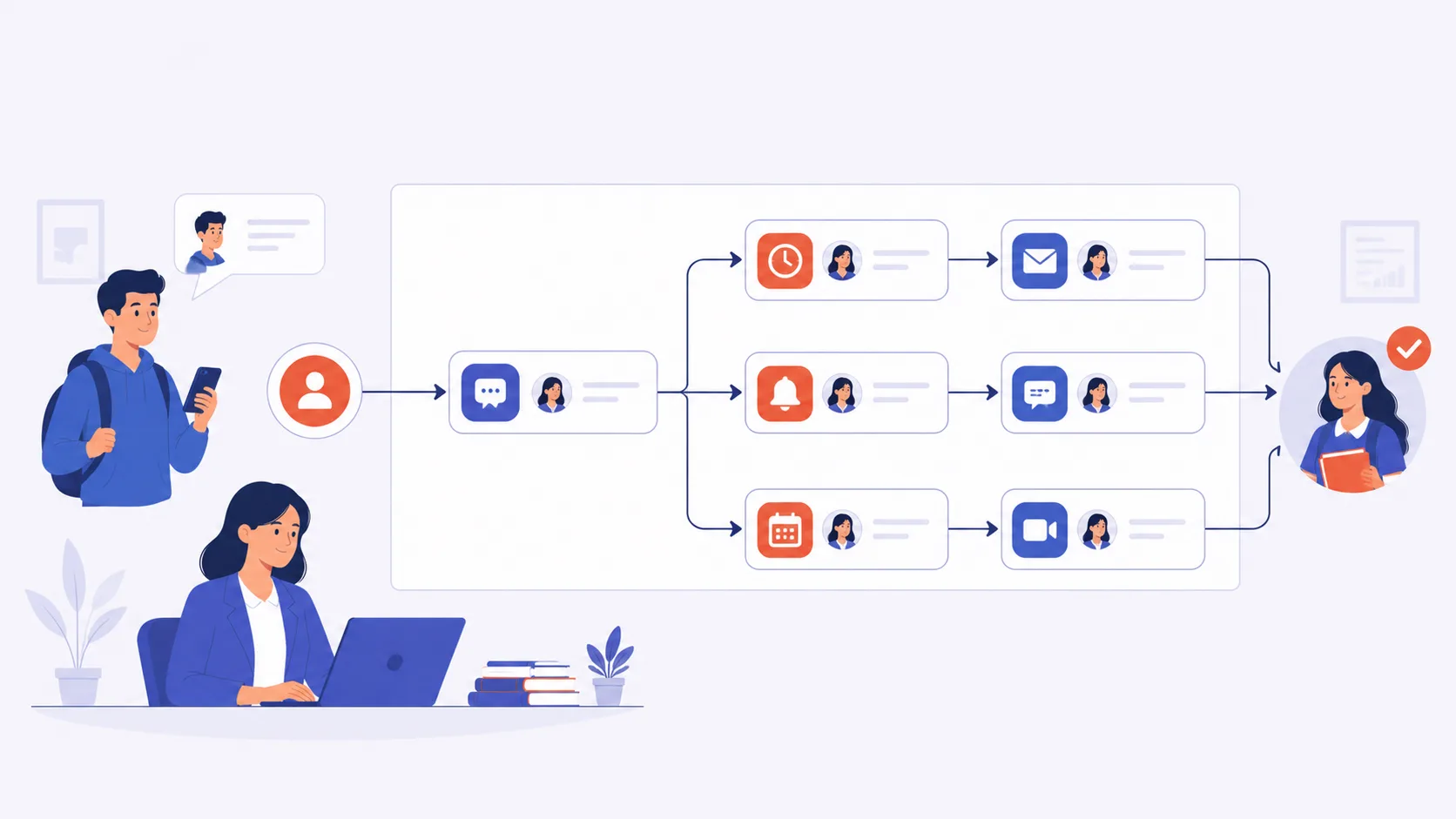
Search “enrollment marketing automation” and page one hands you HubSpot, Slate, Marketo, Pardot, and Element451. Every one of them is built for a US university with a CRM admin on payroll, a six-figure annual contract, and a marketing-ops team. None of them was built for a five-person JEE coaching center in Indirapuram, an EdTech startup in Koramangala running on Meta lead ads, or a solo study-abroad consultant in Jalandhar working WhatsApp from a phone between walk-ins. That is the gap this page closes.
The same admission funnel exists in both worlds. The vocabulary, the budget, and the channel mix do not. So before anything else, here is the honest version of the answer, then the part nobody on page one will tell you: who pays Meta for WhatsApp, why most “education CRM” leaders start at Rs 13,000 a month, and the exact trigger map you should build instead of buying “more reminders.”
Quick answer: what enrollment marketing automation actually is
Enrollment marketing automation is technology that captures every admission enquiry, responds instantly, scores leads hot, warm, or cold, and runs stage-based follow-up (demo reminders, fee nudges, re-engagement) so no enquiry is lost to a counsellor’s memory. For Indian coaching, EdTech, and study-abroad teams it works best as a concrete trigger map: capture Meta lead ads and website forms, auto-assign, send an instant WhatsApp acknowledgement, book the demo via a self-scheduling link, then nurture by stage.
Most page-one tools price this as a flat Rs 12,999 to 14,999 per month or as US enterprise SaaS. The practical Indian SMB answer starts far lower. ViveLead captures enquiries and runs the pipeline and quotations on the Starter plan (Rs 499/user/month), and adds the full automation layer, lead scoring, booking links, native WhatsApp Business, and invoicing, on Professional (Rs 999/user/month), with a 3-day trial and no card. WhatsApp messages are billed by Meta directly to your own WhatsApp Business Account with no markup. The honest rule: automate once enquiry volume is high enough that a counsellor working 100 leads by hand would drop half of them.
That is the summary. The rest of this page is the working detail behind it.
Enrollment marketing automation, translated for Indian admissions (not US higher-ed)
What the phrase actually means
Strip away the jargon and “enrollment marketing automation” is a simple promise: technology-driven processes that capture, nurture, and convert enquiries at scale without losing the personal touch. Capture means every enquiry lands in one place automatically, no matter which ad or form it came from. Nurture means the right message reaches the right student at the right stage, on its own, without a human remembering to send it. Convert means the system pushes the enquiry forward (book the demo, discuss the fee, take the payment) instead of letting it stall.
Notice what is not in that definition. It is not a chatbot. It is not “email blasts.” It is not a dashboard you stare at. It is a set of triggers wired to the stages of an admission journey, so that the journey runs even when your counsellor is on a call, on leave, or simply human and forgetful.
Why every page-one result is irrelevant to a five-person coaching center
The US higher-ed stack (HubSpot, Slate, Marketo, Pardot, Element451) was designed around a different buyer: a university enrollment office, a budget measured in lakhs per month, and at least one person whose full-time job is running the tool. Slate alone is a multi-year implementation. Salesforce Education Cloud, as published in 2026, starts around 81 to 87 US dollars per user per month on annual billing for its Enterprise edition, before GST and before you pay an admin to configure it. Check Salesforce’s own education pricing page for the current figure, but the order of magnitude is the point.
A coaching center with four counsellors and a receptionist does not have that money or that headcount. Pointing that center at a US enrollment-marketing platform is like prescribing an MRI machine to a clinic that needs a thermometer. The funnel is real. The tool is wrong by an order of magnitude.
The vocabulary bridge (read yourself into this)
Here is the part the US pages never address. Indian admissions teams do not say “enrollment.” They say admission. They do not say “inquiry.” They say enquiry, or walk-in. The job is not “lead nurturing,” it is follow-up. The person doing it is a counsellor, not an “enrollment specialist.” The product is a batch or a demo class, not a “cohort experience.” And the money conversation is the fee, full stop.
So this guide uses both languages on purpose. When you search the US-coded phrase, you find this page. When you read it, you recognise your own institute in it. Enrollment equals admission. Inquiry equals enquiry. The mechanics underneath, capture, qualify, follow up, close, are identical across both vocabularies. Translating the keyword into Indian admissions reality is the entire opportunity, and it is also why a generic platform built for the US word tends to fail Indian EdTech admissions in practice.
Who this is for
Three teams, one spine:
- Coaching and test-prep institutes (JEE, NEET, CAT, UPSC, K-12 tuition chains) running on walk-ins, referrals, and Meta ads.
- EdTech companies selling courses online into the Indian market, where Meta lead ads and WhatsApp are the front door.
- Study-abroad consultants and agencies, from solo agents to mid-size firms, juggling 5 to 15 applications per student across countries.
If you are a Byju’s-scale operation with a RevOps team, this is not your guide; you will fit an enterprise stack. If you are any of the three above, doing Indian admissions on Indian budgets, keep reading. We have written a fuller education CRM software guide for the buying decision itself, but the automation mechanics start right here.
The real problem: your memory is the system (and memory leaks)
A counsellor managing 100 leads manually will drop half of them. A system won’t.
That line, from a Classpro scaling playbook published on Medium, is the most honest sentence in this entire category. It is not a motivational poster. It is arithmetic. A human counsellor holding a hundred live enquiries in their head, on sticky notes, and across fifteen open WhatsApp threads will lose track of roughly half. Not because they are lazy. Because that is what happens to memory under load.
When your follow-up process lives in a person’s head, the process has the reliability of a person’s head: good on a quiet Tuesday, catastrophic during admission season when the same person is handling walk-ins, calls, and a parent standing at the front desk all at once.
The Monday-enquiry, Friday-silence gap
Here is how the leak actually shows up. A parent enquires on Monday evening. The counsellor was mid-call, made a mental note to ring back, and never did. By Friday the parent has heard nothing from you and two demo invitations from competitors. The lead is gone, and the painful part is that your “system” was switched on the whole time. The enquiry was captured. It just sat there, because capturing an enquiry and acting on it are two different things, and only one of them was automated.
This is the failure that vendor write-ups from Erino and Vedain describe as leads “falling through the cracks despite the system being on.” Automation’s real job is to remove the dependency on a counsellor remembering. The reminder fires whether or not anyone remembered. The acknowledgement goes out whether or not anyone was free. That is the difference between owning software and owning a process.
The break-point: manageable at 200 students, chaos at 500
There is a specific volume where the manual approach stops working, and operators describe it almost identically. In that same Classpro material the framing is blunt: at 200 students, admin is manageable with spreadsheets, WhatsApp groups, and a couple of staff juggling everything. At 500 students, the same approach becomes chaos.
The reason is that manual coordination cost does not grow in a straight line. Double the students and you more than double the cross-checking, the “who called this parent?”, the “did we send the reminder?”, the duplicate follow-ups from two counsellors who both thought the lead was theirs. The spreadsheet that felt fine at 200 becomes the thing actively losing you money at 500. If your enquiry tracking still lives in Excel, the deeper version of this argument is in Excel vs CRM for lead tracking and the EdTech-specific stop using your EdTech CRM like Excel.
What lost enquiries actually cost
Put a number on the leak. Vendor analyses in this space (TeleCRM, SensationCRM, paraphrased here, not quoted as first-person operator speech) estimate that 20 to 40 percent of serious enquiries never convert, and that 30 to 40 percent of inquiries get lost in inboxes, chats, and spreadsheets before anyone even works them properly. Treat those as directional, not gospel, and verify against your own numbers. But the shape is right, and you can feel it.
Run the math on your own institute. If your average fee is Rs 60,000 and you lose even ten serious enquiries a month to “we forgot to follow up,” that is Rs 6,00,000 of annual revenue walking out the door, before you spend a rupee more on ads. The cheapest growth lever you have is not more leads. It is not dropping the leads you already paid for. This is a systems problem, not an effort problem, and you do not fix a systems problem by telling tired people to try harder.
Speed-to-lead: the one number that decides most admissions
If you automate only one thing, automate speed. The research on response time is some of the most replicated in all of sales, and it maps almost perfectly onto admissions.
The original research, by name
The famous “5-minute rule” did not come from a CRM vendor’s blog. It came from the Lead Response Management Study led by Dr. James Oldroyd at MIT’s Sloan School of Management with InsideSales.com, analysing three years of data across six companies, more than fifteen thousand leads, and over a hundred thousand call attempts. The headline finding: contacting a web lead within five minutes versus thirty minutes made you about 100 times more likely to make contact, and about 21 times more likely to qualify the lead. Harvard Business Review later popularised the same numbers in its 2011 article on lead response, which is why you often see them attached to the Harvard name, but the original measurement was MIT and InsideSales.com.
Twenty-one times more likely to qualify. Not twenty-one percent. Twenty-one times. That is the gap between catching a parent while they are still on your booking page and reaching them after two competitors have already called.
Velocify: speed beats timing, and persistence beats both
A separate Velocify study, “When to Call Sales Leads” (released May 2016, analysing roughly 3.5 million leads, skewed toward mortgage, insurance, and education), found that making the first call attempt within a minute of receiving a lead lifted conversion by about 391 percent versus slower responses. The same body of research is where the often-cited pattern comes from that the average rep effectively gives up after roughly one to two attempts, while the leads that actually convert are reached through six or more touches. Winners simply make more attempts, faster, in the first 48 hours.
These are phone-heavy, high-intent verticals. Coaching admissions and study-abroad counselling sit squarely in that profile. Treat the exact percentages as directional and check the source studies yourself, but the direction is not in dispute: faster and more persistent wins, by a lot.
Decay windows by sector
Speed matters more in some segments than others. For a study-abroad enquiry, vendor analysis from Erino puts the cooling window at roughly 48 hours: the student has filled forms with several consultants, and whoever responds with substance first tends to own the relationship. For a JEE or NEET enquiry during admission season, the window can be shorter still, because the very next institute’s call may land within the hour. The practical takeaway is the same: the clock starts the instant the enquiry lands, not the instant a counsellor happens to open the CRM.
From stat to workflow
Most pages quote these numbers and stop. Here is what “respond in five minutes” actually looks like as a workflow you can stand up, not a slogan:
- The enquiry lands (Meta lead ad, website form, WhatsApp) and is captured automatically, no copy-paste.
- It is auto-assigned to a counsellor by rule (by course, by city, or simple round-robin) so ownership is never ambiguous.
- An instant acknowledgement fires the same second, a WhatsApp template that confirms you received the enquiry and sets up the call.
- A structured follow-up cadence takes over, so attempts two through six happen on schedule instead of relying on anyone’s memory.
Steps one through three remove the human delay entirely. Step four removes the human forgetting. That is the whole game, and it is exactly the trigger map we build next.
The concrete inquiry-to-admission trigger map (build this, not “more reminders”)
This is the part competitors name but never draw. Enrollify talks about “welcome, deadline, and re-engagement sequences” in the abstract. TeleCRM and Vedain say “follow-up reminders.” None of them walks an Indian admissions admin through the actual triggers they would wire. So here is the literal map, mirrored on a real coaching pipeline: Enquiry to Counselling to Demo Class to Fee Discussion to Enrolled.
Read each stage as a trigger (an event that fires an action automatically), not a to-do list a human works through.
Stage 0, Capture: one inbox, not fifteen WhatsApp threads
Every enquiry from every source lands in one place automatically: Meta lead ads, website and landing-page forms, manual phone-in entries your receptionist takes. The source is tagged at creation, so three months later you can answer “Instagram or Google, which one actually paid back?” instead of guessing. No counsellor should ever copy a phone number from a WhatsApp thread into a spreadsheet again; that copy-paste step is exactly where leads die. (The capture mechanics in depth: smart lead capture and connecting Facebook and Meta lead ads.)
Stage 1, Instant response plus auto-assign
The moment an enquiry lands, two things happen on their own: it routes to a counsellor by your rule, and an acknowledgement template fires. This is the speed-to-lead research turned into a trigger. The student hears from your institute within seconds, even at 11pm, even on a Sunday, and a specific human now owns the next step. Ambiguity about “whose lead is this” is designed out.
Stage 2, Qualify and score
Not every enquiry is worth equal effort, and your counsellors have finite hours. Lead scoring sorts enquiries into hot, warm, and cold buckets using configurable rules (source, course interest, responsiveness, budget signals) so the team works the enquiries most likely to enrol first. A counsellor with 120 calls in their daily KRA cannot treat all 120 the same; scoring tells them where to spend the first two hours.
Stage 3, Book the demo or counselling slot
Phone-tag kills warm leads. Instead of four WhatsApp messages to settle a time, the student gets a public booking link and self-schedules a demo class or counselling slot from your team’s real availability. The slot syncs to the counsellor’s calendar, a meeting link attaches automatically, and the back-and-forth disappears. This single change is one of the biggest show-up-rate levers there is.
Stage 4, Nurture cadence by stage (with a hard stop)
This is where automation earns its name. Each stage has its own triggered cadence: deadline reminders before an admission cutoff, demo-class show-up nudges 24 hours and 1 hour before the slot, gentle re-engagement for leads that went cold. Critically, every cadence honours a hard stop the moment a student opts out. Automation that cannot stop is a spam cannon, and we will come back to why that ownership matters.
Stage 5, Fee discussion and close
“Fee” should not live in a separate spreadsheet. At the fee stage, a quotation or invoice is generated against the enquiry, the payment is recorded on the same record, and the close is captured in the pipeline. The money conversation lives where the enquiry lives, so nobody is reconciling a payments sheet against a leads sheet at month-end.
The full pipeline, mapped
Put end to end, the trigger map is a six-stage pipeline any admin can actually keep updated:
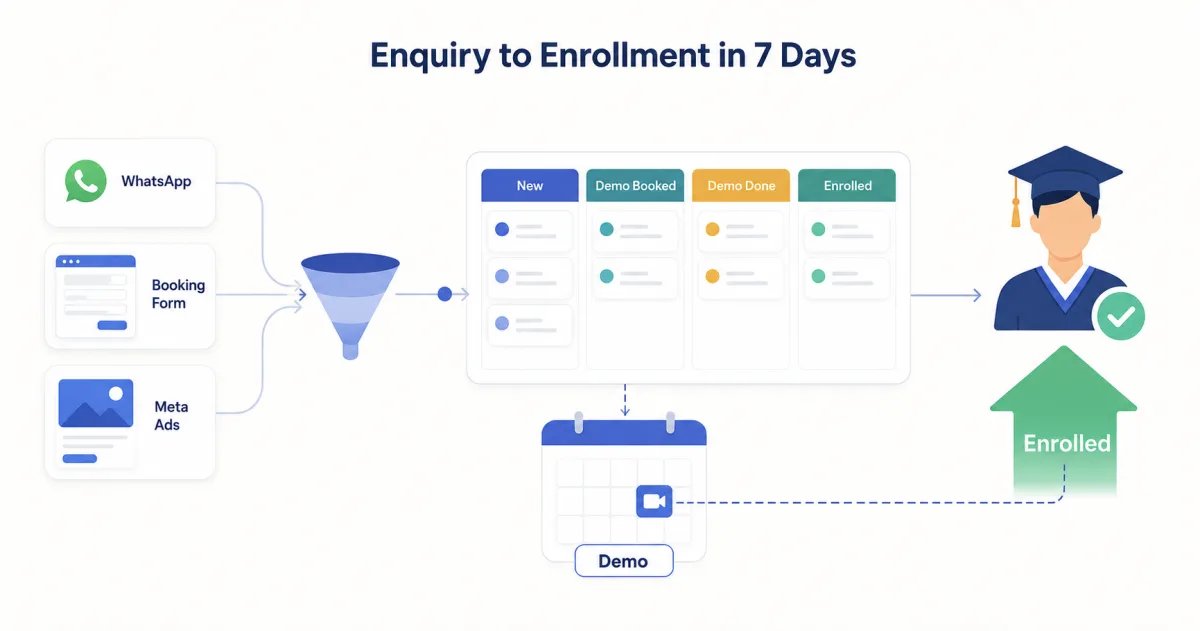
Enquiry to Counselling to Demo Class to Fee Discussion to Enrolled, with a clean “lost reason” tag on every dropped enquiry (fees too high, chose competitor, timing wrong, went silent, decided not to pursue). Keep it to six stages. A twelve-stage pipeline is a pipeline nobody updates. This same skeleton, with the full cadence and the Monday-review numbers, is laid out in our EdTech lead-to-enrollment playbook, which is the natural companion to this page.
That is the build. Notice that not one line of it is “send more reminders.” It is specific events firing specific actions. Now, what does it cost to run, and which plan gives you which stage?
Mapping the trigger map to a budget: what you need vs what you pay
Here is where the abstract map meets a real bill. Every claim below is from ViveLead’s own pricing, with the correct plan named for each capability, because guessing on this is exactly how institutes end up paying for a tier they do not need or, worse, expecting a feature that lives one tier up.
Starter, Rs 499/user/month: the counsellor’s phone is the CRM
Starter covers Stage 0 and the human side of Stage 1. You get core CRM (leads, custom fields, filters, document management), lead capture from website forms, bulk import from CSV and Excel, follow-ups, and the mobile app on Android and iOS. For a small center that just needs every enquiry in one place and a disciplined follow-up habit, this is the entry point. What Starter does not include: Meta lead ads sync, Google Sheets import, pipelines, workflow automation, lead scoring, booking links, and WhatsApp Business. Capture lives here; the automation engine does not.
Professional, Rs 999/user/month: the automation tier
This is the plan this entire article is really about. On top of Starter’s deals, sales pipeline, appointments and quotations, Professional adds everything that turns capture into the full trigger map: workflow automations, lead scoring (configurable hot/warm/cold), public booking links (reschedule and cancel), native WhatsApp Business (templates, broadcasts, marketing inbox), email engage with Gmail tracking, and invoicing with record-payment for the fee stage. Stages 1 through 5 of the map all live here. If you want enrollment marketing automation in the real sense, Rs 999 per user is the number, and a fuller view of CRMs under Rs 500 in India puts that in context against the market.
Business, Rs 1,699/user/month: for the high-volume call floor
Business is for institutes running a serious calling operation. It adds built-in calling via Twilio (numbers, wallet, call recording, dispositions, call logs, with per-minute call charges billed to your in-app wallet), an internal team chat, payment collection, and the AI agents. A 20-seat admission call floor that needs click-to-call inside the CRM lives here. A two-person center does not.
What is on every paid plan, and the honest fit note
ViveSmart AI (ask your CRM from ChatGPT, Claude, Grok, or Perplexity) comes with the Business plan. Every plan ships the mobile app, free data migration, and a 3-day free trial with no credit card.
The honest fit, because picking the wrong tier is its own kind of waste:
- A 2-person tutoring center that just wants to stop losing enquiries: start on Starter (Rs 499), capture everything, follow up by hand.
- The moment you want the funnel to run itself (auto-assign, scoring, WhatsApp follow-up, booking links, fee invoices): move to Professional (Rs 999). This is where most coaching and EdTech teams should be.
- A high-volume call floor making hundreds of dials a day: Business (Rs 1,699) for built-in calling and the AI agents.
If you are weighing the platform against a generic CRM, our note on why generic CRMs fail EdTech is the sharper version of this fit argument.
The price wall: why enrollment automation usually starts at Rs 13,000+ (and doesn’t have to)
Now the wound nobody on page one will press. Most “education CRM” leaders in India are either flat-fee at a level that prices out small centers, or US enterprise SaaS. Here is the landscape as published in 2026. Every figure is a starting point, changes often, and should be verified on each vendor’s own current page before you quote it back to anyone.
The India options, as published
- Kylas: roughly Rs 12,999 per month flat for unlimited users, per Kylas’s own pricing. Predictable, but you are paying that whole fee whether you have 8 counsellors or 80.
- SmartX CRM (study-abroad focused): subscription plans starting around Rs 3,999 per month for a solo plan as published on SmartX’s site, with higher tiers above that. Meritto (formerly NoPaperForms) commonly prices per application rather than a flat monthly fee, a model that scales with your admission volume.
- LeadSquared: India pricing is per-user and published in rupees: Sales Pro at Rs 2,500 and Sales Super at Rs 5,000 per user per month, both billed annually, per LeadSquared’s pricing page (read from India on their pricing page, 27 September 2026). Powerful for field-sales-heavy admissions, but the per-user cost climbs fast on the higher editions.
- TeleCRM: around Rs 799 per user per month on annual billing, plus a one-time Rs 1,999 fee to set up the WhatsApp API, strong for telecalling-led admission teams.
- Zoho CRM: roughly Rs 800 per user per month (Standard) to Rs 1,400 (Professional) on annual billing in India, before GST. We compare the two directly in ViveLead vs Zoho.
The US enterprise stack, as published
- Salesforce Education Cloud: from about 81 to 87 US dollars per user per month on annual billing for the Enterprise edition, before GST, before implementation, and before the admin you will need to hire to run it. The honest take on this for admissions teams is in ViveLead vs Salesforce and the salesforce alternative for small business in India.
- HubSpot: a free tier exists, but the automation, sequences, and reporting that actually matter sit on paid seats that escalate quickly, and someone has to operate it. The full comparison is in ViveLead vs HubSpot.
A competitor says the quiet part out loud
You do not have to take the price-wall argument from us. One of the rivals on this very list was founded to fix it. Kylas built its whole pitch around escaping “per-user pricing that balloons as your team grows.” That is a competitor publicly admitting that the dominant pricing model in this category punishes you for hiring. They are not wrong about the disease. They simply prescribe a flat Rs 12,999 fee as the cure, which only pays off once your team is large.
The false-economy escape hatch
Faced with these numbers, some institute owners decide to build their own CRM. It feels cheaper. It is not. A custom-built admission CRM typically runs somewhere between Rs 4 lakh and Rs 15 lakh as a one-time build, plus on the order of Rs 20,000 a month in maintenance, and you own every bug forever. You would have to run a SaaS subscription for years before the custom build breaks even, and you would carry the maintenance burden the whole time. For almost every coaching center, EdTech startup, and study-abroad agency, that is a worse deal, not a better one.
The honest math
So where does per-user actually win? Run it yourself, because this is the number that decides it. ViveLead Professional at Rs 999 per user stays cheaper than a flat Rs 13,000-ish monthly fee until you cross roughly 25 to 30 active seats (Rs 499 times 26 is about Rs 12,974). Below that line, per-user is dramatically cheaper. Above it, a flat fee may win, which is exactly when a tool like Kylas earns its place. The point is not “ViveLead is always cheapest.” The point is that nobody on page one shows you the line, so you cannot tell which side of it you are on. Now you can. ViveLead enters the picture for the under-25-seat majority of Indian institutes, with enquiry capture at Rs 499 and the full automation layer at Rs 499, on a 3-day trial with no card.
The WhatsApp question, answered honestly (who actually pays Meta?)
WhatsApp is the channel Indian students and parents actually reply on. Every education-CRM page lists “WhatsApp” as a feature bullet. Almost none of them tell you who pays for it, whose account the messages run through, or that the billing is usage-based and metered by Meta. That silence costs buyers real money when the first Meta invoice arrives. Here is the honest version.
WhatsApp Business and the Cloud API, as a general concept
To send templated, bulk admission follow-ups, you cannot use the regular WhatsApp Business app on a personal phone; you would get rate-limited and eventually blocked. The industry solution is the official WhatsApp Business platform, often accessed through what Meta calls the WhatsApp Cloud API. In plain terms, it is the official, sanctioned way for software to send and receive WhatsApp messages at scale through an approved business sender, using pre-approved message templates. That is the general mechanism every compliant WhatsApp tool relies on, regardless of vendor. The deeper buyer’s guide to all of this is WhatsApp CRM in India.
Usage-based Meta billing, explained
The cost nobody on page one discloses: Meta charges on a usage basis, and the rate depends on the message category (marketing, utility, authentication, and so on), with Meta having moved to per-delivered-message billing in India. As a rough order of magnitude, marketing messages run roughly Rs 0.85 to Rs 0.90 each while utility and authentication messages are far cheaper (in the region of Rs 0.10 to Rs 0.15), and Meta bills that directly. Treat those as indicative and check Meta’s current rate card, because the rates and the billing model change, but the structural fact is what matters: there is a real, usage-based WhatsApp cost that sits underneath whatever your CRM charges, and a vendor that hides it is setting you up for a surprise.
ViveLead’s model, plainly
Here is ViveLead’s WhatsApp model with no spin. Native WhatsApp Business (templates, broadcasts, and a marketing inbox) is included from the Professional plan at Rs 999/user/month. The per-message charges are billed by Meta directly to your own WhatsApp Business Account. ViveLead does not mark that up. You set up the WABA, you own the number, and you pay Meta for what you send. That is the entire arrangement, and it is the same arrangement spelled out on ViveLead’s pricing page under what your plan does and does not include.
Why owning your WABA matters
WhatsApp open rates are genuinely high, often cited in the high-90s percent, which is exactly why it is so tempting to over-use, and exactly why the backlash is real. Students who get blasted block the sender and report it. Because your conversations run through your own WhatsApp Business Account on a number you own, you control the cadence and the opt-out, and your sending reputation is yours to protect rather than something you share with a thousand other senders on a vendor’s pooled number. That ownership is not a nice-to-have. It is what keeps your institute’s number off blocklists, which is the bridge to the next section.
Automation as restraint: how not to become the spam cannon students block
Here is the beat every US “enrollment marketing automation” page completely misses, because it is an Indian buyer-side reality. Good enrollment automation is not a bigger megaphone. It is restraint.
The buyer-side reality nobody writes about
Fill out one coaching enquiry form or one study-abroad lead form, and within hours you are, in students’ own words across forums, “bombarded with calls and WhatsApp messages.” That is not an accident. Contact details get shared and sold between consultancies and lead vendors, so a single form fill can trigger a dozen institutes at once. The student did not consent to that. They consented to one enquiry.
Students fight back
The market has already developed antibodies. Students look up the National Do Not Call (NDNC) registry and call-blocking apps specifically to escape admission spam. And the entire “fraud agent” and “ghost consultant” discourse in study-abroad, the constant warnings to “never pay advance money until the offer letter is verified,” is downstream of pushy, untracked, high-pressure follow-up that burned people. When your sector’s reputation is “they will not leave you alone and some of them are scams,” restraint is not just ethical, it is a competitive edge.
What good automation actually does
The contrarian truth: the goal of automation is not to send more, it is to send the right message, at the right stage, and to stop the instant someone opts out. A blast cannon sends everyone everything. A trigger map sends a demo reminder only to the person who booked a demo, a fee nudge only to the person in the fee stage, and nothing at all to the person who said “please stop.” That is the opposite of spam, and it converts better precisely because it respects the student.
Why ownership protects your name
This is where the honest WhatsApp economics pay off twice. Because you own your WhatsApp Business Account and set your own cadence, two things are true: your deliverability is yours to protect (over-send and it is your reputation on the line, which is a healthy incentive), and you are never one of a hundred anonymous senders sharing a vendor’s pooled number and its blocklist risk. Owning your number and your cadence is what keeps your institute’s name clean while everyone else’s gets reported. Automation done right is the most polite your follow-up has ever been, not the loudest.
Study-abroad agents: the same enrollment spine, a different shape
Study-abroad consultancies share the admission spine with coaching centers, but the shape differs enough to deserve its own section, especially because the coaching listicles ignore agents entirely and the agent tools price out the solo operator.
What is genuinely harder for agents
A coaching enquiry is usually one student, one course, one fee. A study-abroad enquiry is one student and 5 to 15 applications spread across universities and countries, each with its own deadline, document set, and status. The lead-cool window is tight, roughly 48 hours by Erino’s analysis, because the student is talking to several consultants at once. And on the back end, agencies dealing with sub-agents have to reconcile who sourced which student and what commission is owed, which is real operational accounting that coaching centers simply do not have.
What the niche leaders own
Tools built specifically for the agent world (SmartX, Agentcis, UniAgents) own that specialised language: sub-agent portals, commission tracking and reconciliation, and country-by-country visa workflows. That is genuinely their turf. The catch is price and fit: those tools are built for established agencies, and a solo agent or a micro consultancy often gets priced out or buried in features built for a 50-person firm.
Where the common spine lives
Strip the study-abroad funnel down and most of it is the same spine every coaching center builds: capture the enquiry from Meta lead ads and forms, respond instantly, move the student through a pipeline, and raise a quotation or invoice for the consultancy fee. ViveLead covers that common spine at SMB price, the same Professional-plan automation a coaching center uses, applied to applications instead of batches. For a solo or small agency that mostly needs to stop losing enquiries and collect fees cleanly, that spine is most of the job.
The honest boundary (read this before you assume)
Be clear about what ViveLead does not ship, because a false claim here would be a serious one. ViveLead does not include a packaged sub-agent portal, a built-in commission-tracking ledger, or country-specific visa workflows. Those are not features you switch on. If an agency genuinely needs a sub-agent portal, that is something it builds, sending leads into ViveLead through the lead capture API, which comes with the Professional plan (Rs 999/user), so the CRM stays the system of record. The API only takes leads in, so a commission ledger stays outside ViveLead. And if the team itself needs to run on one login, the optional HRMS and Payroll add-on (+Rs 99/user/month) handles attendance, leaves, and payroll for the counselling staff. Frame it correctly: the agent-specific portal is a need you build via the API, not a box ViveLead ticks out of the box. See pricing for exactly what each plan includes, and do not let anyone tell you ViveLead ships a visa-workflow module, because it does not.
Run the whole admission engine from one login (sales + the team behind it)
Two differentiators no competitor on page one leads with: admissions is a mobile-first job, and the team running it needs managing too. ViveLead leans into both.
Why counsellors live on the phone
Read any live admission-counsellor job listing and the vocabulary is unmistakable: a daily KRA of “120 calls,” a “minimum 2.5 hours talk time mandatory out of an 8.5-hour shift,” “generate walk-ins from cold calling telephonic leads,” and “convert student enquiry into admission” against “daily and weekly targets.” That is not a desk job staring at a dashboard. The counsellor is on the phone, on the floor, between walk-ins. Every US enrollment-marketing platform assumes a desktop browser. The Indian admission counsellor needs the funnel in their hand.
The mobile app on every plan
ViveLead ships a real Android and iOS app on every plan, including Starter. A counsellor runs follow-ups, updates the pipeline, logs call dispositions, and works their assigned enquiries from the phone, in the gaps between walk-ins, without going back to a desk. On the Business plan, built-in calling (Twilio) means click-to-call from inside that app with the call logged automatically against the enquiry. Mobile-first is not a marketing line here; it is the actual job, and the app is on the cheapest plan, not gated behind the expensive one.
The team behind the funnel
Admissions has a sales funnel and a staff side, and most institutes pay for two tools to run them. ViveLead’s optional HRMS and Payroll add-on at +Rs 99/user/month (Rs 79 on annual billing) puts attendance, leaves, holidays, shifts, and India-compliant payroll (PF, ESIC, TDS) in the same login as the CRM. So the same platform that tracks whether a counsellor hit their admission target also runs that counsellor’s payroll, with no second system and no data sync between them. It is an add-on, not part of the base plan, on by choice. If you want the full argument for one platform over two, CRM vs HRMS difference lays it out.
When enrollment automation doesn’t pay yet (the honest threshold)
Every vendor page assumes you should buy today. Most readers should. Some should not, and saying so is how you know this recommendation is honest rather than reflexive.
The solo tutor under 30 enquiries a month
If you are a solo tutor or a first-time home-coaching center handling under roughly 30 enquiries a month, and your follow-up is genuinely disciplined, a shared spreadsheet and a tight personal routine may still be enough. At that volume, one organised person can hold the funnel in their head and a notebook without dropping much. Automation would be a cost without a matching leak to plug. Buying software to feel professional is not a reason to buy software.
The tipping point
The threshold is volume, and it is the same line we opened with. Once a single counsellor is working around 100 live enquiries by hand, they will drop roughly half no matter how sharp their memory is. Somewhere between “30 enquiries, one disciplined person” and “100 enquiries, half lost,” automation flips from optional to obviously worth it. You will usually feel it before you measure it: callbacks slipping, a parent who enquired Monday going dark by Friday, two counsellors double-working the same lead. Those are the symptoms that say you have crossed the line.
What to fix first if you are not ready to buy
If you are below the threshold, do not buy yet, but do tighten three things now so the eventual move is easy: get every enquiry into one capture inbox instead of fifteen WhatsApp threads, write down a follow-up cadence (even on paper) so it does not live only in your head, and keep a do-not-contact list so you never re-pester someone who opted out. Those three habits cost nothing and make the day you do automate trivial.
How to trial without risk
When you are ready to test, the 3-day free trial needs no credit card. Import your existing enquiries, wire up one cohort, and watch it move through the funnel for a week before you commit a rupee. You are not deciding from a brochure; you are deciding from your own leads in your own pipeline.
Build your first enrollment automation this week
Enough theory. Here is the starter build any admin can stand up in an afternoon, the same shape that produced the case-study result.
The 5-step starter build
- Capture. Connect your Meta lead ads and one website or landing-page form so every enquiry lands in one place automatically, source tagged. Stop the copy-paste.
- Auto-assign. Set a single rule (round-robin to start) so every new enquiry instantly has an owner. Get fancy with course-based or city-based routing later.
- Instant WhatsApp acknowledgement. Build one approved template that fires the moment an enquiry lands, confirming receipt and setting up the call. This alone captures most of the speed-to-lead advantage.
- Booking link. Publish one public booking link for demo or counselling slots and put it in your Instagram bio and on your site, so students self-schedule and phone-tag dies.
- Stage cadence. Wire one demo-reminder automation (24 hours and 1 hour before the slot). Add the cold-lead re-engagement nudge in week two. Do not try to build twelve sequences on day one.
That is a working funnel. Five triggers, an afternoon, and your enquiry-to-demo leak closes hard.
A pre-launch checklist
Before you switch it on, confirm three things so your automation helps your reputation instead of hurting it:
- An opt-out path on every outbound message, honoured by a hard stop. Restraint is the feature.
- One source of truth. Pick the CRM as the system of record and move the team off personal WhatsApp and private spreadsheets, or you will be back to fifteen threads by Friday.
- A single owner per stage, so no enquiry sits in limbo because two people each thought the other had it.
Map it to a plan and start
Match the build to the bill, strictly from pricing: website-form capture lives on Starter (Rs 499/user) and Meta lead-ad capture on Professional; the automations, lead scoring, booking links, WhatsApp Business, and fee invoicing that make up steps 2 through 5 live on Professional (Rs 999/user). ViveSmart AI comes with the Business plan. Start on the 3-day free trial, no card, import your enquiries, and run one cohort through the funnel before you decide. If you are still comparing tools rather than building, the best CRM software in India 2026 roundup is the wider field, and the EdTech CRM hub is the industry-specific view.
The US pages will keep selling “enrollment marketing automation” to universities with admin teams and lakh-per-month budgets. Indian admissions does not work that way. It works on Meta lead ads, WhatsApp, a counsellor’s phone, and a fee conversation, and it wins on speed and restraint. Build the trigger map, own your WABA, automate once your volume crosses the line, and stop letting your best enquiries die in someone’s memory.
Enrollment Marketing Automation FAQs
What it means for Indian admissions, what it costs, and how to start
Related reading
- EdTech lead-to-enrollment playbook. The 7-day cadence, demo show-up tactics, and Monday-review numbers.
- WhatsApp CRM in India: buyer’s guide. Who pays Meta, which tool fits which channel mix.
- Why Salesforce fails EdTech admissions. Why the enterprise stack misfits Indian coaching.
- Education CRM software guide. The full buying decision for admissions teams.
- EdTech CRM hub.
Admission CRM by city: Delhi NCR, Mumbai, Bangalore, Hyderabad, Chennai, and Pune.
Start Your Free 3-Day Trial
Capture admission enquiries on Starter (Rs 499/user) and automate the whole funnel on Professional (Rs 999/user). No credit card required.
Continue Reading

Why Email Fails: Marketing Automation for Education
Email fails for Indian admissions as a channel, not as copy: Meta-lead-ad junk emails, inbox burial, and the 5-minute …

Stop Using Your EdTech CRM Like an Excel Sheet | ViveLead
Most coaching institutes use their EdTech CRM like a spreadsheet. The admissions-specific way to capture, nurture, …
EdTech Lead to Enrollment: The 7-Day Funnel (India 2026)
Move a coaching enquiry from demo booking to enrollment in 7 days: the follow-up cadence, counsellor productivity, and …