Higher Ed CRM Lead Gen Tracking for Marketing Teams
Higher education CRM for lead generation tracking. Prove cost per enrolled student by channel to leadership, not just cost per lead. From Rs 499/user.

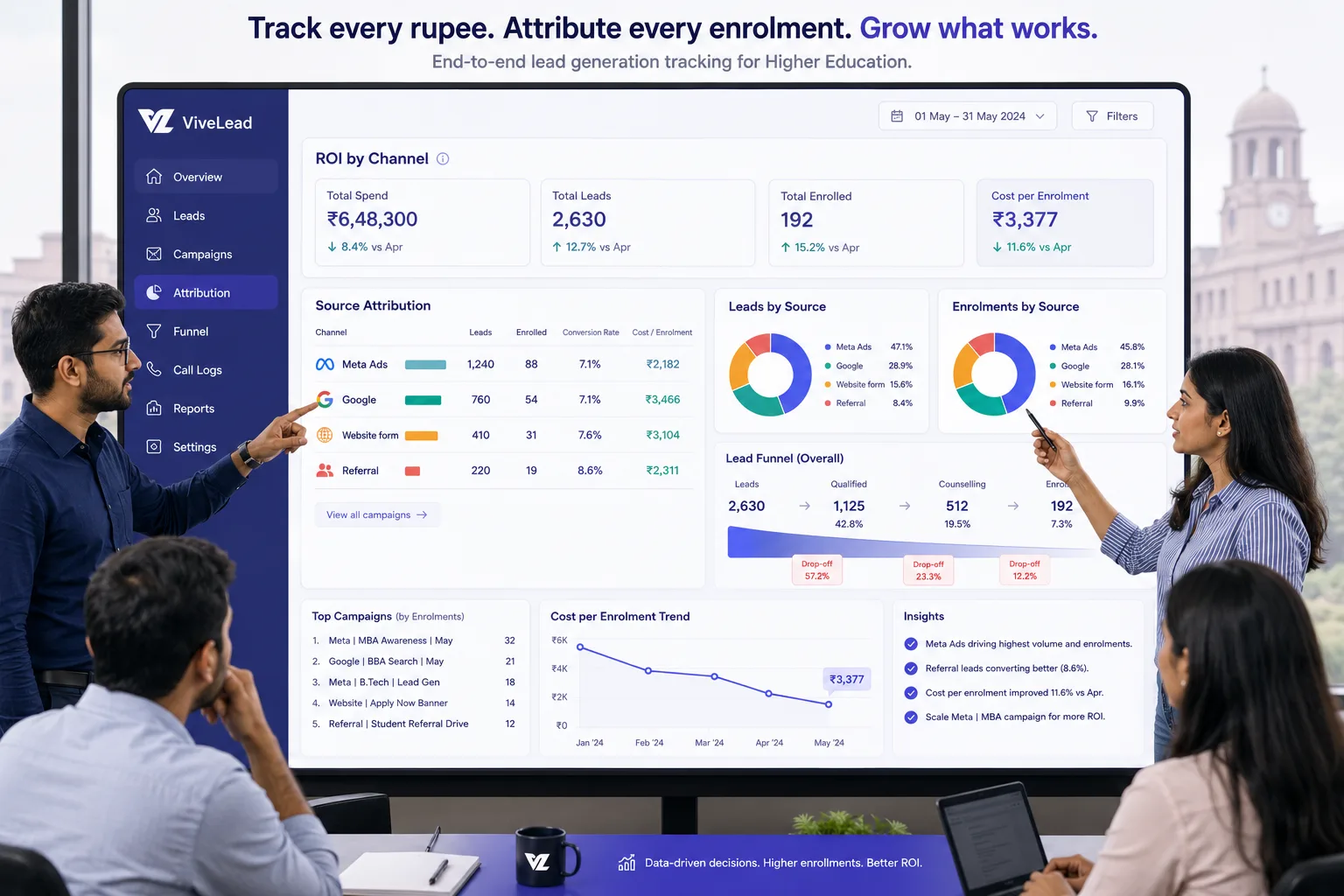
Picture the quarterly budget meeting. The marketing head leans back and says, “I sent you 4,000 leads this month.” The admissions head fires straight back: “Half were junk. Wrong city, dead numbers, parents who filled the form by mistake.” Then the chairperson asks the one question nobody in the room can answer cleanly: “Of the students who actually enrolled and paid this intake, which ad brought them?”
Silence. Somebody opens a laptop. Somebody mentions the agency report. Nobody has the number.
Here is the uncomfortable truth that meeting exposes every quarter. You can prove cost-per-lead all day long. What you cannot prove is cost-per-enrolled-student by channel, and that single missing number is why your ad budget gets cut on vibes instead of data. When leadership cannot see which spend produced paid admissions, they default to gut feel, and gut feel almost always cuts the channel you cannot defend with a clean report.
This piece is for the marketing-ops lead at a university or a large coaching group. Not the counsellor chasing follow-ups. The person who walks into the budget meeting and gets asked to defend every rupee of ad spend against enrolled students, by channel.
The attribution gap is industry-wide, not your team’s failure
First, breathe. This is not a sign your team is incompetent. Across the higher-education sector, fewer than half of marketing teams track core ROI metrics like cost per inquiry (CPI) or cost per enrolled student at all. That benchmark comes from higher-education-marketing.com, citing UPCEA-style sector data, and it is a global higher-ed figure, not India-specific. The point stands either way: most of your peers are flying just as blind.
The metric that matters is well established. Cost per enrolled student, total marketing spend divided by number of students who enrolled, broken out by channel, is the recognised ultimate ROI number in higher education. Not impressions. Not clicks. Not raw leads. Enrolled students per rupee, by source.
And the market is only getting more competitive. Per AISHE 2021-22 (Ministry of Education), India had roughly 4.33 crore students enrolled, more than 1,168 universities and over 45,000 colleges, with the Gross Enrolment Ratio around 28.4 percent and pushing toward the 32 to 33 percent national target. More institutions, more seats, more money chasing the same intake season. Attribution matters more every single year, because the cost of wasting spend on an un-attributed channel compounds as competition rises.
Recruitment is expensive everywhere. In the US, private four-year institutions spend roughly USD 2,795 to recruit a single enrolled undergraduate, public institutions around USD 494 (clearly US and global figures, not Indian numbers). Whatever your equivalent rupee cost, pouring it into channels you cannot measure is the actual waste. You are not overspending. You are spending unattributed.
Where the source dies: the blank source column disease
Here is the mechanism of failure, because it is almost never the ad and almost always the handoff.
Your forms capture UTM and source perfectly at the point of submission. A parent clicks a Meta lead ad, the form fires, and the lead lands with source = Meta, campaign = NEET-2026-Jaipur attached cleanly. Beautiful. Then a counsellor copies the phone number into a follow-up Excel sheet to start calling, and the source column goes blank. “Counsellor ne Excel me daal diya, source column khaali” (the counsellor dumped it into Excel and the source column is empty). The channel attribution is destroyed at the exact moment a human touches the lead.
Now stack the duplicate-call embarrassment on top. The same parent comes in three times: once from the Meta lead form, once from your website enquiry form, once scribbled into the walk-in register at the branch. Three counsellors call the same parent on the same day. The institute looks disorganised at the precise moment a family is deciding whether to trust you with their child’s future and a lakh of fees.
And then the report. “Boss dashboard maangta hai, main raat ko teen Excel merge karta hoon” (the boss wants a dashboard, so I sit up at night merging three Excel sheets). That midnight-VLOOKUP report is what leadership is making budget decisions on. Stitched together by hand, source-free, half-guessed, and stale by the time anyone reads it.
The fix you actually need is not another report template. It is automatic source capture that survives all the way to the enrolled stage, plus all sources landing in one pipeline so the parent is not called three times, plus routing fast enough that the lead is still warm when a counsellor picks it up. Get those three right and the dashboard builds itself.
Speed is half the attribution problem: the routing tax
This is the part most marketing heads miss. A lead routed slowly is a lead lost, which means the channel that supposedly “did not convert” may simply have been mis-routed. You will cut a perfectly good channel because the leads it sent sat unassigned for two days and went cold. That is not a channel problem, that is a routing tax, and you are about to blame the wrong thing.
The speed numbers are not opinion. The MIT and InsideSales.com Lead Response Management Study, led by Dr. James Oldroyd at MIT Sloan in 2007 and later popularised by Harvard Business Review in 2011, analysed over three years, 15,000-plus leads, and 100,000-plus call attempts across six companies. The finding: contacting a web lead within 5 minutes versus 30 minutes makes you roughly 100 times more likely to connect and about 21 times more likely to qualify that lead. (A note on hygiene: you will see a “9x convert in 5 minutes” figure floating around CRM marketing. It is a misattribution that appears in neither study, and we do not use it. The real 100x-connect and 21x-qualify numbers are stronger anyway.)
For an Indian institute the cost is concrete. “Hot lead 2 din baad call hua, tab tak doosre college me admission le liya” (the hot lead got called two days later, by then they had already taken admission in another college). That parent is gone, and your Meta campaign takes the blame in the report it did not deserve.
Tie it back to attribution. If the lead reaches the right counsellor team in seconds with the source tag intact, then whether it converts or not is honestly attributable to that channel. Fast routing is not just a sales nicety. It is what makes your channel numbers true.
What a leadership-trusted dashboard actually shows
Now picture where you want to land. One screen, the one leadership actually trusts, that says for this intake: Meta brought X enquiries to Y enrolled at Z cost per enrolled. Google brought these. Referrals brought these. The website brought these. Every lead auto-routed to the right counsellor in seconds, and never called by three people at once.
The relief that sells this is simple. “Ab budget meeting me data hai, andaaza nahi” (now the budget meeting runs on data, not guesswork). You walk in, you put up enrolled-by-channel, and the conversation stops being a blame fight and becomes a decision.
Contrast that with the agency-screenshot trap you live in today. “Agency screenshot bhej deti hai Meta Ads Manager ka, par wo conversions nahi, enrollments nahi dikhata” (the agency sends a Meta Ads Manager screenshot, but it shows clicks, not enrollments). The agency’s dashboard ends at cost per lead and click-through rate, because that is all Meta can see. It has no idea which of those clicks paid fees four weeks later. You need enrolled-by-channel inside your own CRM, computed from your own pipeline, independent of the agency’s CPL sheet. The day you have that, the agency works for your number instead of the other way round.
The enterprise tools can do this. Here is the catch.
Let me be fair, because this is where most vendor blogs lie and you can smell it. The enterprise enrollment suites genuinely do source-wise admissions analytics. LeadSquared is the category leader and openly cites “250+ colleges.” Meritto, formerly NoPaperForms, calls itself the “OS for student enrollments” and cites “1200+ institutions.” Extraaedge and Salesforce Education Cloud do it too. If you have the budget, they work. So what is the catch? Three of them.
One, the price wall. Per-user expensive, and the education products are quoted rather than listed. LeadSquared’s own Sales CRM page publishes Sales Pro at Rs 2,500 and Sales Super at Rs 5,000 per user per month, billed annually (read from India on their pricing page, 27 September 2026); its higher-ed deployment is quoted on top of that, not listed. A 15-person marketing-plus-counsellor team at Rs 2,500 to 5,000 per user is roughly Rs 4.5 lakh to 9 lakh a year before onboarding fees. Salesforce Education Cloud lands even heavier, listicles cite Rs 8,000 to 35,000 per user per month plus serious implementation cost.
Two, the reporting hostage. This is the documented real pain, not a cheap shot. Independent reviews on G2, Capterra, and TrustRadius repeatedly describe waiting weeks for custom reports, being told dashboard changes are “chargeable,” and slow or laggy loading as the single most-repeated complaint. To be fair, LeadSquared is well-rated overall, around 4.5, it is a capable product. The issue is that it is heavy and report-gated, so marketing flies blind between billing cycles. That is the exact opposite of self-serve ROI, and self-serve ROI is the entire reason you are reading this.
Three, the over-scope. Meritto and Salesforce bundle application processing, document verification, embedded fee payments, and multi-campus hierarchy. A single-campus institute or a 30-counsellor coaching group ends up paying for an enrollment ERP when all it needed was source-tracked leads routed to the right counsellor and a clean enrolled-by-channel report.
There is also a generic-CRM tax worth naming. Zoho CRM is cheap at roughly Rs 800 to 1,400 per user, and HubSpot is free to start, then Rs 585 to Rs 1,670 a seat on Sales Hub Starter and Rs 7,497 a seat on Professional, which also needs a one-time Rs 1,25,000 onboarding fee. Both are cheaper or free, but neither is built for admissions, so weeks of marketing-ops configuration become the hidden cost.
| Capability | ViveLead | LeadSquared / Meritto (enterprise edu) | Generic CRM (Zoho / HubSpot) |
|---|---|---|---|
| Source-wise conversion (enrolled by channel) | Yes, every plan from Starter Rs 499/user | Yes, but quote-gated and report changes often chargeable | Possible after weeks of config, not admissions-native |
| Funnel drop-off + lead CSV export | Yes, every plan from Starter Rs 499/user | Yes, enterprise tier | Varies, often paid add-ons |
| Published price | Yes, Rs 499 / 999 / 1,699 per user | No, quote-only (listicles peg ~Rs 2,500 to 5,000+/user) | Yes (~Rs 800 to 1,400 Zoho; HubSpot free, then Rs 585 to 7,497 a seat + Rs 1,25,000 Pro onboarding) |
| Application processing / doc verification / fee collection | No, CRM only by design | Yes, Meritto and Salesforce bundle it | No |
| Best fit | Institutes and coaching groups needing affordable attribution + routing | Large multi-campus universities needing a full enrollment OS | Teams wanting cheap or free that will invest config time |
Competitor pricing above is third-party and listicle range and quote-gated, so verify each vendor’s current quote. ViveLead pricing is published.
Where ViveLead fits, and where it does not
ViveLead is the affordable attribution and counsellor-routing layer. It is not an enrollment OS, and I am not going to pretend it is.
Here is the feature map, by tier, with the price every time so there is no fog. Multi-source capture with the source tagged at creation starts on Starter at Rs 499 per user per month for website and public forms, and Meta lead ads join on Professional at Rs 999. This is the part that matters most, because the source is captured by the system, not re-keyed by a counsellor, so it does not depend on anyone remembering to fill a column. Source-wise conversion reports, the headline, lead to enrolled by channel, come with every plan from Starter, along with funnel drop-off by stage and Teams and Roles (RBAC). Professional at Rs 999 per user per month adds lead distribution rules and Territory so leads route to the right counsellor team in seconds, and lead scoring so the hottest leads surface first. All sources land in one pipeline as a single source of truth, which is what stops the same parent being assigned to three counsellors. For the “we have our own data team” question, be precise: ViveLead has no BI connector and no API that pulls data out. Your team exports the lead list to CSV, with stage and source, and loads it into Power BI, Looker, or Metabase. ViveSmart AI, for asking your CRM questions from ChatGPT or Claude, comes with the Business plan at Rs 1,699. On the cost-per-enrolled number itself, be clear-eyed: ViveLead gives you enrolled-by-channel, and you divide your own channel spend by it. Ad spend can be entered per campaign in the Acquisition report, which then shows cost per lead by source.
Now the ceiling, plainly. ViveLead does not do application-form processing, document verification, or embedded fee collection the way Meritto does. If you are a genuinely large multi-campus university that needs those things stitched into one enrollment OS, you may legitimately need a Meritto or LeadSquared class suite, and you should buy that, because that is your requirement.
The fit is the institute or coaching group that needs source-tracked, deduplicated, fast-routed leads and a real enrolled-by-channel report without the enterprise price or the report ransom. Try it on the 3-day trial, no card.
Answering the objections you are already thinking
“We already run AiSensy or Interakt for WhatsApp and the agency runs the ads. Why another tool?” Those blast messages and report clicks. Neither one closes the loop to enrolled-by-channel inside a single CRM. They charge a monthly platform fee plus Meta’s per-message pass-through and stop at delivery stats, not paid admissions.
“LeadSquared aur Meritto ka demo dekha, bahut bada aur mehenga hai, we’re a 30-counsellor group, not a university.” (Saw the LeadSquared and Meritto demo, it is huge and expensive.) Then you are exactly who the affordable layer is built for. You do not need the enrollment ERP. You need attribution and routing: the reports come with every plan, and Professional at Rs 999 adds Meta lead ads, routing rules, and lead scoring.
“Will my counsellors actually use it? They live on WhatsApp and the phone.” Capture and routing are automatic and the source tag is system-applied, not re-keyed. Adoption does not hinge on a counsellor remembering to fill a source column, because there is no column for them to forget. The tag is already there.
“Hum small institute hain, Excel se chal raha hai.” (We are a small institute, Excel is working fine.) Until intake season hits and 3,000 leads a month make Excel collapse. A counsellor hand-juggling 100-plus leads will drop roughly half of them (an operator-cited figure from tools like Classpro), and once the season ends, nobody can reconstruct which spend actually paid off. The blank source column is fine right up until the quarter you need the number and it is gone.
Closing: run next year’s budget on data, not vibes
One number changes the budget meeting. Cost per enrolled student, by channel, surviving intact from enquiry all the way to enrolled, in a dashboard you control instead of one you wait on. The day you can put that on screen, marketing stops being the team that “sent 4,000 junk leads” and becomes the team that can name the channel behind every paid admission.
Honest recap of the wedge: the enterprise suites can do this, but they gate the report, charge enterprise money, and make you wait between billing cycles. ViveLead gives you the attribution layer from Rs 499 per user, or Rs 999 with Meta lead ads and routing rules, with the lead list exportable to CSV so your own BI tool can read it. It is a CRM, not an enrollment OS, so if you need application processing and document verification, buy the bigger suite. If you need to know which ad enrolled students, this is the layer.
Start on the 3-day free trial, no card. For the counsellor-side cadence that turns these routed leads into enrollments, read the demo-to-enrollment funnel guide. For the WhatsApp inbox side, see shared WhatsApp inbox for EdTech. For the channel and email autopsy, marketing automation for education. And if Salesforce is on your shortlist, read why Salesforce fails EdTech admissions before you sign.
Higher Ed Lead Tracking FAQs
Attribution, cost per enrolled student, BI export, and how ViveLead compares for Indian higher-ed marketing teams
Related reading
Run next year's budget on data, not vibes
Source-wise conversion and funnel drop-off reports on every plan from Rs 499/user, with Meta lead ads and the lead capture API from Professional Rs 999/user. 3-day free trial. No credit card required.
Continue Reading
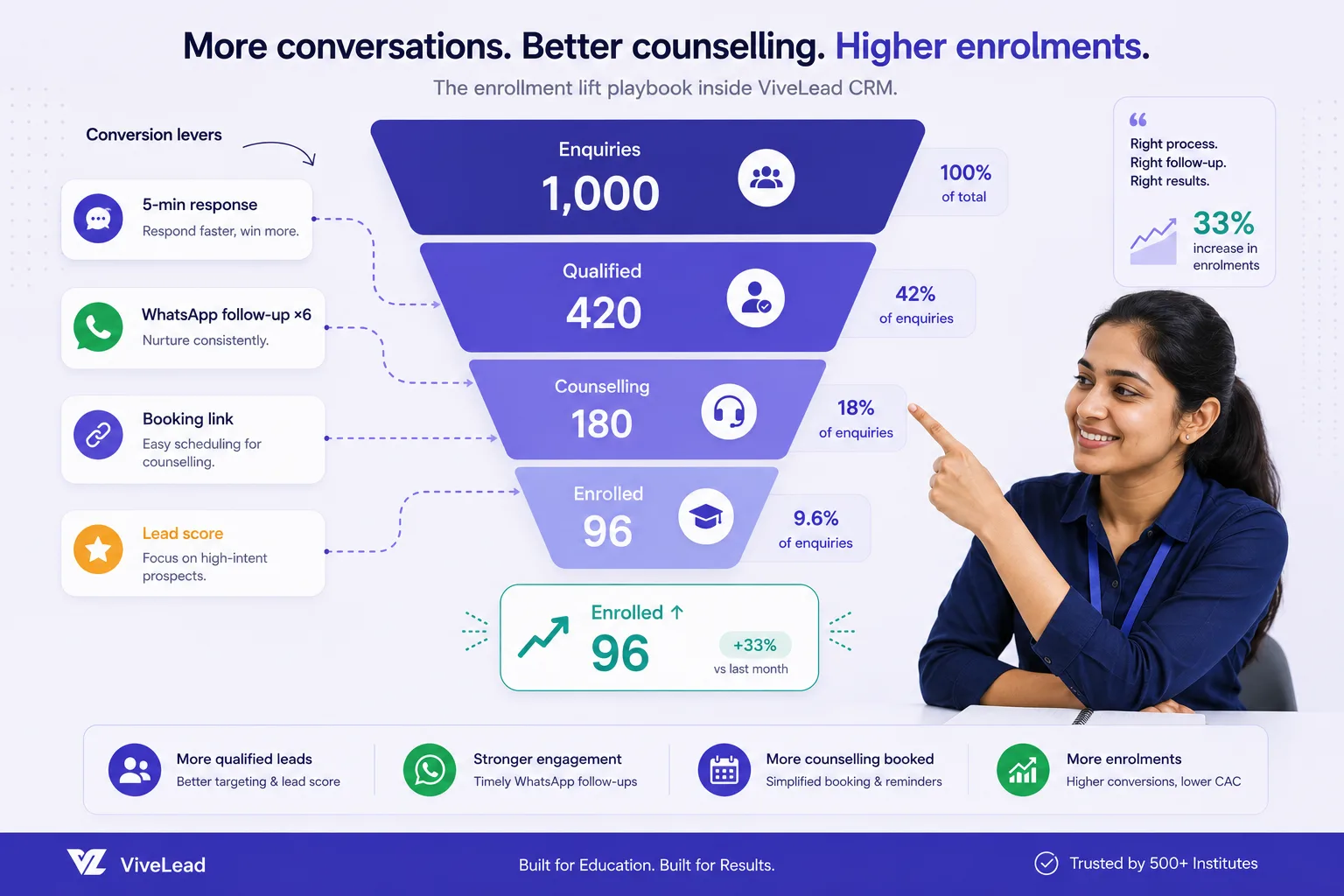
Increase Student Enrollment in EdTech: Math, Not Ad Spend
Increase student enrollment without more ad budget: six conversion levers, the enrollment-lift math, and the ViveLead …
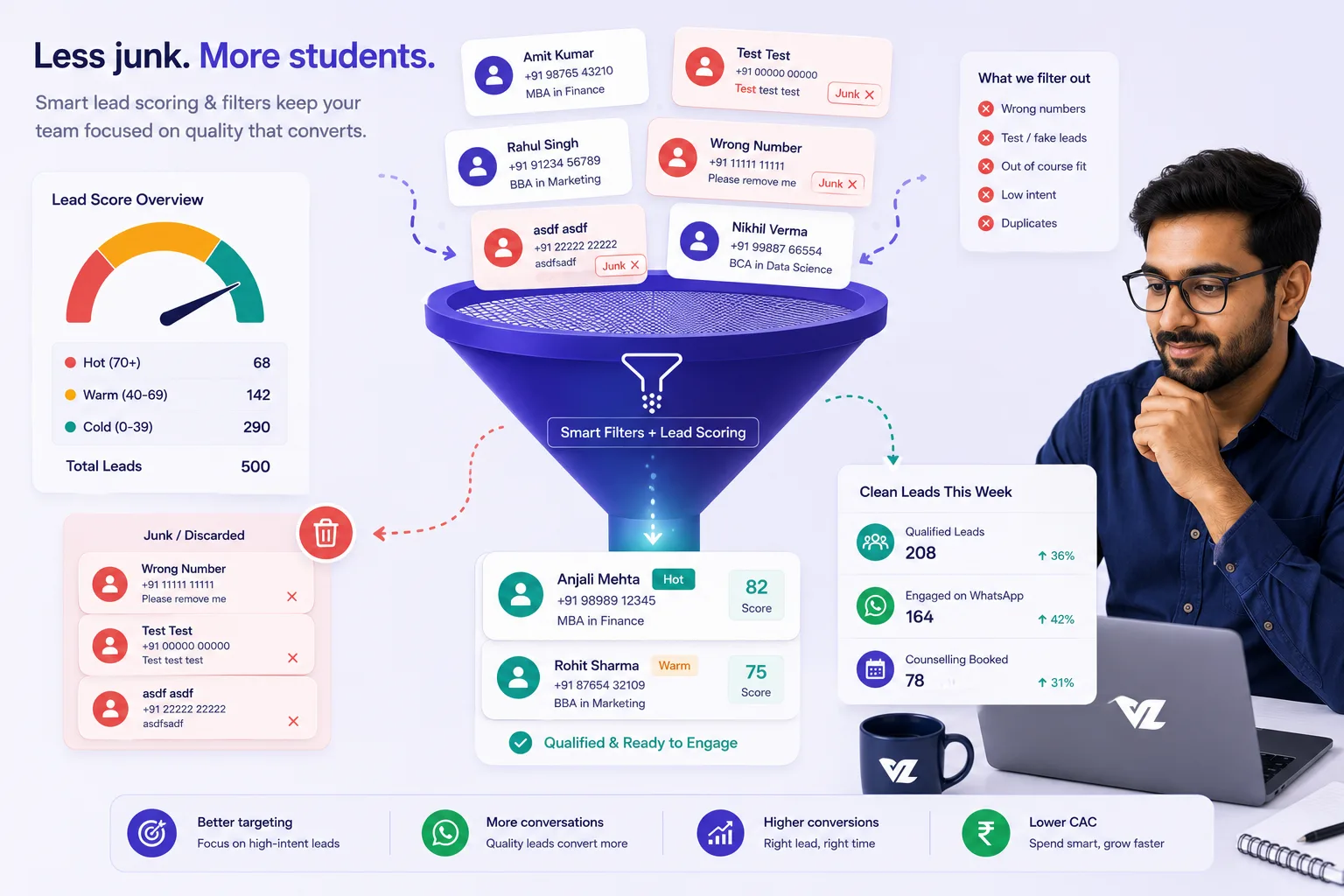
Reduce Junk Leads in EdTech Without Killing Your Pipeline
How to reduce junk leads from EdTech Meta ads: score, filter, route, and kill the bad source. Stop counting CPL, start …