The Hidden HubSpot for Education Middleware Tax | ViveLead
HubSpot for education hides a middleware tax: Data Hub flat fee, a second WhatsApp tool, SIS connectors and onboarding. We itemize the real bill.

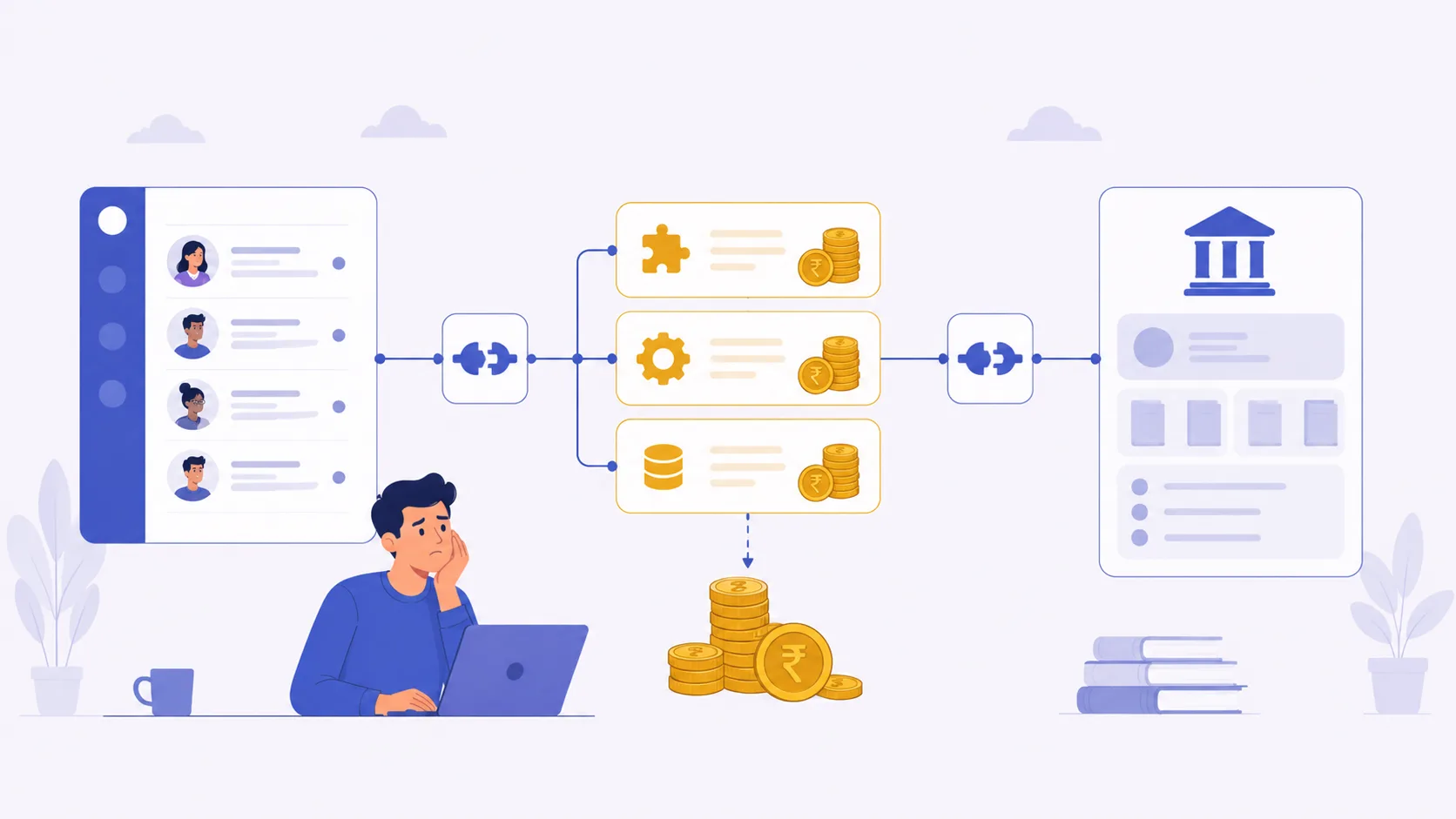
The cheapest line on your HubSpot for education invoice is the license
A parent in Indore fills your enquiry form at 9:47pm. The counsellor sees it at 10:15 the next morning. In that gap, the parent already messaged two competitor institutes on WhatsApp and one of them replied within four minutes. By the time your counsellor calls, the conversation is already half-lost.
That is the unit of work in Indian admissions. Not a lifecycle stage. Not a deal in a pipeline. A specific moment: enquiry landed, did someone WhatsApp the parent in five minutes, did the counsellor log the call or lose it, did we collect the fee before the seat went cold. The institutes that win run that moment well, every time, no matter which counsellor is on shift.
Now open a HubSpot page about “education” and read the vocabulary you are handed: Deals, lifecycle stages, Operations Hub, custom objects, Data Hub. None of that is the language of a counsellor responding on WhatsApp from a personal number at 10pm. One vendor in this space, Erino, puts the mismatch in the market’s own words on its EdTech page: “Traditional CRMs like HubSpot, Zoho, and Salesforce are built for sales data management, whereas education admissions solutions are built for execution.” We did not have to invent that critique. The ecosystem already says it out loud.
Here is the contrarian claim this guide will prove with numbers: when you actually deploy “HubSpot for education,” the per-user license is the smallest number on the invoice. Everything that makes HubSpot work for an admissions team, the integration tier, the WhatsApp tool, the payment connector, the SIS connector, the onboarding, gets quoted on separate pages, in separate currencies, by separate vendors. Add them up and the sticker price you compared on the pricing table turns out to be 40-60% of year one at most.
The midnight enquiry, the personal-WhatsApp counsellor, the lead lost by morning
The lived pain of an admissions team is not abstract. Vendors who sell into this market describe it in painfully specific terms, and the descriptions rhyme: leads submitted at night with no alert or auto-assignment get contacted by competitors by morning. Counsellors respond on WhatsApp and call from personal numbers while updating their notes nowhere. When a CRM depends on a human remembering to create a task and move a stage, leakage is not a risk, it is the default outcome.
If you have run admissions, you recognise every line. The question is not whether you need software. It is whether the software you are about to buy speaks the language of that midnight enquiry, or the language of a sales-operations team in a SaaS company.
Why “HubSpot for education” is a systems-integration project, not a license decision
Most “hubspot for education” pages, HubSpot’s own /crm-for-education page, the agency write-ups from the likes of Aptitude8 and RevPartners, and the Indian listicles, treat this as a license decision. Pick a tier, multiply by seats, done. That framing is the error.
HubSpot ships no admissions data model out of the box. It cannot collect a fee. It does not act as a Student Information System. WhatsApp, the channel Indian admissions actually runs on, is a separately billed add-on. To get clean, programmable automation across all that, you need an integration tier most listicles do not even mention. Stitching those gaps closed is the project. The license just buys you a seat at the start line.
What this guide itemizes that no other ranking page does
We could not find a single ranking page that adds up the whole bill. They quote the per-user sticker and stop. So this guide builds the line items in order: the free-software trap that misroutes half the traffic, the missing education data model, the integration tier nobody quotes, the second WhatsApp bill, the missing payments and SIS layer, the onboarding, and finally one blunt cost-stack table. Then we map where a purpose-built Indian tool, or an SMB CRM like ViveLead from Rs 499/user, actually fits.
Every external figure here is hedged and pointed back to the vendor’s own current page. We do not convert anyone’s dollars into a fake rupee number. Where a figure is published in USD, we leave it in USD and tell you to check the source.
What “HubSpot for education” actually means (and the free-software trap)
Before the bill, a disambiguation that no buyer-focused page seems to own, and that quietly wastes a lot of reader time. The phrase “hubspot for education” is searched by two completely different people.
Two different searchers: the professor and the institute
The first searcher is a professor or a student. They want HubSpot’s software, free, to teach or learn marketing and sales in a classroom. They are not buying anything.
The second searcher is you: someone running or advising an institute, a coaching centre, an EdTech company, or a study-abroad agency, who wants a CRM to manage enquiries and enrolment. You are very much buying something.
These two intents collide on the same keyword, and most content that ranks for it is written for the first searcher (classroom licensing, certifications, syllabi). The buyer lands in the wrong room and leaves confused.
The HubSpot Education Partner Program: free for the classroom, not for your admissions team
The free route is real and worth naming precisely. HubSpot’s Education Partner Program gives actively-teaching educators at accredited institutions a full Enterprise portal, which HubSpot’s academy describes as a roughly $6,000-per-month stack, at no cost, for academic use. Students get free certifications. It is a genuinely good program for a marketing classroom.
The catch is in HubSpot’s own terms: the software must be used for educational purposes only, and revenue-generating activities are not permitted. The moment you point it at your real admissions funnel, your real enquiries, your real fee collection, you are off the free program and onto standard commercial pricing. The classroom license and the admissions license are two different things, and the second one is the one that carries the middleware tax.
Why students and faculty land here and buyers leave confused
So if you are a buyer and you have been reading “hubspot for education” pages feeling like none of them answer your actual question, this is why. Half the corpus is classroom-licensing content. You are not in that room. From here on, this guide is written only for the second searcher, the institute that needs to run admissions. If you want the broader category view first, our education CRM software guide frames the buyer landscape, and why generic CRMs fail EdTech sets up the structural mismatch we are about to itemize.
HubSpot has no education spine: you bend a sales CRM into one
Here is the first hidden cost, and it is hidden because the agencies who sell HubSpot implementations describe it as a feature, not a cost. HubSpot has no native education object model. It has Contacts, Companies, Deals, and Tickets, the furniture of a B2B sales CRM. To make it model admissions, someone has to bend those objects into shapes they were never designed for, and that bending is the project, the bill, and the risk.
Deals become Applications: the custom-object workaround partners actually prescribe
This is not a strawman. Aptitude8, a senior HubSpot partner, has published higher-education prescriptions that document exactly this repurposing: Contacts become “Contact Types,” Companies become “Departments,” Tickets become “Counseling Programs,” and Deals become “Applications.” In other words, the application, the single most important record in admissions, is a Deal wearing a costume.
For a sales team, a Deal is a thing you try to close once. An application is not that. It has stages, documents, a fee, sometimes a visa, sometimes a sub-agent who sourced it, and a parent and a student attached to it. Forcing all of that into a Deal works, technically, but it works the way duct tape works.
Custom objects are an Enterprise-tier feature plus consultant hours
The cleaner answer HubSpot offers is custom objects, building a real “Application” object instead of abusing Deals. Two problems. First, custom objects are an Enterprise-tier capability, which means a higher per-seat tier than the one on the marketing comparison table you were reading. Second, defining the objects, the associations, the properties, and the automation around them is consultant work. That is billable hours on top of the license, and it is precisely the work that does not appear on any pricing page.
What a native admissions data model looks like by contrast
Purpose-built Indian admissions platforms, Meritto, and education-focused stacks generally, ship with the application as a first-class object out of the box: enquiry, application, programme, counsellor, fee, all native, no repurposing. You are not paying a consultant to teach a sales CRM what an “application” is, because the system was born knowing. That is the difference between configuring software and re-engineering it.
Why this is over-engineering for an Indian coaching or study-abroad team
For a 12-counsellor coaching institute in Pune or a study-abroad desk in Hyderabad, building a custom-object admissions model on HubSpot Enterprise is the textbook definition of over-engineering. You are buying an enterprise platform, paying for the enterprise tier to unlock custom objects, then paying a consultant to construct the data model that a cheaper purpose-built tool ships on day one. The market already named this trade-off: sales CRMs are built for data management, admissions tools are built for execution. We walk through the structural reasons in why generic CRMs fail EdTech, and the same logic against the enterprise incumbent in why Salesforce fails EdTech admissions.
The integration tier nobody quotes: Operations/Data Hub at a flat account fee
This is the line item that, on its own, justifies the word “tax” in the title. To get HubSpot to do the programmable automation and clean, deduplicated data sync that an admissions operation actually needs, you cross from the per-seat world into a flat, account-level fee that the Indian listicles do not mention at all.
Roughly $720 per seat per month annual for programmable automation
HubSpot’s Operations Hub, now rebranded Data Hub, has a Professional tier that, as published on G2 and on HubSpot’s own pricing blog, runs about $720 per seat per month billed annually, or about $800 per seat per month billed monthly. That tier is where you get programmable automation (custom-coded workflow actions), data quality automation, and the kind of robust two-way sync that keeps your records clean across systems. Below that tier, your “automation” is the basic workflow builder, which for a real admissions data model is not enough.
Read those numbers again. That is not a per-student fee or a small add-on. That is a flat, dollar-denominated line, and it is the strongest, safest figure in this entire article precisely because it needs no currency conversion to land: $720 a seat, a month, on top of everything else, published in dollars, on HubSpot’s own blog.
The flat fee now stacks on top of per-seat Core Seats, both apply
It is worth being exact about how this bills, because the structure compounds. Data Hub Professional includes one Core Seat, and additional Core Seats are published at around $45 per month each. So you are not choosing between per-seat pricing and the Data Hub fee. You are paying the Data Hub Professional fee and the per-seat Core Seats. Both lines appear. The integration tier does not replace the license, it sits on top of it.
A real worked example: how the bill climbs once Zapier fills the gaps
Picture a modest study-abroad agency: eight counsellors who need real automation, a clean sync between their enquiry forms and HubSpot, and a few connections (payment, a document store, a sub-agent sheet) that HubSpot does not natively cover. They land on Data Hub Professional for the automation and sync quality. That is the flat tier fee plus their Core Seats. The connectors HubSpot does not cover get patched with Zapier or a similar tool, which is another monthly subscription that scales with task volume during peak intake season, exactly when you can least afford a surprise. None of these three lines, Data Hub fee, extra Core Seats, Zapier, appeared on the pricing table they first compared.
Why a dollar-denominated, account-level fee hits an Indian institute hardest
For a US enterprise, a flat $720-a-seat operations fee is a rounding error. For an Indian institute budgeting in rupees, a dollar-denominated, account-level fee that does not flex with your enrolment season is the single most punishing line on the bill, because it is large, it is fixed, and it is in the wrong currency. A small institute in a tier-2 Indian city is subsidising a pricing model designed for companies many times its size. That is the heart of the middleware tax: the integration layer is priced for someone who is not you.
WhatsApp is not native: a second bill in WhatsApp’s home country
If the Data Hub fee is the tax you do not see coming, WhatsApp is the tax you feel every single day, because WhatsApp is not a nice-to-have channel in Indian admissions. It is the channel. And HubSpot treats it as an add-on with its own meter.
68% of coaching institutes run admissions on WhatsApp
Start with how central the channel is. SecondTick reports that 68% of coaching institutes now use WhatsApp to manage admissions, and cites WhatsApp’s roughly 98% message open rate against about 21% for email. Read those two numbers together and the conclusion is unavoidable: the channel your buyer actually runs their business on is WhatsApp, and the difference in open rate is not marginal, it is the difference between a message that gets read and one that dies in an inbox. We unpack the buyer behaviour behind this in our WhatsApp CRM India buyer’s guide.
HubSpot routes WhatsApp at about $70 per 1,000 conversations, now shifting to per-template billing
HubSpot does offer a WhatsApp integration. The published structure: it is free up to 1,000 conversations a month, and roughly $70 per additional 1,000 conversations (rates can vary by region, so confirm yours on HubSpot’s current page). On top of that, effective July 1, HubSpot aligned to Meta’s updated model and shifted the unit of measure from “conversations” to “template messages,” so billing moves from a 24-hour conversation window to individual messages sent. That is a meaningful change to how the meter runs, and it landed mid-2026.
The HubSpot Community thread where existing users cannot predict their own bill
Here is the most honest proof point in this entire article, and it does not come from us. It comes from HubSpot’s own customers. On HubSpot’s community thread announcing Meta’s WhatsApp pricing change, real, named users are openly unsure what they will be charged:
- One user, stuartna, asks: “If I send one template to 100 contacts, will that count as 100 template messages? Or still as 1, since it’s the same template?”
- Another, RJones25, asks: “what about subsequent messages after a contact has engaged? Is that still open for 24 hours… Or is this saying it will now charge for every message someone sends?”
- A third, MKamel4, asks whether reply messages within an engaged conversation count as template messages.
These are existing, paying HubSpot users on HubSpot’s own forum, and they cannot predict their own WhatsApp bill. That uncertainty is the middleware tax in microcosm: a core admissions channel, billed on a meter that even committed users find hard to forecast. If the people already paying cannot model the cost, an Indian institute evaluating from the outside certainly cannot.
Why institutions still bolt on Wati, Interakt, AiSensy, or Go4whatsup anyway
Even with the native integration, Indian institutions routinely bolt a dedicated WhatsApp tool, Wati, Interakt, AiSensy, or Go4whatsup, onto HubSpot. Why pay twice? Because counsellors live in WhatsApp, and these tools are purpose-built for the broadcast, template, and inbox workflows that Indian teams run all day. Interakt, for instance, publishes marketing conversation rates around Rs 0.87 to Rs 0.88 each (as published, on top of a monthly subscription, verify on Interakt’s current page). So the bill is not just HubSpot’s WhatsApp meter, it is frequently a whole second platform subscription on top, because the native experience is not enough for the way India actually uses the channel.
A partner literally sells “make HubSpot WhatsApp usable” as a service
The clearest tell that native WhatsApp is not solved: a HubSpot partner, Niswey, sells making HubSpot’s WhatsApp genuinely usable as a paid service. You do not build a service business around a feature that already works out of the box. The existence of that offering is the market admitting, in commercial terms, that HubSpot WhatsApp for India needs help. That help is another line on your bill.
HubSpot is explicitly not a SIS and cannot collect your fees
Two more connectors that ranking pages bury, and these are not opinion. They come straight from HubSpot’s own documentation, which makes them impossible to argue with.
HubSpot’s own KB: it does not store, process, or collect card information
HubSpot’s knowledge base is explicit that the platform does not store, process, or collect customers’ credit card information. Payments route through Stripe. For a SaaS company billing a subscription, fine. For an Indian coaching institute or a study-abroad agency that needs to collect an application fee, an admission fee, or an instalment, that means fee collection is a separate, integrated system, not something HubSpot does. That is another connector, another vendor relationship, another line nobody quoted.
Application-fee and recurring-fee collection means yet another connector
Indian admissions money is messy in ways a generic CRM never anticipates: application fees, seat-booking fees, instalment plans, sibling discounts, scholarship adjustments. Routing all of that through a Stripe connector bolted to HubSpot is workable, but it is integration work and an ongoing dependency. Purpose-built admissions platforms tend to ship a payment and fee ledger natively. With HubSpot, it is a build.
“Sits in front of your SIS”: no transcripts, no financial aid, no fee ledger
On the records side, the framing across the HubSpot education ecosystem is consistent: HubSpot “sits in front of your SIS.” It is a communication and recruitment layer, not a Student Information System. It does not handle transcripts, degree audits, financial-aid compliance, or a proper fee ledger. So if you need a real system of record for student data, that is a separate SIS, and connecting the two is, again, integration work, the cost of which appears on no comparison table.
Document, visa, and sub-agent tracking for study-abroad agents lives elsewhere
The study-abroad case stresses this hardest. An overseas-education agent needs document checklists, visa-stage tracking, university-application status, and a sub-agent network with attribution and commissions. None of that is native HubSpot. Each becomes a custom object, an integration, or a spreadsheet bolted alongside, and each is a place where data drifts out of your “single source of truth.”
When “integration depends on your SIS, budget, and technical resources” means a developer
The honest reading of every “HubSpot for education” integration guide is the quiet line that the right approach depends on your SIS, your budget, and your technical resources. Translated: you need a developer, or a partner, or both. For an institute without an in-house RevOps or engineering person, and most small Indian institutes do not have one, that is not a setting you toggle. It is a project you scope, fund, and maintain.
Implementation: the silent 40-60% of your first-year spend
Add up the previous sections and a pattern emerges: almost none of the real cost is the license. The wiring is the cost. And the single largest piece of that wiring in year one is onboarding and implementation.
License is only 40-60% of year one; the rest is wiring it together
A recurring piece of industry guidance on HubSpot deployments is that the software license is only about 40-60% of first-year spend. The remainder is onboarding, implementation, integration, and migration. Sit with that ratio for a moment. The number you compared on the pricing page, the one HubSpot leads with, is roughly half of what year one actually costs. The other half is the part nobody puts on a comparison table.
HubSpot direct onboarding: roughly $3,000 to $7,000 depending on tier
HubSpot itself charges for onboarding on its paid tiers, and you generally cannot opt out unless a certified partner waives it in exchange for doing the implementation. As published in 2026 onboarding guides, direct HubSpot onboarding runs roughly $3,000 for Professional-tier onboarding and around $7,000 for Enterprise, with combined multi-hub onboarding landing in between. Treat those as published ranges and confirm the current figure on HubSpot’s own onboarding page, because these numbers move.
India and global partners: roughly $6,000 to $30,000+ to build the portal and migrate data
If you want someone to actually build the portal, construct the custom-object admissions model we discussed, migrate your existing data, and wire the connectors, that is a Solutions Partner engagement. Published ranges for full HubSpot implementation services sit at roughly $6,000 to $30,000 and up, depending on complexity, the number of integrations, and how much custom architecture your admissions model needs. The more you bend HubSpot into an education shape, the higher this climbs, which is the cruel irony: the feature gap you are filling is what makes the implementation expensive.
Why an admissions team without an in-house RevOps person feels this most
A SaaS company with a RevOps team absorbs implementation internally. An Indian coaching institute does not have a RevOps team. So the implementation is either a partner invoice or months of a founder’s and a couple of counsellors’ time, which is its own cost, just an unbilled one. Either way, the license was the cheap part. This is the section that turns “HubSpot looks affordable on the pricing page” into “HubSpot for education is a capital project.”
Add up the invoice HubSpot hides: the full middleware-tax stack
This is the section the whole guide was built to reach. Below is the first-year cost stack for a real “HubSpot for education” deployment, itemized. Every figure is exactly as published by the named source, hedged, and flagged for you to verify on the vendor’s current page. We deliberately do not convert USD figures into rupees, because a made-up INR number would be exactly the kind of false precision this article exists to call out.
The cost-stack table
| Line item | What it covers | Published figure (verify on vendor page) | Recurring or one-time |
|---|---|---|---|
| Per-user license (Core Seats) | Base HubSpot access for each user | From free up to a few thousand rupees per user; Enterprise tier needed for custom objects | Recurring |
| Operations/Data Hub Professional | Programmable automation, data-quality automation, robust sync | Recurring | |
| Additional Core Seats | Extra named users beyond the one included | ~$45/month each, as published | Recurring |
| Native WhatsApp (HubSpot meter) | WhatsApp routing inside HubSpot | Free to 1,000 conversations, then ~$70 per 1,000 (Americas); now per-template-message under Meta’s July change | Recurring, usage-based |
| Third-party WhatsApp tool | Broadcast, templates, inbox the way India runs them | A whole separate subscription (Wati, Interakt ~Rs 0.87-0.88/marketing conversation plus a monthly fee, AiSensy, Go4whatsup) | Recurring |
| Payment connector | Application and fee collection (HubSpot routes via Stripe) | Stripe fees plus any connector subscription | Recurring, usage-based |
| SIS connector | System of record HubSpot “sits in front of” | Custom integration; “depends on your SIS, budget, technical resources” | One-time build plus upkeep |
| Direct onboarding | Mandatory HubSpot onboarding on paid tiers | ~$3,000 (Professional) to ~$7,000 (Enterprise), as published | One-time |
| Partner implementation | Build the portal, custom objects, migrate data | ~$6,000 to $30,000+, as published | One-time |
| Meta per-message charges | The actual WhatsApp message cost | Billed by Meta per delivered template message to your WABA | Recurring, usage-based |
Why we present published USD and flat figures as-is and refuse to fake an INR number
Notice that several lines are in dollars and we left them there. That is deliberate. A wrong competitor figure published under our name would be a serious error, and converting $720 a seat into a confident rupee figure would invent precision that does not exist (exchange rates move, regional pricing differs, your tier differs). The honest move is to show you the published number, name the source, and tell you to confirm it. The dollar-denominated lines are also, separately, part of the argument: an Indian institute paying core costs in dollars is exposed to a pricing model and a currency that were never built around its budget.
The recurring tax vs the one-time tax: what keeps billing every month
Scan the right-hand column. Onboarding and the SIS build are one-time. But the Data Hub fee, the WhatsApp tooling, the payment and Meta charges, and the per-seat lines are all recurring, and most are in dollars or usage-based. The one-time tax stings once. The recurring tax is the one that quietly compounds every month for as long as you run the system, through every admission season, whether or not your enrolment grew.
How to verify each figure on the vendor’s own current page before you sign
Do not take this table on faith, take it as a checklist. Before you sign anything, open each vendor’s current page and confirm the live number for your region and tier: HubSpot’s pricing and onboarding pages for the license, Data Hub fee, and onboarding; HubSpot’s WhatsApp documentation for the conversation or template rate; your chosen WhatsApp tool’s pricing; Stripe’s fees; and a written partner quote for implementation. If a salesperson cannot itemize all ten lines for you in writing, you do not yet know what HubSpot for education costs.
The Indian education-CRM landscape: purpose-built but pricey or complex
So if HubSpot is a sales CRM you bend into admissions at a hidden total cost, what about the tools built for Indian education from the start? They are real, they are often genuinely good at the admissions job, and the honest critique is different: they tend to punish small institutes on price or complexity. The listicles that rank for these terms are mostly written by these very vendors, so none of them frame the from-the-bottom price gap honestly. We will.
Meritto (formerly NoPaperForms): per-application pricing that punishes small institutes
Meritto is purpose-built for education and strong at it. Its pricing model is per application rather than flat per user, and review aggregators repeatedly note that this can mean higher costs for smaller institutions, where every application carries a fee and volume discounts are out of reach. Meritto does not publish a clean per-application figure publicly, so treat any number a salesperson quotes as the thing to verify, and model it against your real annual application volume, not a sticker. For a high-volume university, per-application can be fair. For a small coaching centre, it can be the wrong shape entirely.
LeadSquared: published at Rs 2,500 and Rs 5,000/user, plus “laggy UI” complaints
LeadSquared is a serious India-built sales-execution CRM with a strong education vertical. Its published India plans are Sales Pro at Rs 2,500/user and Sales Super at Rs 5,000/user per month, both billed annually (read from India on their pricing page, 27 September 2026), with a custom-quote route above that and a list of add-ons that carry no public pricing. Review aggregators also surface recurring complaints about a heavy, sometimes laggy UI and slow loading on large datasets, and note it is not aimed at very small businesses. Powerful, yes. From-the-bottom affordable for a five-counsellor institute, not really.
Kylas: flat roughly Rs 12,999/month for unlimited users, as published
Kylas takes the opposite pricing shape: a flat fee, published around Rs 12,999 per month for unlimited users (some sources list Rs 15,000 and a higher month-to-month rate), with records, storage, and workflows capped per tier rather than headcount, all as published, confirm on Kylas’s own page. For a 40-plus-user team this flat model is genuinely attractive. For a small institute with six counsellors, paying Rs 12,999 flat is paying for headroom you do not use yet. It is a great deal at scale and an awkward one at the bottom.
Where the genuine gap sits: from-the-bottom pricing for a small Indian institute
Line them up and a gap appears that the vendor-written listicles never name. Meritto is priced per application. LeadSquared starts at thousands per user. Kylas is a flat four-figure monthly fee. None of them is built to be cheap for the institute that has six counsellors today and wants to start at a few hundred rupees per user, paying only for the seats it uses. That from-the-bottom slot, purpose-built admissions workflow at sub-Rs-500-per-user entry, is the one nobody writing these articles has any incentive to point you toward.
Hedge everything: check each vendor’s own current page
Every figure in this section is as published at the time of writing and moves over time. Treat all of them as starting points to verify on each vendor’s current pricing page, and ask, in writing, for the all-in number for your team size and your application volume. For a structured way to run that comparison, our guide on how to choose a CRM lays out the questions, and best EdTech CRM fatal flaws covers the traps specific to this category.
Where ViveLead fits: SMB admissions without the integration project
We sell a CRM, so read this section with that in mind. We are not going to claim ViveLead is a higher-education student-lifecycle platform, it is not, and we will say plainly at the end where it does not fit. What ViveLead is built for is exactly the institute this article keeps describing: the small-to-mid Indian admissions team that needs to run the midnight-enquiry moment well, without funding an integration project to do it. Here is the honest mapping against the admissions job, strictly by plan.
Inquiry intake on Starter (Rs 499/user)
The Starter plan at Rs 499/user/month covers the front of the funnel: core CRM with leads, custom fields, and filters; Meta lead-ad capture and website-form capture so enquiries from your Facebook and Instagram ads and your landing pages land directly in one pipeline; Forms Desk and public forms on a forms.vivelead.com URL you paste into your Instagram bio; bulk import from CSV and Excel for your walk-in registers; follow-ups; document management; and the mobile app on Android and iOS so counsellors work from their phones. That is the entire enquiry-capture problem solved at the entry tier, no connector project required. Our smart lead capture guide shows how multi-source intake works in practice.
Native WhatsApp Business on Professional (Rs 999/user)
The Professional plan at Rs 999/user/month is where the channel Indian admissions actually runs on comes in natively. ViveLead includes WhatsApp Business with templates, broadcasts, and a marketing inbox, and the way the billing works is the part that matters against everything above: Meta’s per-message charges are billed by Meta directly to your own WhatsApp Business Account, with no markup from ViveLead. You are not paying a HubSpot WhatsApp meter and a separate Wati subscription on top. The channel is in the plan, and the only message cost is Meta’s, billed to you, transparent. For the full picture of how WhatsApp works inside a CRM, see our WhatsApp CRM India guide.
Counsellor follow-up on Professional
The same Professional plan carries the tools that make the follow-up moment repeatable instead of dependent on a counsellor’s memory: lead scoring with configurable hot, warm, and cold buckets so the hottest enquiries surface first; workflow automations so a confirmation message fires the instant an enquiry lands and reminders go out before a demo; Google Calendar and Meet sync for appointments; and public booking links with reschedule and cancel so a parent self-serves a demo slot without WhatsApp ping-pong. Rule-based lead distribution splits the workload, and the roles every plan has (RBAC) keep each counsellor seeing only their own. This is the cadence engine we detail in the EdTech lead-to-enrollment playbook.
Fee workflows on Professional
For the money side, deals, pipelines and quotations with line items come with every plan, and Professional adds multi-currency invoicing and record-payment. That covers quoting a fee, raising an invoice, and recording a payment against an enquiry inside the same system, without the Stripe-connector detour HubSpot requires for fee handling. It is not a full SIS fee ledger, and we will not pretend it is, but for a coaching institute’s quote-invoice-record-payment loop, it is native and in-plan.
Lead capture API on Professional when you genuinely need to connect another system
If you do reach the point of needing to connect an external system, an LMS, a custom portal, a legacy database, the Professional plan at Rs 999/user/month includes a lead capture API that sends leads from that system into ViveLead, and workflow automations can call a webhook to push an update back out. The point is that integration is an option you grow into, not a mandatory project you fund on day one to make the product usable at all. That is the structural difference from the middleware tax.
No setup fee, free migration, 3-day trial with no card
Across every plan, ViveLead includes free data migration from your current system, free setup and onboarding, and a 3-day free trial with no credit card. ViveSmart AI, which lets you query your CRM from tools like ChatGPT, Claude, Grok, or Perplexity, comes with the Business plan. There is no $3,000 onboarding floor and no mandatory partner engagement, because there is no integration project to fund. For a head-to-head, see ViveLead vs HubSpot.
To be straight about fit: if you are a Byju’s-scale operation with a RevOps team, or a university that genuinely needs a full student-lifecycle and SIS platform with transcripts and degree audits, ViveLead is not your tool, and neither, honestly, is a bent HubSpot. ViveLead fits the institute with roughly 5 to 200 staff handling a few hundred to a few thousand enquiries a month, in India, on WhatsApp, on a rupee budget. That is most coaching institutes, study-abroad desks, and EdTech sales teams in the country.
Data residency and total-cost honesty for student and parent data
One more dimension that admissions buyers underweight until a compliance conversation forces it: where the data lives. Admissions data is not ordinary CRM data. It is student PII, parent contact details, and, very often, the personal data of minors. That raises the stakes on residency and access control, and it is worth being precise, and honest, about what any vendor can actually claim.
Why student PII, parent data, and minors raise the stakes on where data lives
When you hold a 16-year-old’s marks, a parent’s phone number, and a counsellor’s notes about a family’s financial situation, “where is this stored and who can see it” stops being an IT detail and becomes a duty of care. The cost-of-ownership conversation has to include residency and access control, not just licence fees, because the downside of getting it wrong is not a budget overrun, it is a breach of trust with families.
ViveLead hosts data in India with AES-256/SSL, RBAC, and GDPR principles under the IT Act 2000
Here is what ViveLead does claim, and only what it can honestly stand behind: data is hosted in India; it is encrypted at rest with AES-256 and in transit with SSL; access is governed by role-based access control so a counsellor sees only their own enquiries and not the whole database; the platform follows GDPR principles; and it operates under India’s IT Act 2000. For an Indian institute holding student and parent data, data-in-India plus RBAC is the practically relevant combination, your records stay in-country, and access is scoped by role.
What we do not claim (no ISO 27001, no SOC 2) and why honesty matters here
To be straight with you, because this is exactly the kind of section where vendors inflate: ViveLead does not hold ISO 27001 or SOC 2 certification, and we will not claim it. If a vendor waves certifications at you, ask for the certificate and its scope. In a category handling minors’ data, the trustworthy posture is to state precisely what is and is not certified, not to borrow credibility from acronyms. The same honesty principle runs through our data-security discussion in the what-is-CRM guide.
FERPA is a US framework and does not apply in India: do not let anyone sell you on it
You will occasionally see “FERPA” invoked in education-software marketing. Be clear-eyed about it: FERPA is a United States education-records law. It does not apply to Indian institutions. If a vendor selling into India leans on FERPA compliance as a selling point, that is a US framework being used as marketing decoration where it has no legal force. The frameworks that actually govern your Indian institute are India’s own, the IT Act 2000 and India’s evolving data-protection regime, not an American statute.
The HRMS angle: an optional +Rs 99/user add-on for institutes that also run faculty/staff payroll
A bundle worth naming, because HubSpot has no answer to it at all: an institute does not only run admissions, it runs people, counsellors, faculty, and back-office staff with attendance, leave, and payroll. ViveLead offers an optional HRMS and payroll add-on at +Rs 99 per user per month (Rs 79 billed yearly) on any plan, with Indian payroll compliance (PF, ESIC, TDS), attendance, leave, and onboarding, in the same login as your admissions CRM. HubSpot has no HRMS, so this is not a comparison HubSpot can even enter. If you want the distinction between the two systems, our CRM vs HRMS guide lays it out. The add-on is genuinely optional, skip it if you only need the CRM.
A practical checklist before you buy any “HubSpot for education” setup
Turn the whole analysis into a test you can run in a single procurement call. If a vendor or a HubSpot partner cannot answer all five of these in writing, you do not yet know what you are buying. Each question is designed to surface a hidden line from the cost stack above before it surfaces on your invoice.
Five questions that surface the hidden middleware tax before you sign
- Itemize every recurring line. Not “the plan,” the full monthly bill: per-user license, the integration or Data Hub tier, the WhatsApp meter and any separate WhatsApp tool, the payment connector, and Meta’s message charges. If the answer is one number, it is the wrong number.
- Show me the one-time bill. Mandatory onboarding plus any partner implementation, plus the SIS and custom-object work to make admissions actually function. Get the range in writing.
- Where does WhatsApp live, and who bills it? Is the channel native and billed by Meta to my own account, or am I paying a platform meter plus a third-party WhatsApp subscription on top?
- Who collects the fee, and through what? If the CRM cannot collect a payment itself, name the connector, its fees, and who maintains it.
- What is the all-in year-one total, license plus everything around it, and what recurs after year one? The gap between the sticker and that total is the middleware tax, in your own numbers.
Does your true single source of truth need a second WhatsApp app to function?
This is the cleanest single test. If the “single source of truth” you are buying needs a second WhatsApp application bolted on before counsellors will actually use it, it is not a single source of truth, it is a hub with a tax. A CRM where WhatsApp is native and billed only by Meta to your own WABA passes this test. One where WhatsApp is a meter plus a third-party app does not.
Who pays the flat Data Hub fee, and does it scale with your enrolment season?
The flat, dollar-denominated integration fee is the line that hurts a seasonal admissions business most, because it does not shrink in your off-season. Ask explicitly whether your real automation needs require that tier, and whether you are paying it year-round to cover three months of peak intake.
What does year one actually total, license plus everything around it?
Hold the vendor to the 40-60% rule. If the license is genuinely only about half of first-year spend, then the number on the pricing page is half a number. Make them build the other half with you before you sign, not after.
When a from-Rs-299 Indian tool is the smarter admissions starting point
For most Indian coaching institutes, study-abroad desks, and EdTech sales teams, the smarter starting point is not an enterprise platform you bend into education at a hidden total cost. It is a purpose-built admissions tool sized to you, or an SMB CRM like ViveLead that starts at Rs 499 per user, puts native WhatsApp on the Rs 999 Professional plan billed by Meta to your own account, and needs no integration project to run the midnight-enquiry moment well. Start with ViveLead’s pricing, compare it against HubSpot directly, and if you run admissions in a specific metro, our city pages for Delhi NCR, Mumbai, Bangalore, Pune, Hyderabad, and Chennai map the same workflow locally. The EdTech CRM hub ties it all together.
The license was never the expensive part. The wiring around it is. Price the wiring before you buy the license.
HubSpot for Education FAQs
The free-software trap, the real cost, WhatsApp, SIS limits, and the small-institute pick
Related reading
- Why generic CRMs fail EdTech. The structural mismatch behind the middleware tax.
- Education CRM software guide. The full buyer landscape for admissions software.
- CRM for education consultants. Enquiry to visa file for consultancies and study-abroad advisors.
- Why Salesforce fails EdTech admissions. The same argument against the enterprise incumbent.
- EdTech lead-to-enrollment playbook. The cadence that runs the midnight-enquiry moment.
- WhatsApp CRM India: buyer’s guide. How WhatsApp actually works inside a CRM.
- ViveLead vs HubSpot. The direct head-to-head.
- Pricing. CRM from Rs 499/user, WhatsApp on the Rs 999 Professional plan.
Admissions CRM by city: Delhi NCR, Mumbai, Bangalore, Pune, Hyderabad, and Chennai.
Start Your Free CRM Trial
Admissions CRM from Rs 499/user/month, native WhatsApp on the Rs 999 Professional plan. No setup fee, no card.
Continue Reading

Why Generic CRMs Destroy Your EdTech Pipeline | ViveLead
Generic CRMs leak EdTech enquiries: wrong pipeline, WhatsApp as a bolt-on, no post-enrolment system. What an admissions …

CRM for Education Consultants India 2026: Buyer's Guide
CRM for education consultants: omnichannel capture, application and commission tracking, mobile app, native WhatsApp. …

EdTech CRM Software India 2026: Real Prices and Hidden Costs
EdTech CRM software for Indian institutes, compared on all-in price, who pays Meta for WhatsApp, demo-gating, DPDP and …