Increase Student Enrollment in EdTech: Math, Not Ad Spend
Increase student enrollment without more ad budget: six conversion levers, the enrollment-lift math, and the ViveLead plan each maps to.

You are staring at the wrong dashboard
Picture the moment. You are in your Meta Ads Manager at 9pm, the cost-per-lead line is creeping up, intake season is near, and the thought lands the way it always does: “I need to spend more.” So you raise the daily budget by a few thousand rupees, more enquiries come in, and a month later enrollments have barely moved. The number you are watching, leads, went up. The number you actually sell on, enrolled students, did not.
Here is the thing you half-suspect already. The leak is not in your lead count. It is in the gap between the lead and the enrollment. Enrollment is not a spend number, it is a multiplication: leads times conversion rate. You have been pouring water into the top of a bucket with holes in the side. In 2026, with cost-per-lead climbing into every intake season, conversion is the cheaper lever, and it is the one almost nobody touches.
One honest caveat before the playbook, because this is not magic. This post organizes speed, follow-up, and focus. It cannot fix a weak course, the wrong price, a program the market does not want, or a counsellor who simply will not pick up the phone. Results depend on your course and your team. What it can do is stop you from paying full price for leads you then drop on the floor.
Below are six conversion levers, the percentage point each one can buy you, and the exact ViveLead tier each maps to, including where it does not fit.
More ads is the expensive answer, and usually the wrong one
Let us start with the instinct itself, because it is not stupid, it is just expensive.
Indian coaching and EdTech Meta cost-per-lead commonly runs around Rs 60 to Rs 120 on average, stretching to roughly Rs 80 to Rs 400 depending on competition and season, and high-ticket study-abroad or executive programs can sit at Rs 800 to Rs 2,000 per lead. Those are commonly reported ranges, not your numbers. Check your own account, because your city, course, and creative move that figure a lot.
Now hold that next to a simple principle: a Rs 50 lead that converts beats a Rs 5 lead that nobody calls. The cheap lead you never follow up on is not cheap. It is the most expensive lead you own, because you paid for it and got nothing, and you will pay again for its replacement. Buying more volume when your conversion is leaking does not fix the leak. It just runs more leads through the same holes at the same cost per hole.
So the pivot for the rest of this piece: if you cannot convert the enquiries you have, more enquiries simply means more leakage at higher spend. Fix the conversion rate first. That is the cheapest growth you own, and the math below shows exactly how cheap.
The math: enrollment is leads times conversion, so move conversion
The leak is a number, not a vibe
Owners talk about lost leads like weather, something that just happens. It is not weather. It is a measurable rate.
Vendor analyses in this space (TeleCRM, SensationCRM, paraphrased here) estimate that 20 to 40 percent of serious enquiries never convert, and that 30 to 40 percent of enquiries get lost in inboxes, chats, and spreadsheets before anyone even works them properly. Treat those as directional and verify against your own numbers, but the shape is right and you can feel it. And to kill the vanity metric early: a lead that has been counselled but has not paid is not enrolled. Counselled is not converted. Only the fee clearing counts.
The enrollment-lift calculator
This is the part no sibling post does, and it is the whole point. Put a calculator on the funnel.
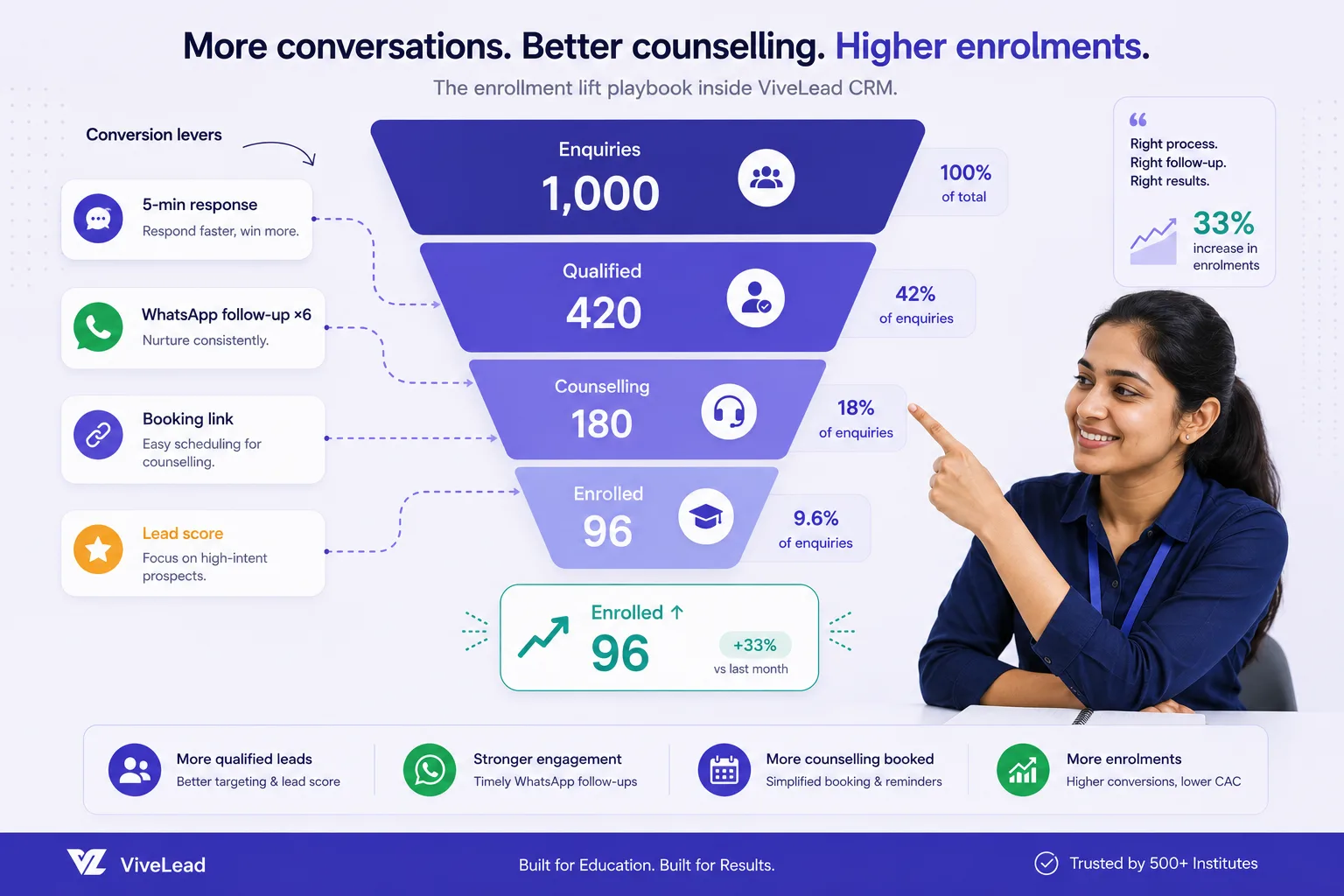
Take round, obviously illustrative numbers. Say you get 1,000 enquiries a month. Walk them down the stages with a baseline that is deliberately ordinary:
| Stage | Baseline rate | Students | After a 5-point lift | Students |
|---|---|---|---|---|
| Enquiries captured | 100% | 1,000 | 100% | 1,000 |
| Contacted in time | 60% | 600 | 65% | 650 |
| Demo or counselling booked | 50% | 300 | 55% | 358 |
| Demo attended | 60% | 180 | 65% | 233 |
| Enrolled | 30% | 54 | 35% | 81 |
Baseline: 54 enrolled. After about a 5-percentage-point improvement at each stage, roughly 81 enrolled. That is a lift of around 50 percent in this illustrative model, and even a more conservative read of the same logic lands you in the commonly cited zone: improve each funnel stage by about 5 percentage points and total enrollment can rise by up to roughly 29 percent. Model it on your own stage rates. These are illustrative numbers, not a promise, and your real figure depends entirely on your course economics and where your specific leaks are.
The punchline is the part that should change your spending. That extra enrollment came from zero additional ad spend. To get the same lift by buying leads, you would pay your full cost-per-lead on every single one of those extra enquiries, every month, forever. The conversion lift, you pay for once by fixing the process, and it compounds. This is the cheapest growth lever in your whole business, and the six levers below are how you actually move each of those stage percentages.
Lever 1: Speed-to-lead, the biggest point you are leaving on the table
If you do exactly one thing from this list, do this one. Speed-to-lead is the most replicated finding in sales and it maps cleanly onto admissions.
The famous “5-minute rule” came from the Lead Response Management Study led by Dr. James Oldroyd at MIT’s Sloan School of Management with InsideSales.com, analysing more than 15,000 leads and over 100,000 call attempts. The finding: contacting a web lead within 5 minutes versus 30 minutes made you about 100 times more likely to make contact and about 21 times more likely to qualify it. That is MIT and InsideSales.com, not Harvard. Harvard Business Review’s 2011 study of 2,241 US companies is the separate source for the roughly 42-hour average first-response time most firms actually post, and for the first-hour advantage. The safe, directional version you can repeat to your team without a footnote: respond in minutes, not hours.
Now the Indian reality. An enquiry hits at 11pm from a Click-to-WhatsApp ad. Your counsellor sees it the next afternoon, by which point 40 callbacks are already overdue, and the warm parent has enrolled their child somewhere that called back in ten minutes. You did not lose that parent on price or product. You lost them on the clock.
In ViveLead, the capture half of this starts on Starter (Rs 499/user/month): website-form enquiries land in one place automatically, with Meta lead-ad enquiries added on Professional, no copy-paste from a WhatsApp thread into a sheet. The instant half, an automatic acknowledgement the moment an enquiry lands, auto-assignment to an owner, and the full follow-up automation, is on Professional (Rs 999/user/month). For the day-by-day cadence that follows the first response, see the EdTech lead-to-enrollment playbook, and for the 11pm-enquiry problem in full, the shared WhatsApp inbox guide.
Lever 2: Multi-touch follow-up, because your team quits at touch two
Most enrollments do not happen on the first call. They happen on the fifth. And most teams stop at the second.
The persistence numbers, attributed: the Brevet Group puts it at roughly 80 percent of sales needing five or more follow-ups, while about 44 percent of salespeople give up after one attempt. Marketing Donut’s often-quoted figure is that 92 percent give up after four no’s. Industry benchmarks commonly cite 6 to 8 touches to convert a qualified lead, and 7 to 12 touchpoints for non-immediate web leads (inquir.com for the 7 to 12 range). Call these industry-standard aggregates, not peer-reviewed studies, but the direction is not in dispute.
You feel this one in your gut. You know enquiries are being abandoned at touch two, because your telecaller works a list, gets two no-answers, and quietly moves on to fresher leads. Nobody decided to drop that parent. The follow-up just lived in a tired human’s memory, and memory under load drops things.
In ViveLead, workflow automations plus WhatsApp templates and broadcasts on Professional (Rs 999/user) run the sequence so persistence stops depending on a counsellor’s sticky notes. One restraint note, because this matters: automation here is a cadence with a hard stop, not a spam cannon. Over-message and students block you; because you own your WhatsApp Business Account, you also own the opt-out and your sending reputation. This post does not re-print a full cadence table on purpose; the lead-to-enrollment playbook owns that, and it is the right place to copy the actual sequence from.
Lever 3: A shared WhatsApp inbox, so no enquiry dies on a personal phone
Here is a leak that hides in plain sight: your enquiries are living on individual counsellors’ personal phones.
A parent WhatsApps a counsellor’s number. The conversation sits in that one phone. The manager has zero visibility into it. And when that counsellor quits, and Indian telecaller attrition runs an estimated 30 to 50 percent a year (an industry estimate, not audited), their leads walk out the door with them. This is not a rare disaster. At that churn rate it is a recurring monthly tax on your pipeline.
In ViveLead, the fix is a native shared team inbox on the official Meta WhatsApp Business (Cloud) API, with your own WhatsApp Business Account connected, on Professional (Rs 999/user). The institute owns the number and the full conversation history; RBAC controls who sees what; a departing counsellor cannot take the thread because the thread was never theirs to take. That is the lever in one paragraph. The full argument, including Section 27 of the Indian Contract Act and why “their leads” was never a real claim, is in the shared WhatsApp inbox for EdTech guide, which is the deep-dive this section deliberately points to.
Lever 4: Lead scoring, so counsellors call the parents ready to pay
Your counsellor sits down at 10am with 40 callbacks due. The 3 genuinely hot leads, the parent who asked about the fee yesterday, are sitting behind 37 cold ones, and the counsellor works the list top to bottom. By the time they reach the hot three, two have enrolled elsewhere. “My counsellors say they’re calling everyone” is self-reported with no proof, and “calling everyone” is exactly the problem, not the solution.
The fix is to sort by intent. Hot, warm, and cold buckets so the morning call list starts with the people most likely to pay. This is a small-gains lever: better focus lifts your demo-booked and enrolled stages by a few points each, which feeds straight back into the calculator above.
In ViveLead, configurable lead scoring (hot/warm/cold) plus lead distribution rules are on Professional (Rs 999/user). And for proof that the calls are actually happening on phone-based counsellors, the ViveLead Android app logs calls made from the rep’s own phone SIM, with call recording, so every call ties back to the lead automatically, no extra data entry and no honour system. That is the Android app specifically; iOS restricts call-log access, so do not expect SIM logging there. Cloud click-to-call, with dispositions, voicemails, and call logs through Twilio, is the Business plan (Rs 1,699/user), billed per use, your number or ours. The SIM logging is passive tracking with recording; the dialer is active cloud calling. They are two different things, do not blur them.
Lever 5: Booking links, to kill the back-and-forth and the no-show
Six WhatsApp messages to agree a demo slot (“Saturday?” “evening?” “after 6?” “okay 6:30”) and then the student ghosts on the day. That whole dance is conversion you are leaking on calendar logistics, and no-shows for booked demos commonly run 20 to 40 percent.
The fix is a self-serve booking link. The student picks a slot from your team’s real availability, gets automatic reminders, and can reschedule in one tap instead of vanishing. Tools that do this commonly report no-shows pulled toward under 10 percent with reminders and easy reschedule (koalendar, oncehub, phoneburner; commonly reported, not audited), and a quick nudge within 10 to 15 minutes of a missed slot recovers a few more.
In ViveLead, appointments come with every plan, and public booking links (with reschedule and cancel) and Google Calendar/Meet sync are on Professional (Rs 999/user). More demos actually attended means a higher mid-funnel rate, which is the demo-attended row in the calculator climbing from 60 to 65 percent and pulling everything below it up with it.
Lever 6: Source analytics, to fund what enrolls, not what fills forms
Most owners optimize to the lowest cost-per-lead. That is a trap. The cheapest source often produces the most form-fills that never pay, and the number that actually matters is cost per enrolled student, not cost per form. You only get that number if every lead carries its source from the moment it is created.
The fix is source-wise conversion analytics: see which campaign, channel, and creative actually produces paying students, then shift budget toward what converts rather than what is merely cheap at the form stage. This is the compounding flywheel that closes the loop on the whole playbook. Better data leads to better spend leads to the same budget buying more enrollments, which is exactly the conversion-rate lever working on the input side too.
In ViveLead, source-wise conversion analytics and funnel drop-off, so you can see exactly which stage is bleeding, come with every plan from Starter (Rs 499/user).
What this won’t fix, read this before you buy anything
This is the honest part, and it is also the part that should make you trust the rest.
ViveLead organizes speed, follow-up, and focus. It does not fix a weak course, the wrong price, a market that does not want your program, or a counsellor who refuses to call. If your demo converts badly because the demo itself is poor, no automation saves it. Results depend on your course and your team, full stop.
It is also a CRM, and only a CRM. It captures enquiries, follows up, and reports. It does not deliver classes (it is not an LMS), it does not run your books (it is not an ERP or a fee-accounting system), and it does not replace a full marketing-automation suite. It integrates with and feeds those jobs; it is not those tools. If a vendor tells you one product does all of that for Rs 999, read the fine print.
And the volume threshold. Under roughly 30 enquiries a month with genuinely disciplined follow-up, a tight spreadsheet may still be enough; one organised person can hold that funnel in their head. The levers earn their keep once a counsellor is juggling around 100 leads by hand and dropping half. Buying software to feel professional is not a reason to buy software.
What it costs versus buying more leads
One per-user price bundles these levers, so the contrast with “just spend more” is clean.
Professional at Rs 999/user/month carries the engine: WhatsApp (official Meta API, your own WhatsApp Business Account, shared inbox), lead scoring, booking links, and workflow automations. Starter at Rs 499/user/month captures website-form enquiries (the capture half of Lever 1) and includes the sales pipeline and source-wise analytics; Meta lead-ad capture is on Professional. Business at Rs 1,699/user/month adds telephony (Twilio, per use) and the AI agents. ViveSmart AI, asking your CRM from ChatGPT, Claude, Grok, or Perplexity, is on the Business plan. HRMS and payroll, for the team behind the funnel, is an optional add-on at +Rs 99/user/month (Rs 79 yearly). Trial is 3 days, no card, with free migration and setup.
Now the fair comparison. A 6-counsellor institute on Professional pencils out to Rs 5,994 a month (6 × Rs 999) for every lever above, billed in rupees, plus GST. Against the alternatives:
- WhatsApp BSPs (AiSensy roughly Rs 1,500 to Rs 3,200/month, Wati roughly Rs 2,199 Growth to Rs 14,799 Business/month) charge a platform fee plus Meta’s per-message pass-through plus a 10 to 30 percent markup, and they are not a CRM. Your lead, pipeline, call log, booking, and WhatsApp thread end up in tools that do not talk to each other, which is itself an enrollment leak.
- LeadSquared (Sales Pro Rs 2,500, Sales Super Rs 5,000 per user per month, billed annually plus 18 percent GST, telephony separate) is built for funded EdTech and BFSI call floors and is overkill for 4 to 12 counsellors.
- Meritto/NoPaperForms is quote-only, demo-gated enterprise.
- Salesforce and HubSpot Professional start around Rs 7,500/user; almost nobody at a small Indian institute runs these for admissions.
On WhatsApp money specifically: ViveLead does not mark up Meta’s charge. Connect your account, no extra charge from us. Meta bills per message (the per-message model has been live since July 2025) directly to your WhatsApp Business Account, marketing messages around Rs 0.86 each and utility or authentication far cheaper, plus applicable taxes. Check Meta’s current India rate card, but the structure is the point: the messaging cost is yours and metered, and a vendor that hides it is setting up a surprise bill.
Increase Student Enrollment FAQs
Conversion math, speed-to-lead, follow-up, WhatsApp billing, and fit for Indian EdTech teams
The one idea, and your next move
You do not need 1,000 new leads. You need to stop losing 200 of the 1,000 you already bought. Enrollment is leads times conversion, and conversion is the cheaper, faster, compounding lever in 2026.
The six levers, as a checklist:
- Speed-to-lead. Respond in minutes, not hours.
- Multi-touch follow-up. Five-plus touches, run by automation, not memory.
- Shared WhatsApp inbox. No enquiry dies on a personal phone.
- Lead scoring. Counsellors call the ready buyers first.
- Booking links. Kill the demo back-and-forth and the no-show.
- Source analytics. Fund what enrolls, not what fills forms.
Capture lives on Starter (Rs 499/user); the engine, levers 2 through 6 plus instant response, lives on Professional (Rs 999/user). Start the 3-day trial, no card, import your existing enquiries, and watch one cohort move through the funnel before you commit a rupee. Decide from your own leads, not a brochure.
Related reading
- EdTech lead-to-enrollment playbook. The fixed 7-day demo-to-enrollment cadence.
- Shared WhatsApp inbox for EdTech. The shared-inbox lever in full, plus Section 27.
- Enrollment marketing automation. The full inquiry-to-admission trigger map.
- Meta lead ads to WhatsApp CRM. Cost-per-lead, junk leads, and speed-to-lead on Meta.
- Pricing. Plans, what’s included, and the no-card trial.
EdTech CRM by city: Delhi NCR, Mumbai, Bangalore, Hyderabad, Chennai, and Pune.
Start Your Free 3-Day Trial
Run the whole funnel on Professional (Rs 999/user): WhatsApp, lead scoring, booking links, and automations. No credit card required.
Continue Reading
Enrollment Marketing Automation That Wins Clicks | ViveLead
Enrollment marketing automation for Indian coaching, EdTech & study-abroad: the inquiry-to-admission trigger map, honest …

Why Email Fails: Marketing Automation for Education
Email fails for Indian admissions as a channel, not as copy: Meta-lead-ad junk emails, inbox burial, and the 5-minute …

Stop Using Your EdTech CRM Like an Excel Sheet | ViveLead
Most coaching institutes use their EdTech CRM like a spreadsheet. The admissions-specific way to capture, nurture, …