LMS (Lead Management System): What It Does and Costs in India
LMS in sales means lead management system, not learning management system. What one does, who buys it in India, and real prices from Rs 499 a user to LeadSquared Rs 2,500.

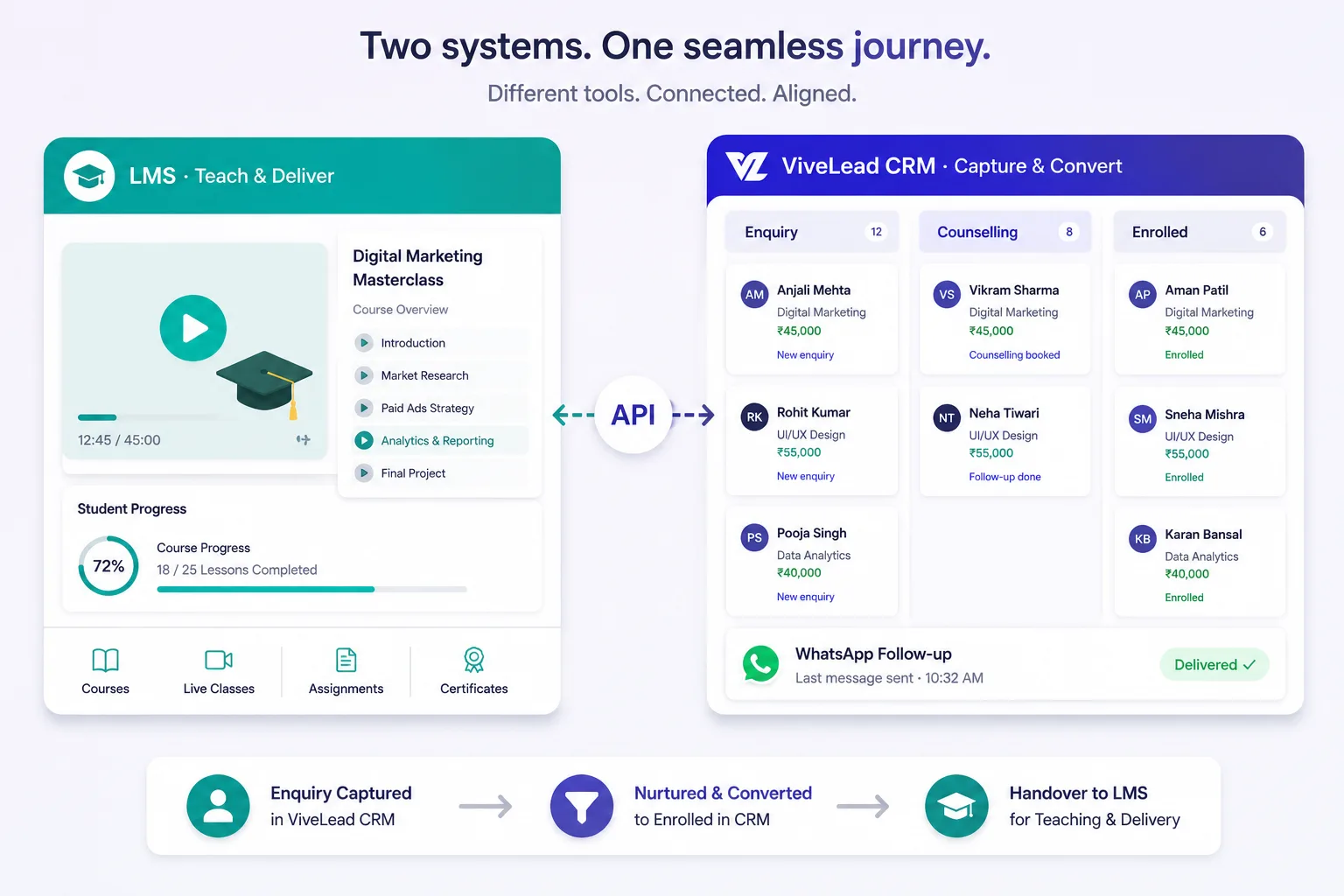
LMS as a lead management system: what it is
If you typed “LMS lead management system”, you mean the sales tool. A lead management system captures every enquiry from Meta ads, your website, WhatsApp and walk-ins, tags where each one came from, scores it, assigns it to a rep, and keeps the follow-up cadence running until the person buys or says no. In India, that tool is a CRM. LeadSquared, TeleCRM, Kylas and ViveLead all sell one; the name on the box changes, the job does not.
It is not an education-only tool, and the search term is not an education-only term. The same software runs the enquiry desk at a real estate developer, an insurance agency, a diagnostics chain, an IT services firm, a travel operator and a manufacturer taking dealer enquiries. Anywhere a stranger raises their hand and somebody has to call them back before a competitor does, this is the category.
What one costs in India
The SERP for this term is full of definitions and almost empty of prices, so here they are, each read from the vendor’s own published page:
| Tool | Published price | Billing |
|---|---|---|
| ViveLead | Rs 499 per user per month | monthly or yearly, in rupees |
| TeleCRM | Rs 799 per user per month | billed annually |
| Kylas | Rs 12,999 per month, flat | unlimited users, so it pays off past roughly 26 people |
| LeadSquared Sales Pro | Rs 2,500 per user per month | billed annually |
| LeadSquared Sales Super | Rs 5,000 per user per month | billed annually |
Two things decide which band you belong in. Team size: under about 25 people, per-user pricing is cheaper than a flat fee, and above it the flat fee wins. Whether you need the enterprise machinery: field-force tracking, deep permission trees and a dedicated implementation team are what the Rs 2,500 and Rs 5,000 tiers are actually selling, and a six-person enquiry desk does not use them.
There is a second meaning of those three letters, and it is the reason many people land on this page.
The other LMS: learning management system
The three letters collide with a second product. A Learning Management System (Classplus, Teachable, Graphy, LearnDash, Moodle) hosts your videos, runs your batches, and delivers the course to students who already paid. One line settles it: a learning management system teaches the students you already have; a lead management system captures and converts the strangers who just enquired. One tool delivers. The other tool sells.
That collision is why admissions feel leaky on a course platform. You did not buy the wrong tool. You bought a teaching tool and asked it to do sales, and it was never built for that.
If you sell courses, the rest of this page works through that handoff in detail, because it is the case where the two products sit next to each other and the boundary has to be drawn. If you sell anything else, the same mechanics apply without the course platform: the capture, the scoring, the assignment and the follow-up cadence are the product, and the sections below describe them.
What an LMS is brilliant at (and what it was never built to do)
Let me be fair to your LMS first, because it earns its money. A learning management system is genuinely excellent at course delivery: hosting content, running batches, live classes, attendance, drip schedules, certificates, and fee collection for students who are already enrolled. If you sell courses, you need one. Keep paying for it. None of what follows is an argument to drop it.
The boundary shows up the moment a stranger fills a form on your landing page at 11pm. Your LMS has no source tag to tell you that lead came from a Meta ad versus an Instagram bio link. It has no lead score to say this enquiry is hot and that one is tyre-kicking. It has no pipeline stage, no follow-up cadence, no record of who called and when, and no source-wise conversion report at month end. Your LMS is brilliant at teaching. It is terrible at chasing a stranger who filled a form at 11pm. Those are two different jobs.
The “but my app already has a CRM tab” trap
This is the objection I hear most, so let me answer it head-on. Yes, your course app probably has a tab labelled “Students” or even “CRM.” That tab manages the people you already enrolled. It does not capture and convert the strangers who enquired but have not paid. A “basic CRM feature” bolted onto a learning platform is usually a notes field and a contact list, not a sales engine.
Here is what that tab does not give you, itemised, because the gap is specific:
- Source tagging so you know which ad, page, or channel produced each enquiry.
- Hot, warm, and cold lead scoring so counsellors call the right lead first.
- Pipeline stages so an enquiry visibly moves from new to demo-booked to enrolled.
- A disciplined follow-up cadence across WhatsApp, call, and email instead of “she called once.”
- Source-wise conversion analytics so you stop guessing which spend actually enrolled.
To name a real example honestly: Classplus is widely reviewed as an all-in-one platform with basic CRM features. It is strong at managing already-enrolled students inside a white-label app. It is weak at the stranger-capture-to-conversion job, because that was never its primary design. That is not a knock on Classplus. It is a knock on asking a course-delivery product to run your sales floor.
What a lead management system (CRM) actually does
A lead management system does the half your LMS leaves on the floor. Cleanly defined, the job is this: capture every enquiry from every source with the source tag intact, score it, route it to the right counsellor, drive a follow-up cadence over WhatsApp and call and email, move the enquiry through visible pipeline stages, and at the end tell you which source actually converted to enrollment. That is the entire lead-to-enrolled spine, and an LMS does none of it.
The speed-to-lead spine (the why behind all of it)
Why does any of this matter more than feelings? Because admissions is won or lost in minutes, and there is hard data on it.
The MIT and InsideSales lead-response study found that leads contacted within five minutes are roughly 100 times likelier to connect and 21 times likelier to qualify than leads contacted after 30 minutes. Separately, a Harvard Business Review analysis from 2011 found the average company took 42 hours to respond to a web lead, and that firms responding within one hour were about 7 times likelier to have a meaningful qualifying conversation than those that waited longer. Two different studies, same lesson: speed is everything, and “the counsellor called once or twice, then the lead went cold” is how most institutes quietly lose half their pipeline.
Your LMS cannot fix this, because it does not even know a lead arrived. A CRM can, because alerting and routing a fresh enquiry is its core job. For the deeper teardown of why generic and education tools fall short here, see our piece on why generic CRMs fail EdTech.
The funnel: where the LMS ends and the CRM begins
Picture the funnel as a relay, not a single runner. Each system carries the baton for one leg only.
Enquiry comes in from a Meta lead ad, a course landing-page form, or your website. That enquiry hits the CRM, which tags the source, scores the lead, kicks off a WhatsApp follow-up, drops it into a pipeline stage, and offers a demo or counselling booking link. The lead converts and pays. Enrollment and payment are recorded. Then, and only then, you hand the paying student off to the LMS for delivery: batches, content, classes, certificates. One system per leg. Nobody runs the whole track alone.
Now the boundary, stated loudly so there is no confusion: ViveLead is the lead-management, CRM half of this funnel. It does not deliver courses, host content, or run batches. It sits in front of your LMS, never replaces it.
How does the handoff actually connect? Via ViveLead’s lead capture API on the Professional plan at Rs 999 per user per month, or simpler capture and webhook flows for lighter setups. The title of this article says “natively,” so let me disambiguate that word precisely: natively means ViveLead natively captures and manages your leads end to end. The link to your LMS is via our lead capture API, or capture and webhook flows, not a prebuilt one-button connector to Classplus, Teachable, LearnDash, Graphy, or any named platform. If a vendor promises you a magical one-click connector to your exact LMS, read the fine print.
LMS vs WhatsApp BSP vs dedicated CRM
A lot of owners try to solve the sales gap by bolting a WhatsApp tool onto the LMS instead of getting a real CRM. So here is the honest three-way comparison, with ViveLead scored truthfully, including a deliberate “No” where it belongs.
| Capability | LMS (course platform) | WhatsApp BSP (Wati / AiSensy / Interakt) | Dedicated CRM (ViveLead) |
|---|---|---|---|
| Captures Meta and website enquiry with source tag | No | Partial (chat only) | Yes |
| Lead scoring (hot / warm / cold) | No | No | Yes |
| Sales pipeline stages | No | No | Yes |
| WhatsApp follow-up | No | Yes | Yes |
| Demo / counselling booking link | No | No | Yes |
| Source-wise conversion analytics | No | No | Yes |
| Delivers and teaches the course | Yes | No | No |
Read that bottom row twice. ViveLead says “No” to teaching the course on purpose, because that is your LMS’s job and pretending otherwise would be a lie. The LMS says “Yes” only on teaching. The WhatsApp BSP says “Yes” only on the WhatsApp leg.
A WhatsApp BSP like Wati, AiSensy, or Interakt is a WhatsApp inbox with broadcast tools. It is not a CRM. It does not score leads, it does not run a pipeline, and it does not tell you which source converted. The owner who buys an LMS, plus a BSP, plus a separate CRM ends up paying three bills for three tools that barely talk to each other. ViveLead folds capture, WhatsApp, pipeline, scoring, and analytics into one screen, so the sales side is a single login, not a tab graveyard.
The rupee math (why LeadSquared-class is overkill for a 6-counsellor institute)
“Fine,” you say, “then I will just buy LeadSquared or Meritto.” Hold on. Those tools are built for BYJU’s and upGrad-scale tele-calling floors running 200 reps, predictive dialers, and a full marketing-automation suite. For a 4 to 15 person institute, that is a Formula 1 car for a school run. You will use maybe 10 percent of it and pay for all of it.
On their own published numbers: LeadSquared runs Rs 2,500 per user for Sales Pro and Rs 5,000 for Sales Super, billed annually plus GST (read from India on their pricing page, 27 September 2026), and a serious education configuration lands above that once you add the modules institutes actually buy, because the add-ons carry no public price. The two seat rates are published; what a configured deal costs is not.
Now the comparison, framed as an illustrative estimate, not a vendor quote. A six-seat institute on ViveLead Professional pays 6 x Rs 999, which is Rs 5,994 per month before GST, and that already includes WhatsApp Business, sales pipelines, lead scoring, and source-wise analytics. A LeadSquared-class setup for similar seats realistically runs Rs 24,000-plus per month, roughly four times the cost, for capability you will mostly leave switched off. Meanwhile your LMS keeps doing the one thing it is great at. The honest companion read on getting a lead all the way to enrolled is our EdTech lead-to-enrollment guide for India.
Why dropping a lead is more expensive than it looks (intake season)
Here is the part that turns a leak into a fire. Meta cost-per-lead for coaching in India in 2026 typically runs roughly Rs 80 to Rs 400 for mainstream courses, and roughly Rs 800 to Rs 2,000 for high-ticket study-abroad and executive programmes, based on benchmark reports from agencies tracking education ad spend. Those are labelled ranges, not guarantees, and your number depends on city, course, and creative.
During intake season, enquiry volume often triples. That is exactly when the personal-WhatsApp-plus-spreadsheet system collapses, and exactly when each lost lead is most expensive, because you paid peak CPL to get it. As an industry observation, not a ViveLead statistic: a counsellor managing 100 leads manually will drop half of them. A system will not. When a dropped lead costs you Rs 400 to acquire, dropping fifty of them in a busy week is real money walking out the door.
“My counsellors live in WhatsApp and won’t update a CRM”
This is the single biggest reason CRMs die in coaching teams, and it is a fair objection. Counsellors will not log into a fourth tab to type call notes. So the answer is not discipline lectures. The answer is making the tool capture the work automatically.
Two concrete counters, both verified against what ViveLead actually ships:
- WhatsApp is inside the CRM, not a separate app. WhatsApp Business via the official Meta Cloud API is built into ViveLead on Professional at Rs 999 per user per month. You connect your own WhatsApp Business Account, bring your own templates and broadcasts, and your team works from a shared team inbox. Meta bills per message directly to your WABA, and ViveLead does not mark that up. You connect your own account, and there is no extra messaging charge from us. So the chats are already captured in the system without anyone copy-pasting.
- Calls log themselves on Android. The ViveLead Android app logs calls a rep makes from her own phone SIM, with recording, tied back to the lead automatically. Zero typing. This is the Android app specifically. On iPhone, Apple restricts call-log access, so SIM call logging is Android-only, and I will not pretend otherwise.
Put together, the data-entry tax drops far enough that the tool stops becoming shelfware. And the consolidation is the real win: the sales side lives in one CRM with capture, WhatsApp, pipeline, and analytics, and one clean handoff to the LMS, instead of five disconnected tabs nobody keeps in sync. If WhatsApp is your main channel, our deeper write-up on WhatsApp CRM for coaching institutes goes further on this.
The data your counsellor walks out with (the boundary you can actually defend)
Here is the quiet risk in the spreadsheet-and-personal-WhatsApp setup. When the lead “went to her personal WhatsApp,” it left with her the day she resigned. Leads sitting idle in a spreadsheet nobody else can open are leads you cannot reassign, cannot audit, and cannot recover. This is not just an efficiency problem. It is a control problem. If a sheet is honestly where you are today, the admission enquiry tracker at least makes it one file the whole desk can open, with an owner column that says whose enquiry it is.
A quick word on the law, and this is general information, not legal advice, so check with your own lawyer. Under Section 27 of the Indian Contract Act, 1872, a post-employment non-compete clause on a departing counsellor is largely void and unenforceable in India. You usually cannot stop her from joining a rival institute. However, non-solicitation and confidentiality or trade-secret covenants are enforceable, a position Indian courts including the Calcutta High Court have upheld (for instance in Parraj Automobiles v. Samiran Sinha, 2026). The practical takeaway: you cannot fence the person, but you can protect the data. The defensible move is keeping every lead inside a company CRM, where access dies the moment she leaves, rather than on a personal phone you never controlled.
There is also a compliance angle that is sharper for anyone capturing minors, which test-prep and school-tuition outfits do constantly. The Digital Personal Data Protection Act, 2023 treats anyone under 18 as a child, and processing a child’s personal data requires verifiable parental consent. The Act also expects defined retention and secure deletion, with penalties running up to Rs 250 crore for serious breaches. A minor’s enquiry sitting in a counsellor’s personal chat with no consent trail and no deletion policy is a risk you do not want.
ViveLead’s answer here is straightforward: leads live in a controlled CRM with role-based access control (RBAC), and on the Business plan, role-based access control. To be precise about what we do and do not claim: ViveLead follows GDPR principles, the IT Act 2000, SSL and AES-256 encryption, and RBAC. We do not claim DPDP certification, SOC 2, ISO 27001, HIPAA, or FERPA. DPDP is Indian law we help you operate within, not a badge we wear.
Where ViveLead fits, said plainly (the honest boundary, repeated)
Let me close by stating the boundary one more time so nobody finishes this article thinking ViveLead is a course platform. It is not.
ViveLead is the CRM, lead-management half of your funnel:
- Starter, Rs 499 per user per month: core CRM, leads, custom fields, document management, sales pipelines and quotations, source-wise reports, and lead capture from website and course-landing-page forms, with follow-ups and the mobile app on Android and iOS.
- Professional, Rs 999 per user per month: adds Meta lead ads capture, WhatsApp Business (official Meta Cloud API, your own WABA, shared team inbox), invoicing, demo booking links, workflow automations, lead scoring, and the lead capture API. This is the tier most coaching institutes actually want.
- Business, Rs 1,699 per user per month: adds telephony and calling via Twilio, the AI agents, audit logs, and payment collection.
What ViveLead does not do: it does not deliver courses, host content, run batches, or grade assignments. That is your LMS’s job, and it should keep it. ViveSmart AI, which lets you ask your CRM questions from ChatGPT, Claude, Grok, or Perplexity, comes with the Business plan. The trial is 3 days with no credit card. And if you also want to handle attendance and payroll for the staff behind the institute, there is an optional HRMS and payroll add-on at +Rs 99 per user per month (Rs 79 yearly) on any plan, fully optional and not bundled into any tier by default.
So the move is not to pick one tool. It is to run both and connect them at the handoff: your LMS teaches the students you enrolled, and ViveLead captures and converts the strangers who enquired, before they go cold on someone’s personal phone.
LMS vs Lead Management System FAQs
The acronym collision, the funnel handoff, pricing, and fit for Indian coaching institutes and course sellers
Start Your Free 3-Day Trial
Capture leads and run pipelines from ₹499/user/month, add WhatsApp from ₹999. No credit card required.
Continue Reading

Stop Using Your EdTech CRM Like an Excel Sheet | ViveLead
Most coaching institutes use their EdTech CRM like a spreadsheet. The admissions-specific way to capture, nurture, …
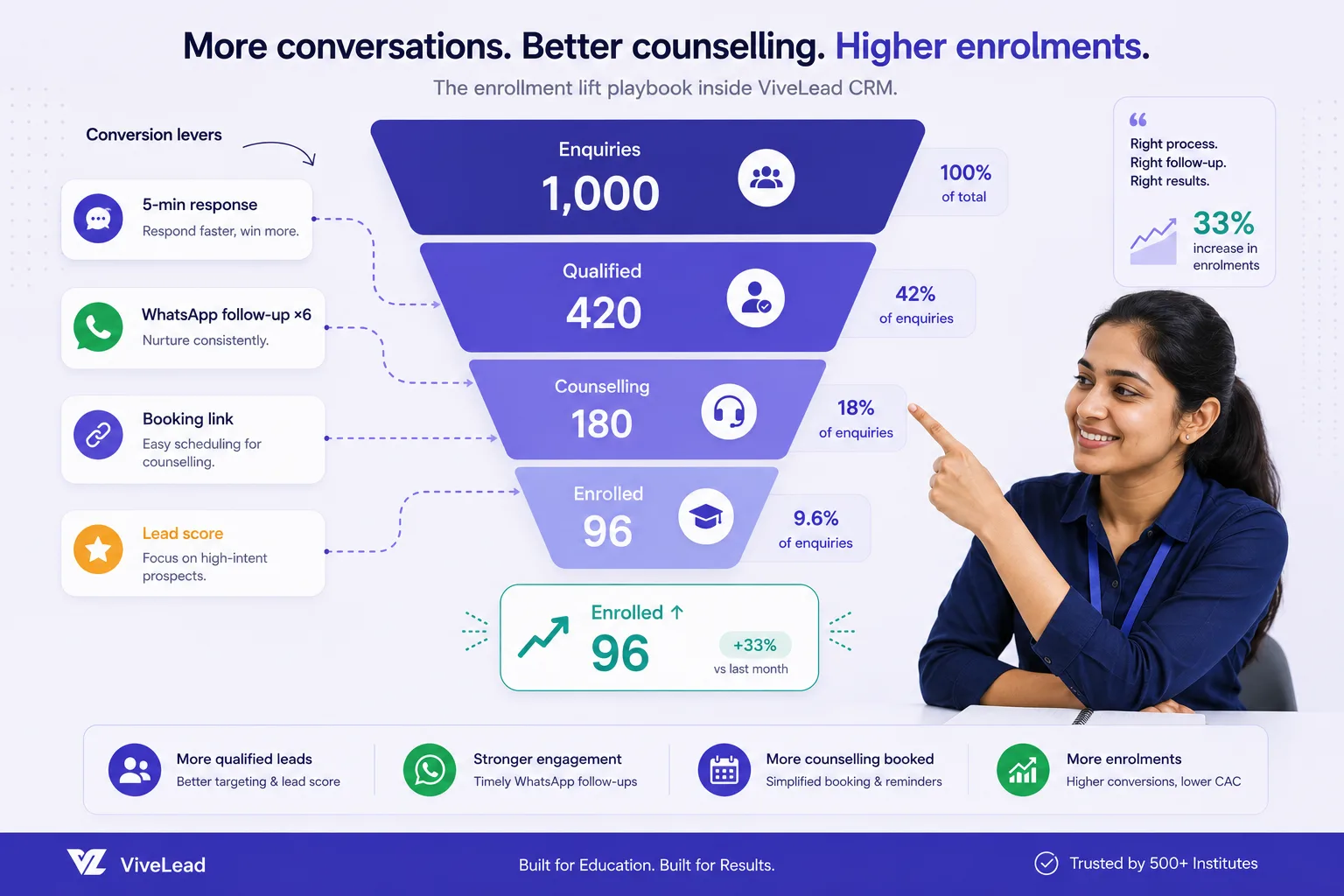
Increase Student Enrollment in EdTech: Math, Not Ad Spend
Increase student enrollment without more ad budget: six conversion levers, the enrollment-lift math, and the ViveLead …
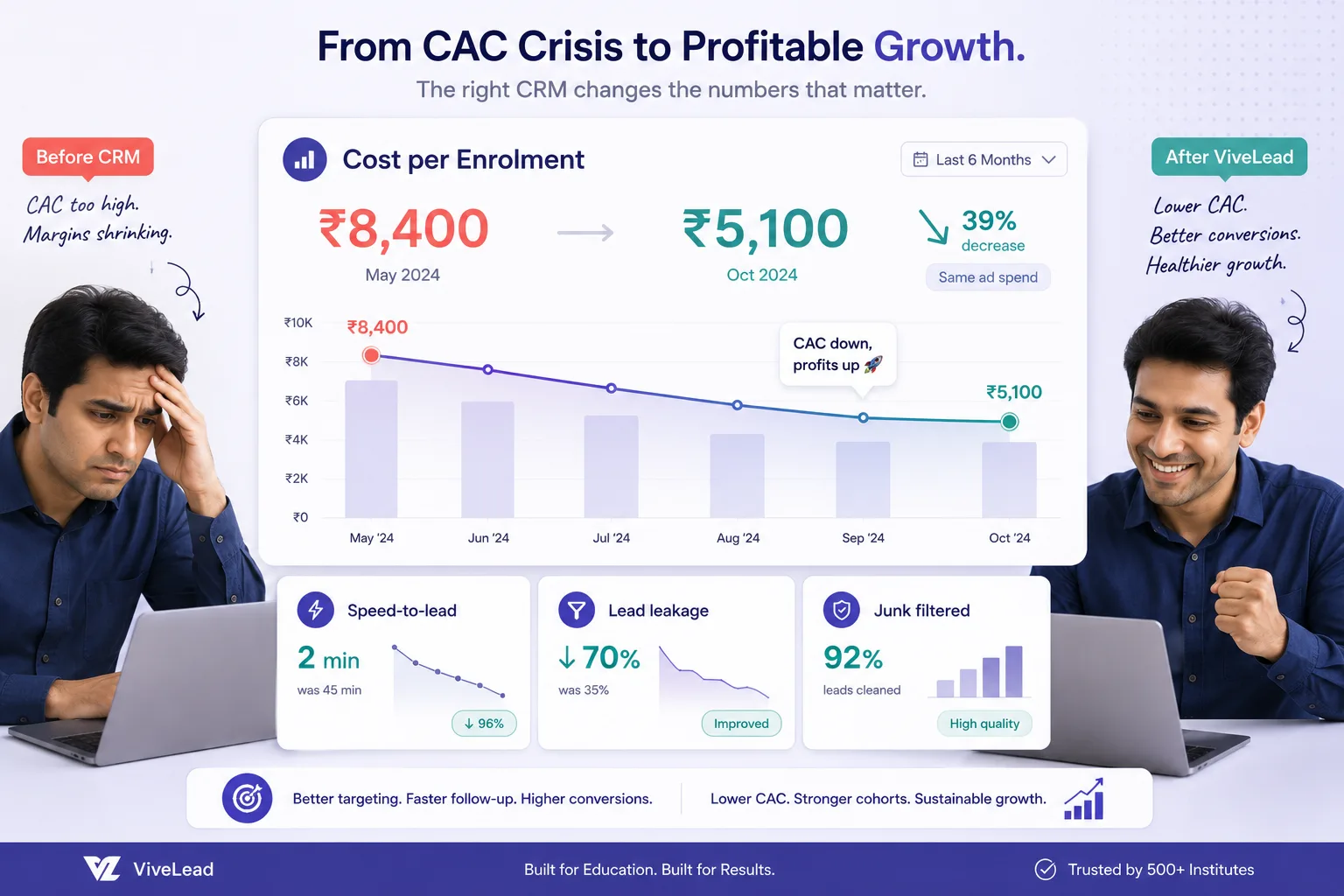
The EdTech CAC Crisis: Buying More Leads Won't Save You
CRM software for education industry that cuts your real cost per enrolled student: speed-to-lead, less leakage, cost per …