Why Email Fails: Marketing Automation for Education
Email fails for Indian admissions as a channel, not as copy: Meta-lead-ad junk emails, inbox burial, and the 5-minute speed-to-lead window explained.

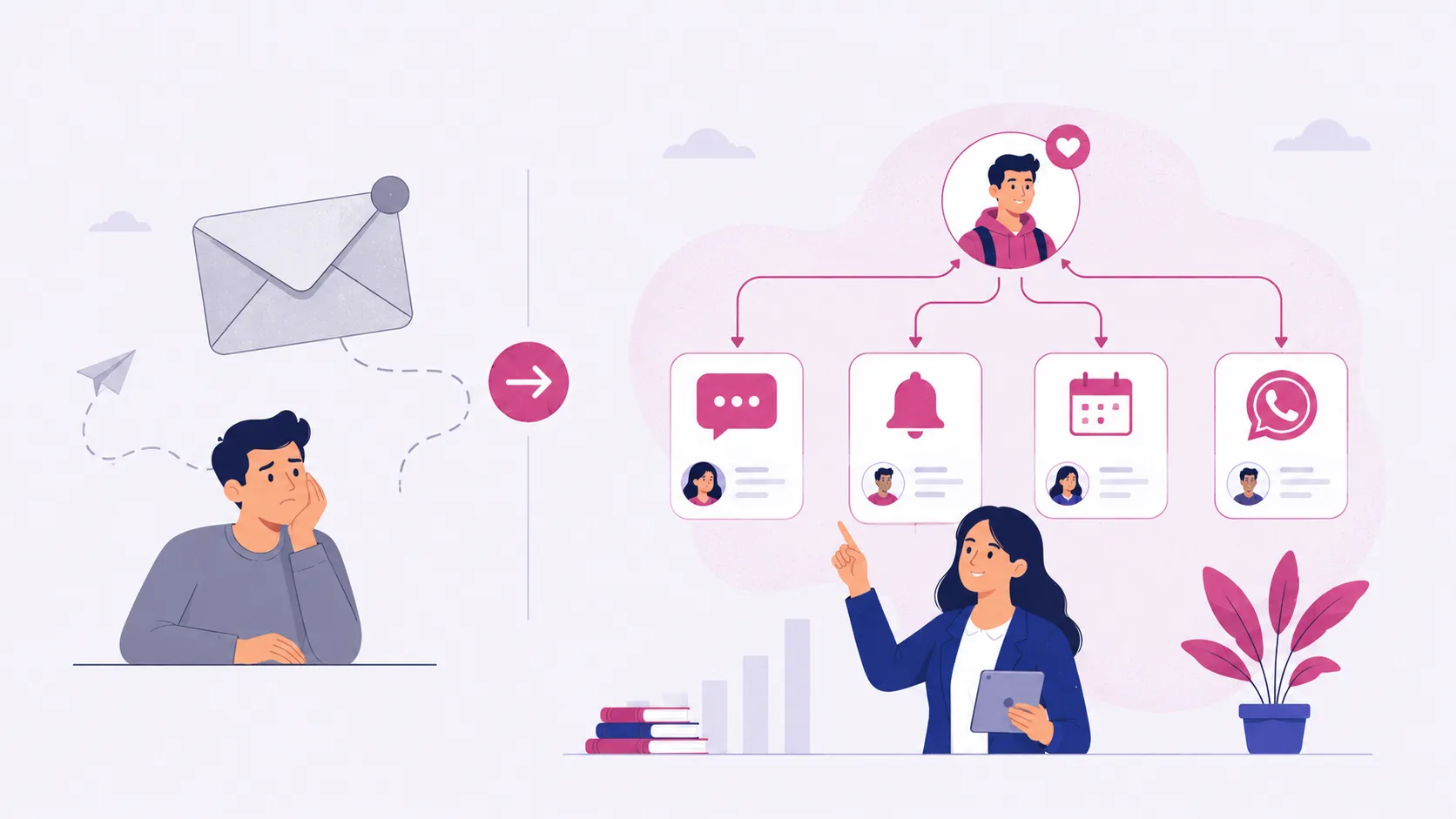
The enrollment was lost at hour three. The email went out at hour eighteen.
That is the whole story, and almost every guide on marketing automation for education gets it backwards. They blame the subject line. They blame the “low 21% open rate” with no source. They tell you to A/B test your call-to-action button. None of that touches the actual wound, because the email was never the problem. The pipe it travelled through was.
This is an autopsy, not a pep talk. We will open up exactly why email fails for Indian coaching and study-abroad admissions, name our sources where the field cites none, steel-man the one honest argument for email, then show which channel does which job, what real marketing automation looks like when it is built for an Indian counsellor on a scooter instead of a Boston SaaS rep, and what this category actually costs once you strip away the “request a quote” curtain.
Quick answer: Email does not fail for Indian admissions because of weak copy. It fails because it is the wrong channel for the first response. Most coaching and study-abroad leads are born in Meta or Google lead ads where the email field is auto-filled and often junk, then the message dies in a Promotions tab a student-and-parent buyer never opens during a two-week decision. Meanwhile the enrollment is decided in the first few minutes: operators say the institute that responds first usually wins, because the same student filled forms on several platforms at once. The fix is not deleting email, it is matching each channel to its job. WhatsApp and a call for the instant first touch and reminders, email for documentation like fee receipts and offer letters, and a structured nurture sequence for the parent researching at 11pm. In ViveLead, Meta lead-ad capture and native WhatsApp Business both sit on Professional (Rs 999/user/month, with Meta billing your own WhatsApp Business Account), a 3-day trial, no card, so the whole ad-to-enrollment pipe lives in one tool.
The 18-hour email that lost the enrollment (and why it was never the email’s fault)
A real admission-season morning
Picture the first week of an admission cycle at a JEE/NEET coaching institute in Kota, a study-abroad agent in Pune, or a K-12 tuition chain in Chennai. The pattern is identical. A Meta lead-ad campaign is live. Overnight, eighty enquiries land. The counsellor walks in at 10am and works the list top to bottom. By the time she reaches the parent who submitted at midnight, it is afternoon, and the “automated nurture” your last vendor sold you fires a welcome email at the eighteen-hour mark, beautifully designed, perfectly on-brand.
The student enrolled somewhere else at hour three. Not because the competitor had better teachers or lower fees. Because at 12:08am, ninety seconds after the same student tapped “Submit” on a second institute’s ad, that institute’s WhatsApp pinged with a real human reply and a demo slot for the next evening. Your email was still queued.
This is not a hypothetical. It is the single most consistent thing operators in this space say: the institution that calls first wins, because a serious applicant rarely fills one form. They fill several at once, then go with whoever shows up first. Our playbook on moving a coaching enquiry from demo booking to enrollment is built entirely around this five-minute window.
Email did not underperform, it was the wrong pipe
Email did not “underperform” for that lead. Underperformance implies it was the right tool turned in a weak score. It was the wrong tool entirely. The buyer was born inside a Meta instant form on a phone, is a student whose decision is gated by a parent, both of whom live inside WhatsApp, and is making a high-consideration purchase under time pressure against five competitors. You answered that buyer with a channel that is asynchronous by design, filtered into a Promotions tab by Gmail, and addressed to an email field the user never actually typed. Every structural property of email is misaligned with every structural property of the buyer.
A copywriting fix cannot save a channel-fit failure. You can write the best welcome email in the history of Indian EdTech and it will still arrive eighteen hours late, in a tab nobody opens, addressed to rahul12345@gmail.com that Meta auto-filled and the real Rahul has not logged into since 2021.
What this guide will and will not claim
We will not repeat the circular “98% WhatsApp open rate, 21% email open rate” statistics that every vendor blog copies from every other with no primary source. Where we cite a hard number, it will be attributable. There are exactly two genuinely defensible external facts in this piece, and we lean on both: the Meta instant-form pre-fill behaviour documented across independent ads-practitioner guides, and the Central Consumer Protection Authority crackdown on coaching ads, with named institutes and rupee figures. Everything else we label as an industry pattern operators report, not as gospel. And the honest thesis is narrow: email fails as the first-response and lead-capture layer, not as the documentation or long-nurture layer. Conflate those and you are as wrong as the vendor who tells you to delete email entirely.
The autopsy: four reasons email structurally fails for Indian admissions
Four mechanisms, none of which a better template touches. This is the diagnostic core.
Reason 1: the Meta lead-ad email field is auto-filled junk before you write a word
Start where the lead is actually born. For most coaching and study-abroad campaigns in India, that is a Meta instant form on Facebook or Instagram, not a website. Meta’s instant form is built to remove friction: it pre-populates the user’s name, email, and phone from their Facebook profile so they can submit in, as Meta’s own positioning puts it, a couple of taps. That frictionlessness is the feature for ad cost-per-lead, and the bug for email deliverability.
Independent ads practitioners are blunt about what it produces. LeadsBridge’s guide on fake Facebook leads describes throwaway or stolen emails and phone numbers from people who only want a freebie, plus accidental low-intent taps where someone hits submit just to keep scrolling. ClickFortify’s teardown of Meta instant-form lead quality makes the same point: auto-filled name, email, and phone make a junk lead frictionless, one tap-tap and a complete “lead” the person never intended to send is in your CRM. Aurelius Media’s write-up on low-quality Meta leads adds that disposable-email and recycled-phone patterns are common enough that validation tooling exists specifically to catch them. The fix these practitioners recommend is telling: shift at least some campaigns off native instant forms toward a structured landing-page flow, or switch the form to a higher-intent mode that adds a review step.
Now layer your email-first automation on top. Your day-zero welcome email fires to an address the user never typed, that may be a years-dead Gmail, a recycled handle, or a bot that auto-submitted inside the Facebook environment. The sequence is not underperforming; it is firing into a void before a single word of copy matters. The phone number, by contrast, is far more often real, because the student wants the callback. That asymmetry alone reorders your entire channel strategy.
Reason 2: the Promotions-tab burial nobody opens during a two-week decision
Suppose the email address is real. You are still not safe. Gmail, which dominates Indian consumer inboxes, routes bulk and templated mail into the Promotions tab, and an automated welcome-and-nurture sequence is, by Gmail’s own classifiers, exactly the kind of mail that belongs there, sitting alongside Myntra sale alerts and Swiggy coupons. A parent weighing a ninety-thousand-rupee decision over two weeks is not excavating the Promotions tab. This is not a deliverability problem you fix with a warmer sending domain. It is a category problem: the medium you chose for your most time-sensitive message is the one room in the house your buyer has agreed to ignore.
Reason 3: the buyer is a student-plus-parent who lives in WhatsApp, not an inbox
The Indian admissions buyer is not one person and does not live in email. It is almost always a pair: the student who will attend and the parent who will pay and therefore decide. Coaching-tech operators are explicit that parents are the final decision-makers in a large share of Indian admissions, which is why a separate parent communication track is treated as essential. And the medium both of them live in, react to, and trust for back-and-forth is WhatsApp, where the family already coordinates everything else. A message there is read in minutes; a message in a Promotions tab is read in, optimistically, days.
Email assumes a single professional recipient who checks an inbox as part of a workday. That describes a B2B SaaS buyer in San Francisco, not a sixteen-year-old and their mother in Indore deciding on a NEET batch. Our buyer’s guide to WhatsApp CRM in India goes deeper on why WhatsApp is where Indian customers actually reply, and admissions is the sharpest version of that pattern.
Reason 4: speed, by the time the email sends, a competitor already replied
The fourth reason swallows the other three, and it decides the money. Admissions is a speed-to-lead race, and email is structurally the slow runner. Even a well-built email automation introduces lag: queueing, send-time optimisation, throttling to protect domain reputation. None of that is wrong for nurture; all of it is fatal for first response. By the time your email is delivered, opened, and read, the student who filled five forms has already had a live WhatsApp exchange with whoever answered first and very possibly booked a demo.
Operators put a hard, if vendor-sourced, number on the cost of slowness: the odds of qualifying a lead reportedly drop by around 21 times when first response slips from five minutes to thirty. Treat that as an industry assertion, not a peer-reviewed law, but the direction is not in dispute. The first institute into the conversation sets the frame, books the slot, and anchors the relationship; everyone after is negotiating from behind. You cannot win a five-minute race with a channel built for asynchronous, batched, reputation-protected delivery. That is not a flaw in email. It is email working exactly as designed, on the one job it was never designed for.
Speed-to-lead is the battle email loses: the 5-minute window vs the 12-day sequence
If you take one section away, take this one. It is also where we do the work nobody else does, which is to argue the other side fairly before we beat it.
“The institution that calls first wins”
The strongest India-specific framing we found, and it comes from people who run admissions for a living, is brutally simple: the institution that calls first wins. Not the one with the best brochure or the slickest twelve-day drip. The first human reply.
The mechanism is the multi-form student. A serious applicant does not research one institute. They fill enquiry forms on several platforms in a single sitting, often within the same hour, because filling a Meta instant form costs two taps. From that moment you are not competing on quality in the abstract. You are competing on who reaches them while the decision is still warm and unanchored. The institute that replies in minutes gets to define what “good” looks like. The institute that replies tomorrow is auditioning to replace a choice the student has half-made.
Why the enrollment is decided before any email sequence even starts
Here is the structural punchline. Your beautiful twelve-day nurture sequence, whatever channel it runs on, begins on day one. The enrollment was very often decided in the first thirty minutes. The sequence is running a race that finished before it left the blocks.
This is why “improve your email open rate” is the wrong project. Even a hypothetical 100% open rate on a sequence that starts eighteen hours after a competitor already booked the demo changes nothing. The leak is not in the funnel’s middle. It is at the mouth, in the gap between enquiry and first human contact. Plug that, and the rest of the funnel suddenly has leads to work. Leave it open, and you are optimising the plumbing of an empty tank.
The honest math: a counsellor managing 100 leads manually drops half
There is a capacity reality underneath the speed reality, and it is where automation earns its place honestly.
Operators report that a counsellor handling around a hundred leads purely by hand will drop roughly half of them, simply because human attention does not scale to that volume with five-minute response times. Indian institutes routinely expect counsellors to make eighty to ninety calls a day, and counsellors report spending the bulk of their time, some say around 70%, on calls that go nowhere. No human can manually hit a five-minute first response on eighty overnight Meta leads while also running demos and chasing yesterday’s warm list.
This is the actual job of marketing automation in admissions, and it is narrower and more useful than “send drip campaigns”. It is to fire the instant first touch the moment the lead lands, so the human is freed to do the high-value work: the qualifying call, the demo, the fee conversation. The machine wins the five-minute race; the counsellor wins the relationship. Get that division of labour right and one counsellor stops dropping half the list.
Steel-manning the other side: where email genuinely still wins
Now the part every other page is too lazy to write. There is a serious, honest argument for email in EdTech, and pretending otherwise would make this piece exactly the kind of one-eyed vendor blog we are criticising.
The case, argued well by people who do not sell WhatsApp tools, runs like this. EdTech consideration cycles are long, often two to four weeks, sometimes months for study-abroad. Parents do real asynchronous research, comparing institutes late at night after the kids are asleep. Email is asynchronous by nature, which fits that rhythm. It is cheap at scale, fractions of a rupee per send, while WhatsApp’s API conversations cost meaningfully more per message. And email is where decisions get documented: the fee structure, the offer letter, the brochure that the parent forwards to the spouse and pulls up again in week three. As one good framing puts it, WhatsApp is where conversations happen, email is where decisions get documented.
Every word of that is true. And none of it contradicts our thesis, because it is all about the nurture and documentation layer, not the first-response and capture layer. We concede the long-nurture role to email without hesitation. We are not claiming email is dead. We are claiming email is the wrong pipe for the first five minutes and the wrong pipe for the auto-filled-junk capture moment. Lose those, and the world’s best two-week email nurture never gets a lead to nurture, because a faster competitor already enrolled them. Win those on WhatsApp and a call, then hand the patient, documented, late-night research to email. That is the synthesis, and the next section maps it precisely.
Where the lead is born vs where you must answer: the handoff nobody draws
Every page in this category says “use WhatsApp”. Almost none connects where the lead is born to where you must answer as one continuous pipe. That missing diagram is the whole game.
The full pipe: Meta lead ad to first WhatsApp reply to demo booking to enrollment
Draw it once and the strategy becomes obvious.
A student taps your Meta lead ad and submits the instant form. That is the birth. The phone number on it is usually real even when the email is junk, because the student wants the callback. The instant the lead lands, an automated WhatsApp acknowledgement and a counsellor alert should fire, so first contact happens in minutes, on the channel the family lives in, with the real identifier you captured. From that first reply you book a demo or counselling slot. The demo happens. The fee conversation happens. The enrollment happens. Documentation, the offer letter and the receipt, goes to email, where it belongs.
That is the pipe: ad, to instant WhatsApp reply, to demo, to enrollment, with email running alongside for documents and the slow parent track. It is one connected system, not five disconnected inboxes and a drip tool bolted on the side. If you want the day-by-day cadence that runs inside this pipe, our demo-to-enrollment playbook lays out the seven-day version.
Why “just use WhatsApp” advice ignores the source-to-channel connection
“Use WhatsApp” is true and useless on its own, because it treats the answer channel as if it floated free of the source.
The reason WhatsApp wins for admissions is not a general preference for green bubbles. It is specifically that the lead is born in a Meta ad with a real phone number and a junk email, and WhatsApp is keyed to the phone. The source determines the channel. Advice that says “use WhatsApp” without saying “because your leads are born in Meta ads with junk emails and real phones” leaves you unable to reason about the case where leads come from a Google Search ad, or a referral, or a walk-in, each of which shifts the right first channel. Marketing automation for education is not “add WhatsApp”. It is “route every lead to the right first channel based on where it was born”, and then make the handoff instant.
Native WhatsApp Business vs sending from a bolt-on tool
There is a real operational difference between WhatsApp living inside the system where the lead, the pipeline, and the counsellor already are, versus WhatsApp living in a separate broadcasting tool you alt-tab to.
When WhatsApp is native to the CRM, the inbound reply attaches to the lead record, the counsellor sees the full history in one place, and the first-response automation can fire off the same lead event that created the record. When it is a bolt-on, you are stitching two systems and reconciling who said what, which is exactly the spreadsheet-and-scattered-threads chaos automation was supposed to kill.
This is the first natural place ViveLead fits the story, and we will keep it strictly to what our pricing page states. Meta lead-ad capture and native WhatsApp Business, with templates, broadcasts, and a marketing inbox, are both on the Professional plan at Rs 999 per user per month, with Meta’s per-message charges billed directly to your own WhatsApp Business Account and no markup from us. That is the published scope, no more.
A note on the wider industry term, kept general on purpose. “WhatsApp Cloud API” refers to Meta’s hosted way of letting business software send and receive WhatsApp messages programmatically, as opposed to the consumer WhatsApp Business app on a single phone. It is the plumbing that lets any compliant platform offer templates and broadcasts against a business’s own WABA, with Meta billing for messaging on a usage basis (per delivered message in India as of January 2026, so check Meta’s current rate card). That is a general description of how WhatsApp Business works across the market. For what ViveLead specifically ships, the honest line is the one above: native WhatsApp Business on the Professional plan, billed by Meta to your own account. If you need the channel explained end to end, the WhatsApp CRM buyer’s guide is the deeper read.
But do not delete email: the channel each job actually belongs to
The strawman version of this article is “email bad, WhatsApp good”. That is not the argument, and believing it will cost you. Email has a real, irreplaceable job. The skill is assignment, not abolition.
Speed-to-lead and reminders: WhatsApp and a call, not email
For the first touch and for time-sensitive nudges, WhatsApp and a phone call win, full stop. The demo confirmation, the twenty-four-hour reminder, the one-hour-before nudge with the meeting link, the “are you still coming?” before a counselling slot. These are read-in-minutes jobs, and email is read in days. Routing reminders through email is how demo no-shows climb, because the reminder arrived in a tab the parent checks on Sunday.
Documentation, fee receipts, offer letters, brochures: email’s real job
For anything that needs to be permanent, forwardable, and pulled up again in week three, email is the right channel and WhatsApp is the wrong one.
The offer letter. The official fee structure and payment receipt. The detailed course brochure the parent forwards to a spouse. The GST invoice. These are documents, not conversations. They need to live in a searchable archive the family can return to, not scroll past in a chat thread that buries them under sixty newer messages by Thursday. This is email’s home turf, and trying to do it on WhatsApp is as wrong as trying to do first-response on email.
The async parent who researches at 11pm
There is one more job that is genuinely email’s, and it is the steel-manned case from earlier made concrete.
The parent who, at eleven at night after work, sits down to actually compare three institutes is in a research mindset, not a reply mindset. A well-built nurture sequence, a comparison of your batch options, a topper’s story, a clear breakdown of fees and outcomes, meets that parent where they are. It does not demand an instant reply. It documents your case so they can weigh it on their own clock. For the long-consideration, parent-gated, late-night-research slice of the funnel, a thoughtful email sequence still converts, and we are not too proud to say so.
A simple channel-by-stage map for a coaching admissions funnel
Put it all on one page and the binary vendor blogs look as lazy as they are.
- Enquiry lands (minute 0): automated WhatsApp acknowledgement plus counsellor alert. Not email.
- First human contact (minutes 0 to 30): counsellor call to qualify and book a slot. Not email.
- Demo and counselling reminders: WhatsApp at booking, twenty-four hours before, one hour before. Not email.
- Offer letter, fee receipt, GST invoice, detailed brochure: email. The permanent, forwardable record.
- Long parent-side nurture (the 11pm researcher): an email sequence, paced over the two-to-four-week decision.
- Re-engagement of cold or next-cycle leads: a mix, WhatsApp for the nudge, email for the deeper case.
Notice that email keeps three of six jobs. This is not anti-email. It is anti-email-doing-WhatsApp’s-job, which is the actual disease.
What marketing automation for education actually means in India (not a Western email tool)
The phrase “marketing automation for education” was coined around a Western reality, and importing it whole is most of why institutes buy the wrong thing.
The Western playbook and what it misses about India
The classic playbook is email campaigns, plus lead scoring, plus analytics dashboards, all orbiting the inbox as the centre of gravity. It assumes a single professional buyer who lives in email, a long self-serve research journey, and a credit-card checkout at the end. For a US university courting domestic applicants, that is not unreasonable.
It misses almost everything about the Indian admissions reality. It assumes email is the primary channel; here it is a documentation channel. It assumes one buyer; here it is a student-plus-parent pair. It assumes self-serve; here a counsellor’s human call is the hinge of the whole funnel. It assumes a card checkout; here fee payment is often a separate, negotiated, instalment-friendly step. Bolt a Western email-marketing tool onto an Indian coaching institute and you have automated the least important channel and ignored the most important one.
The India reality: counsellor-on-mobile, parent-gated, multi-touch over weeks
Build the definition up from the actual conditions instead.
The counsellor is on a mobile phone, often away from a desk, sometimes between branches. The decision-maker is a parent who must be communicated with separately from the student. The journey is multi-touch over weeks, four to six meaningful touchpoints is a number operators commonly cite for an enrolled lead, not a single click. And there is a distinct fee-payment step that is itself part of the funnel. Marketing automation for education in India has to serve a counsellor-on-mobile selling to a parent-gated buyer over weeks, with a payment conversation at the end. Anything that ignores those four facts is selling Boston software in Bhopal.
Automation that earns its keep: instant routing, follow-up cadences, deadline reminders
So what should actually be automated? The boring, high-leverage, time-sensitive plumbing, not clever copy.
- Instant lead routing and first response. The moment a Meta lead, website form, or WhatsApp enquiry lands, the lead is created, assigned to a counsellor by rule, and an acknowledgement fires. This is the five-minute race, won by a machine.
- Follow-up cadences. A Day 1, Day 3, Day 7 sequence of nudges so a busy counsellor never silently drops a warm lead, with the human stepping in at the moments that move the needle.
- Deadline and document reminders. Batch-start dates, the seat-hold expiry, the “we still need your marksheet” nudge. The cadences that recover leads who went quiet for an addressable reason rather than a real “no”.
In ViveLead these map to workflow automations, on the Professional plan, the same tier as native WhatsApp Business. This is automation as reliability, not as a clever-words generator.
Segmentation that matters: NEET vs UPSC vs study-abroad, student track vs parent track
The last piece is relevance, and in admissions relevance has two axes that the Western playbook flattens.
The first is intent. A student preparing for NEET does not care about your UPSC batch, and blasting both groups the same message is how you train people to ignore you. Segmenting by exam, course, and intent is not a nicety; it is the difference between a message that lands and noise. The second is the parent track. Because the parent is the decision-maker, they need their own communication thread, weighted toward outcomes, fees, safety, and value, while the student thread can speak to the course and the peer group. ViveLead’s lead scoring buckets, configurable hot, warm, and cold on the Professional plan, plus custom fields for course and intent, are the primitives for that segmentation. The point is not the feature list. It is that relevance, not volume, is what marketing automation for education is actually for, a point that becomes a legal one later in this piece.
The 6 inquiry-management failures automation is supposed to kill
Practitioners who audit coaching institutes name a recurring set of inquiry-management failures. They are operational, not technological, and they are exactly what good automation exists to kill. Map each failure to its fix and the feature list stops being a brag and starts being a checklist.
Irregular follow-up and no second-level calling
The most common failure is simply inconsistent follow-up: leads contacted once, then forgotten, because the cadence lives in a counsellor’s memory and a sticky note. Close behind is the absence of second-level calling, no senior counsellor to take over an escalated or high-value conversation the junior cannot close. The fix is an automated follow-up cadence so nothing is dropped silently, plus an escalation or reassignment rule that routes a hot, stuck lead to a senior. In a CRM with workflow automations and lead distribution rules, both are configuration, not heroics.
No conversation tracking: the same student called by three counsellors
The second failure is no central logging of conversations, which produces the worst look in admissions: the same student called three times by three counsellors who each open the conversation cold, each ask the same questions, each make slightly different promises. To a parent comparing institutes, that signals chaos. A single lead record with every call, message, and note attached, and an audit log of who did what, ends it. This is the most basic thing a CRM does, and the most common thing a spreadsheet cannot. We wrote a whole piece on why Excel breaks for lead tracking for exactly this reason.
Missing the peak-season surge and conflicting commitments
Two failures pair naturally. The first is missing the peak-season surge: during the admission rush, call volume spikes, and institutes that follow up by hand simply skip the overflow, dropping leads precisely when leads are most plentiful. The second is conflicting commitments, different counsellors promising different fees, batch dates, or discounts to different enquiries, with no shared source of truth. Automation absorbs the surge by handling the instant first response at any volume, so humans are not the bottleneck at the worst moment, and a shared CRM with standard quotation and fee fields keeps the commitments consistent across the team.
No marketing-campaign analysis: 70 to 90% of institutes cannot read their own ad ROI
The failure that quietly bleeds the most money is the inability to read campaign performance. Practitioners estimate that the large majority of coaching institutes, on the order of 70 to 90%, cannot actually analyse which marketing campaign produced which enrolled student. They know they spent on Instagram and Google. They do not know which one paid back, because the source is lost the moment a lead is downloaded to a spreadsheet and worked by hand.
This is what source-wise conversion analytics, on every ViveLead plan, is built to fix. Tag every lead with its source at creation, carry that tag all the way to enrolled, and the report writes itself: enrolled students by channel, which you divide into each channel’s spend to get cost per enrolled student. That single number should drive next month’s ad budget, and most institutes have never seen it. The fix for all six failures is not more counsellors. It is a system that makes consistency the default, and the whole why generic CRMs fail EdTech argument is that admissions has enough of these specific failure modes to deserve software built for them.
The pricing nobody will show you: what education marketing automation actually costs
Here is the wedge the entire category hides behind, and the one most worth your attention as a buyer. Almost nobody will tell a coaching institute what marketing automation for education actually costs. We will, with every competitor figure framed as published and hedged, and a clear instruction to verify on the vendor’s own page, because a wrong competitor number printed under our name would be a real error.
Quote-only and lakhs-per-year: LeadSquared, Meritto, Salesforce Education Cloud
Start at the top of the market, where “request a demo” is the price tag.
LeadSquared, one of the most visible education CRMs in India, does at least publish. Its Sales CRM pricing page publishes two plans in rupees, read from India on their pricing page, 27 September 2026: Sales Pro at Rs 2,500 per user per month and Sales Super at Rs 5,000, both billed annually, with a long list of add-ons whose prices are not published. Marketing Automation is priced separately, per account rather than per user, at Rs 90,000 and Rs 1,49,000 a year. For a modest team that is already several times ViveLead’s entry cost before add-ons. Verify the current figures on the LeadSquared pricing page, since vendors change tiers.
Meritto, formerly NoPaperForms, is structurally opaque by design. It is widely reported to price per application rather than per seat, and it does not publish standard rates, you request a quote. Per-application pricing skews toward large universities and enterprise consultancies with high application volumes, not a five-seat coaching institute. Salesforce Education Cloud sits highest of all: its global pricing starts, as published, around 87 US dollars per user per month billed annually, which is roughly seven thousand-plus rupees per user per month before tax, and in India it is sold on annual contracts by quote. That is enterprise software with enterprise total cost of ownership, and our own teardown of why Salesforce fails EdTech admissions covers the fit problem in detail. Check each vendor’s current page; these figures move.
Even “affordable” starts at thousands: SmartX from Rs 4,999 per month
Drop to the tools that market themselves as the affordable, transparent option, and the floor is still in the thousands.
SmartX CRM, which positions itself for coaching centres and study-abroad consultancies, publishes plans starting at Rs 4,999 per month, with a solo-consultant tier from Rs 3,999 per month, as listed on its own site in 2026. Credit where due, that is genuinely more transparent than the quote-only players, and we will say so. But “the affordable one” still opens north of a few thousand rupees a month, which tells you how high the floor sits across this entire category. Verify on the SmartX pricing page.
The transparent ladder: Rs 499 capture to Rs 999 full automation, 3-day trial no card
Against that backdrop, here is ViveLead’s published ladder, and it is the only fully transparent per-seat price in a category that is mostly quote-only.
Capture starts on the Starter plan at Rs 499 per user per month with the website-form layer, core CRM, the pipeline, appointments, source-wise conversion analytics, the mobile app, and follow-ups; Meta lead-ad capture is on Professional. Full admissions automation, native WhatsApp Business, workflow automations, lead scoring, and public booking links, is on the Professional plan at Rs 999 per user per month. Annual billing costs the same per user. There is a 3-day free trial with no credit card. That entry point is a fraction of the per-user starting price of the named players, and it is published rather than quoted. If you want the budget framing in full, our roundup of CRM under Rs 500 in India and the pricing page lay it out.
How to evaluate a quote: the questions to ask any vendor
Whoever you end up choosing, including us, make the salesperson answer these before you sign. This is buyer self-defence, not a pitch.
- Is it per seat, per application, or flat? Per-application pricing can balloon in a busy admission season. Know the unit.
- What is the setup or onboarding fee? Several enterprise tools add a substantial one-time charge on top of the subscription.
- Is WhatsApp included, and who marks up Meta’s charges? Many tools route WhatsApp through a paid third-party add-on and add a margin on Meta’s per-message cost. Ask whether Meta bills your own WABA directly, as it does with ViveLead, or whether the vendor sits in the middle.
- Which features are add-ons with unpublished prices? The published tier is rarely the real bill. Ask for the add-on rate card in writing.
A vendor who answers all four plainly is one you can trust on the rest. A vendor who deflects to “let’s discuss on a call” is telling you something.
Built for the 5-seat coaching institute and the solo study-abroad agent
The whole category aims upmarket, and a large, real slice of the market is left with nothing built for it. This is the slice ViveLead is actually for, framed as “who this category finally serves” rather than a sales pitch.
The under-served slice
Meritto prices per application for universities. Salesforce Education Cloud and the upper LeadSquared tiers are enterprise tools for large institutions and big consultancies. Even SmartX, the transparent one, opens around four to five thousand a month.
So who serves the solo tutor with two part-time counsellors? The fifteen-seat coaching institute in a tier-two city? The one-person study-abroad agent running IELTS and visa counselling out of a small office? These businesses have real lead volume, real follow-up chaos, and real money on the table, and the entire “education marketing automation” category has quietly decided they are too small to build for. That is the gap.
Off Excel and personal WhatsApp, onto one mobile-first system
The honest description of how that under-served operator works today, in the exact words practitioners use, is this: still juggling Excel spreadsheets, WhatsApp chats, and scattered email threads, which leads to missed deadlines, dropped leads, frustrated students, and lost revenue.
That is the real starting stack. Not a competitor CRM, a mess of three free tools and a personal phone. The leads live in a downloaded CSV, the conversations live in a personal WhatsApp that walks out the door when the counsellor quits, and the follow-ups live in nobody’s head reliably. The move that matters for this operator is not “switch CRMs”, it is going from no system to one mobile-first system where the lead, the conversation, and the cadence finally live together. Our piece on why you should stop running an EdTech CRM like Excel is written for exactly this person.
The concrete admissions kit
Named strictly from what ViveLead actually ships, here is the kit that fits this operator, on the Professional plan unless noted.
- Public booking links and appointments, so a parent self-serves a counselling or demo slot from a link in your Instagram bio, no back-and-forth, with reschedule and cancel built in.
- Lead scoring, configurable hot, warm, and cold buckets, so a solo operator works the ten leads most likely to enrol first instead of top-to-bottom by luck.
- Workflow automations for deadline and document-reminder cadences, the Day 1, Day 3, Day 7 nudges and the seat-hold expiry reminder.
- Website-form capture from the Starter plan at Rs 499, and Meta lead-ad capture from Professional, feeding everything above.
- The mobile app, Android and iOS, because this counsellor is on a phone, not a desktop.
Why mobile-first matters when the counsellor is on the road and the parent decides
The reason mobile-first is not a checkbox here is the working reality of the role. The small-institute counsellor is mobile by default, taking a call between branches, replying to a parent from a scooter stop, booking a demo from the field. The decision-maker, the parent, is also on a phone. A system that assumes a desk and a browser tab does not fit either end of this conversation. A system that lives properly on a phone, where the lead alert, the WhatsApp reply, and the booking confirmation all happen in your hand, is the only thing that matches how this segment actually works. That is the EdTech CRM ViveLead is built to be, and you can see the segment-specific version for Delhi, Mumbai, Bangalore, Pune, Hyderabad, and Chennai.
Why “send more” is the wrong answer: the consent and trust line
There is one more reason the email-blast and call-blast mentality is wrong, and it is no longer a matter of taste. India’s data-protection law has changed the rules, and the buyer in admissions, a minor whose parent must consent, sits right at the centre of those changes. This section reframes marketing automation as relevance and restraint, not volume.
The DPDP Act 2023: a minor’s data, a parent’s consent, and a Rs 250 crore ceiling
Admissions is the worst possible funnel to run on a blast-everyone reflex, because the buyer is usually under eighteen. Under India’s Digital Personal Data Protection Act 2023, anyone below the age of 18 is a child, and processing a child’s personal data requires verifiable parental consent that is informed, purpose-specific, and withdrawable. Legal analyses of the Act and the DPDP Rules 2025 are explicit that a generic checkbox or a standard admission form is not sufficient consent, and that behavioural tracking and targeted advertising directed at children are specifically restricted. The Act sets penalties of up to Rs 250 crore for serious breaches. For a coaching institute or a study-abroad agent harvesting student phone numbers and email addresses off Meta lead ads, “consent” is no longer a footer link. It is a legal obligation tied to the exact buyer you are marketing to.
This is not a reason to fear marketing automation. It is a reason to choose the kind that captures and records consent properly, rather than the kind that just sends more.
The advertising crackdown: real fines for unsubstantiated claims
There is a second, parallel pressure, on what you say rather than how you store data, and it is just as concrete.
In April 2026 the Central Consumer Protection Authority, India’s apex consumer regulator, fined Motion Education Rs 10 lakh and Career Line Coaching (CLC) Sikar Rs 5 lakh for misleading JEE and NEET advertisements under the Consumer Protection Act 2019. As reported by Bar and Bench and BestMediaInfo, the regulator has issued more than sixty notices to coaching institutes and imposed penalties exceeding Rs 1.39 crore on thirty-one centres covering UPSC, IIT-JEE, NEET, RBI, and other exams. The specific objection is instructive: institutes advertised topper counts and selection numbers without disclosing course type, duration, or the fact that many featured students were enrolled only for test series, not full courses. The era of throwing big unqualified claims at the largest possible audience is the era that now draws a fine.
Untargeted blast is exactly what students and parents resent
The regulators caught up to a resentment that was already real on the ground.
A student who fills a single enquiry form is, as operators describe it, inundated with calls from multiple coaching centres for days, the predictable result of lead lists getting blasted by everyone at once. That experience does not warm a buyer; it sours them. The lesson is not subtle. The problem was never that institutes sent too few messages. It is that untargeted, irrelevant, often unconsented blasting, by email or by call, is what buyers hate, what the consent law now constrains, and what the advertising regulator now fines.
Right channel, speed, and relevance beat volume
So the strategic conclusion of this whole article is also the compliant one, which is rare and worth noticing.
The winning move is not “send more”. It is right channel, plus speed, plus relevance, with consent captured up front. Reach the buyer fast, on the channel they actually chose, with a message segmented to their real intent, NEET to the NEET aspirant, study-abroad to the study-abroad family, the parent track to the parent, all of it on a documented opt-in. That is simultaneously what converts and what keeps you on the right side of both the DPDP Act’s consent requirements and the advertising regulator. Volume is the strategy that loses money and now invites a penalty. Relevance is the strategy that enrols students and keeps the regulators uninterested in you.
Automation as a compliance asset: consent, opt-outs, and a source of truth
Reframed this way, marketing automation stops being a megaphone and becomes a compliance asset.
A proper system captures consent at the point of enquiry and stamps it on the lead. It honours opt-outs, so a “stop” actually stops. It keeps a single source-of-truth record of who consented to what and when, which is exactly what you want to be able to show if a question is ever raised under the DPDP framework. ViveLead keeps these records inside a system with role-based access control, data hosted in India, and the security posture we actually stand behind, which is encryption in transit and at rest (SSL/AES-256), GDPR principles, and IT Act 2000 alignment. We do not claim ISO 27001 or SOC 2, and a US education-records law like FERPA does not apply in India at all, so any vendor waving it at an Indian institute is selling you a sticker, not a safeguard. The honest security story is enough on its own, and our WhatsApp CRM guide covers the consent mechanics in more depth.
A 30-day switch plan: from email-first chaos to speed-to-lead
Enough diagnosis. Here is a four-week plan to move from an email-first, blast-everything setup to a speed-to-lead system, skimmable and built to actually execute.
Week 1: connect the source and stop the CSV downloads
The first job is to stop leaking at the mouth of the funnel. Connect your real lead sources, your Meta lead ads and your website forms, directly into one system so leads arrive automatically instead of being downloaded as a CSV and worked by hand a day late. Set up your pipeline stages, six is plenty: New, Contacted, Demo Booked, Demo Done, Negotiation, Enrolled. The single behaviour change this week is that no lead ever again lives in a spreadsheet. They land in the system, tagged with their source, the moment they enquire.
Week 2: instant first-response on WhatsApp plus a Day 1/3/7 cadence
Now win the five-minute race. Turn on an automated WhatsApp acknowledgement the instant a lead lands, and a counsellor alert so a human follows within minutes. Then build the simplest follow-up cadence that works: a nudge on Day 1, Day 3, and Day 7, so a busy counsellor never silently drops a warm lead. Do not try to build twelve templates. Build the day-zero acknowledgement and the first reminder, and ship them. This is the week your first-response time drops from hours to minutes, and it is the week the numbers start to move.
Week 3: lead scoring buckets, counsellor routing, and the parent track
With capture and first-response solid, add prioritisation and structure. Switch on lead scoring so the hottest applicants surface first and a counsellor works the ten most likely to enrol before the long tail. Set up lead distribution rules so enquiries route to the right counsellor by course or by round-robin, with no manual triage. And stand up the parent track, a separate communication thread weighted to outcomes, fees, and value, because the parent is the decision-maker and deserves their own conversation. This is the week the system starts to feel like it is doing the thinking a tired counsellor cannot.
Week 4: read your source-wise data and cut the ad spend that does not enrol
Finally, close the loop with money. By now every lead carries its source from enquiry to enrolled, so pull the report most institutes have never seen: cost per enrolled student, by channel. It will surprise you. The channel with the most leads is often not the channel with the most enrolments, and the gap is where your budget has been quietly burning. Cut the spend that does not enrol, double the spend that does, and you have turned a guessing game into a measured one. That is the whole plan. Capture in week one, speed in week two, structure in week three, measurement in week four. Most institutes can have the core of it running inside a month, and the first two weeks alone usually move enrolment further than any clever email campaign ever did.
Marketing Automation for Education FAQs
Email, channels, Meta-ad leads, pricing, WhatsApp, and compliance, answered honestly
Related reading
- EdTech and coaching lead-to-enrollment playbook. The 7-day demo-to-enrollment cadence that runs inside this pipe.
- WhatsApp CRM in India: buyer’s guide. How native WhatsApp Business actually works for Indian teams.
- Why generic CRMs fail EdTech. The admissions-specific failure modes a horizontal CRM misses.
- Why Salesforce fails EdTech admissions. The enterprise fit-and-cost problem in detail.
- Excel vs CRM for lead tracking. Why spreadsheets break at exactly the inquiry-management failures above.
- LMS vs lead management system. Two tools, one funnel: which one captures and converts enquiries.
- EdTech CRM hub and pricing.
Coaching CRM by city: Delhi NCR, Mumbai, Bangalore, Pune, Hyderabad, and Chennai.
Start Your Free CRM Trial
Capture from Rs 499/user/month, full admissions automation from Rs 999. 3-day trial, no credit card.
Continue Reading
Enrollment Marketing Automation That Wins Clicks | ViveLead
Enrollment marketing automation for Indian coaching, EdTech & study-abroad: the inquiry-to-admission trigger map, honest …
Stop Using Your EdTech CRM Like an Excel Sheet | ViveLead
Most coaching institutes use their EdTech CRM like a spreadsheet. The admissions-specific way to capture, nurture, …
WhatsApp CRM Guide for Indian Coaching Institutes | ViveLead
WhatsApp CRM for coaching institutes in India: stop WhatsApp number bans, decode the Meta bill, meet DPDP on student …