Performance Marketing Agency Lead Quality Proof Guide
Performance marketing agency lead quality proof: evidence that settles the junk-leads fight, with timestamps, dispositions and joins by source.

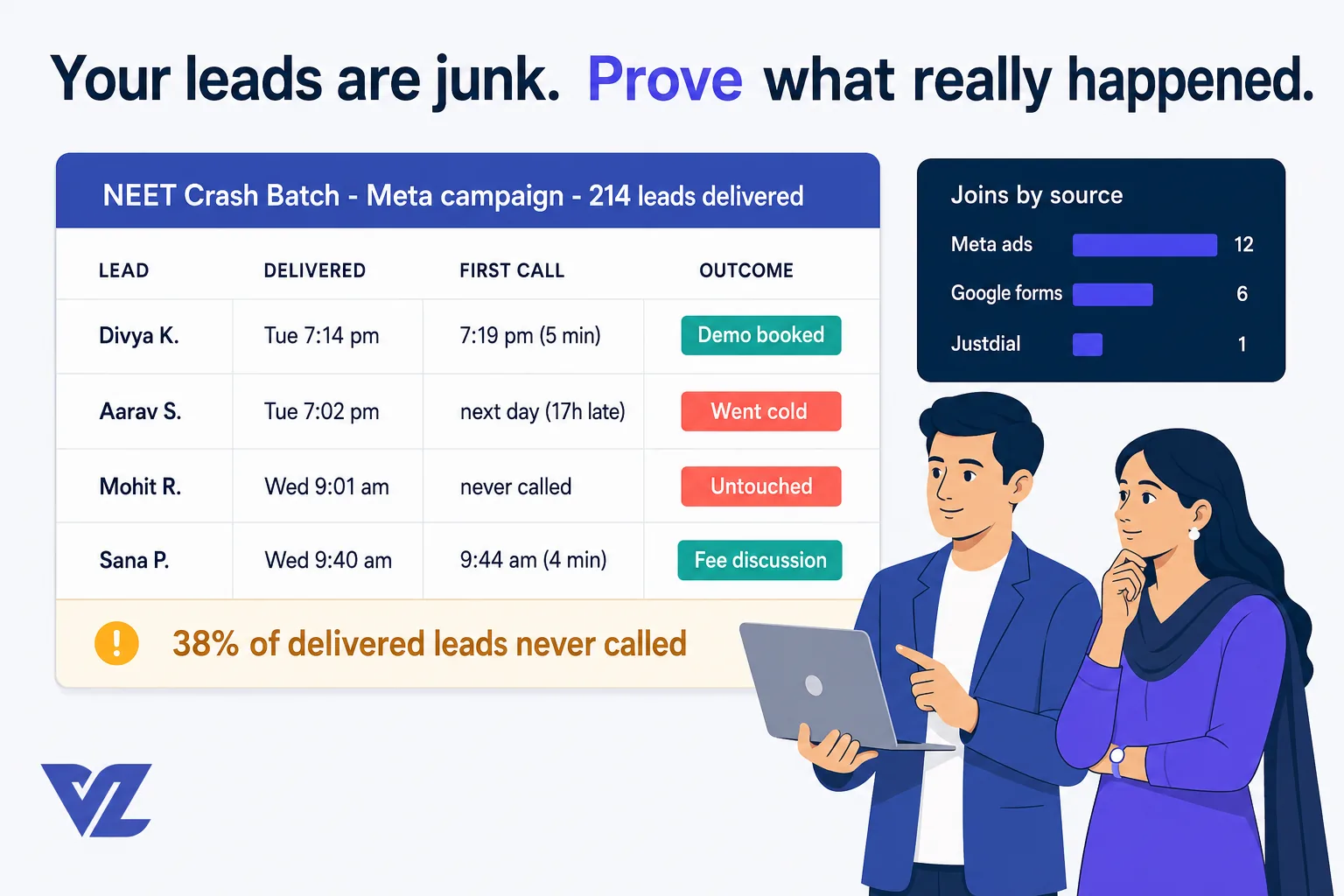
The Monthly Review Where Everyone Loses
It is the last Thursday of the month, and you are on a review call with your coaching client in Gurgaon, deck open: CTR up 31 percent, CPL down to Rs 62, 412 leads delivered against a target of 350. The centre head lets you finish, then says the sentence every account manager in Indian performance marketing has memorised: “Your leads are junk. My counsellors say there is not one serious student in the lot.” You scroll the deck for a defence and find nothing, because everything you brought proves delivery, and his accusation is about what happened after it.
Hold the outrage, because he has a version too. From the client’s chair, an agency dumped 200 unfiltered numbers into a Google Sheet and went quiet until invoice day. One founder on r/StartUpIndia described burning about Rs 18 lakh on a “top rated” agency with zero pipeline to show, then questioning his own product instead of his funnel. Both sides argue from the only data they can see, and neither dataset covers the crime scene.
The retainer gets decided by whoever tells the better story. It should get decided by evidence.
Why Ads Manager Can Never Settle This
Ads Manager answers one question: did the ads deliver? Impressions, CTR, CPL, forms filled. The moment a lead crosses into the client’s world, the report goes blind. It cannot tell you if anyone called, how fast, what the counsellor heard, or at which stage the lead quietly died. You are defending post-handoff outcomes with pre-handoff metrics, which is why the meeting never reaches a verdict.
The reporting-tool aisle does not fix it either. AgencyAnalytics runs about USD 20 per client per month and Whatagraph from around USD 229 a month, per their pricing pages as of Jul 2026 (verify on each vendor’s current page). They make prettier, white-labelled versions of the same ad-platform metrics, and none can produce a first-call timestamp or a counsellor’s disposition, because that data was never captured anywhere.
Now look at the client’s side of the fence. A 2011 Harvard Business Review audit of 2,241 US companies found the average first response to a web lead took 42 hours, and 23 percent of companies never responded at all. Agency owners know the plainer version: let a lead sit internally for two or three days and by the time the call comes the prospect has forgotten ever enquiring. If any of that is happening in your client’s counselling room, “your leads are junk” is a diagnosis made without an X-ray.
The Evidence Table That Ends the Argument
The fix is not a better ad report. It is a shared record, for every delivered lead, of five facts:
- Arrival: when the lead landed, tagged with its source and the exact Meta form and ad it came from.
- Ownership: who it was assigned to, and when.
- First touch: timestamp of the first call or WhatsApp, measured against arrival.
- Disposition: what each attempt produced: connected, wrong number, not reachable, counselling booked.
- Outcome: the pipeline stage where it died, or the batch it joined.
Here is an illustrative week from one coaching client’s account (details changed, results vary):
| Lead and source | Arrived | First touch | Disposition | Outcome |
|---|---|---|---|---|
| Meta lead ad, NEET ad A | Tue 7:42 pm | Call at 7:46 pm (4 min) | Connected, counselling booked | Joined, Rs 45,000 batch |
| Meta lead ad, NEET ad A | Tue 9:15 pm | Call next day, 4:10 pm (19 hrs) | “Not interested” | Dead at New |
| Meta lead ad, JEE ad B | Wed 11:05 am | None | None | Dead at New, untouched |
| Meta lead ad, JEE ad B | Wed 2:30 pm | WhatsApp 2:31 pm, call 2:39 pm | Wrong number | Junk, ad flagged |
| Website form | Thu 6:20 pm | Call next day, 10:05 am (16 hrs) | Not reachable, single attempt | Dead at Contacted |
Read it once and the monthly meeting changes shape. Ad A produced a Rs 45,000 admission at a four-minute response and a “not interested” at nineteen hours: same ad, same targeting, opposite handling. Ad B is throwing wrong numbers: that one is a genuine lead-quality problem, and now it has a name: fix that form and that audience instead of defending the whole account.
And proof cuts both ways, which is exactly why you should want it. Fake form fills are real; every agency has lived weeks where a painful share of entries is gibberish. Dispositions surface the junk pattern by ad within days. Our playbook on cutting junk leads in EdTech campaigns goes deeper. A client who watches you flag your own bad ad starts trusting your good ones.
Building the Layer in ViveLead, Honestly
Start with the honest architecture, because this is where vendors usually fudge. ViveLead has no agency portal, no white-label dashboard, and no multi-client view. The client runs their own ViveLead account, and your agency is added as a user with an RBAC role scoped to what the client is comfortable sharing. One seat inside each client’s CRM. That is the whole mechanism, and it is enough: the argument you need to win lives inside that account.
The wiring, fact by fact:
- Arrival, source-tagged. Connect the client’s Meta lead ads once and every lead lands in real time via webhook, with a cron fallback, carrying its source. No CSV downloads, no midnight syncs, no “the sheet did not update”. Setup walkthrough: Meta lead ads into ViveLead.
- First touch, timestamped. A workflow automation can send a pre-approved WhatsApp template the minute a lead arrives, through the official Meta API on the client’s own WhatsApp Business Account; Meta bills per delivered message directly, no markup from ViveLead. Calls and follow-ups log against the lead with timestamps, so internal rot finally has a clock on it. Full wiring guide: Meta lead ads to WhatsApp.
- Dispositions. With cloud telephony on the Business plan, every call attempt logs a disposition. On lower plans, counsellors record the outcome on the lead’s follow-up, slower but still evidence.
- Stages and source analytics. Deals, pipeline stages, and source-wise conversion analytics come with every plan from Starter at Rs 499/user/month: joins by source, not just leads by source. Funnel drop-off, also on every plan, shows the exact stage where each cohort dies. Configurable lead scoring (hot, warm, cold buckets, on Professional) keeps counsellors on the likeliest leads first.
Then put the SLA in writing before the first campaign: every new enquiry called inside five minutes, dispositions mandatory, a monthly joins-by-source review. HubSpot’s research claims companies with a written marketing-sales SLA are 34 percent likelier to report higher year-on-year ROI. Define a quality lead before the first rupee of spend, and for coaching clients tie it to counselling sessions and cost per enrolment.
The CAPI Loop: Proof That Also Pays
Here is where the evidence layer stops being defensive overhead. When a deal is marked closed-won in ViveLead, it posts back to Meta as a conversion event. Be precise about who does what: ViveLead does not optimise your campaigns. It supplies the truth signal, and Meta’s delivery system does the optimising, aimed at people who resemble the students who actually joined, not everyone willing to fill a form.
Meta’s own advertiser numbers, quoted in its partner materials, claim roughly 21 percent lower cost per quality lead on lead ads campaigns using CRM conversion feedback, and about 9.5 percent on website-form campaigns. Treat those as Meta’s claims about Meta’s product. Its developer documentation also publishes the bar for the conversion leads goal: around 200 leads a month, conversion events uploaded at least daily, an optimised funnel stage reached within 28 days, a stage conversion rate between 1 and 40 percent, and matching via the Meta lead ID or phone and email.
For the agency, this rewires the renewal pitch. “We optimise on admissions, not form fills” is an argument a competitor without CRM access cannot copy: they have no join data to feed back. The same table that defends you in the review meeting is teaching the algorithm what a good lead looks like.
Most Junk Leads Were Just Called Late
One stat explains half the junk verdicts you have ever received. The Lead Response Management study led by Dr James Oldroyd at MIT Sloan, built on more than 15,000 leads and 100,000 call attempts, found the odds of contacting a lead called within five minutes versus thirty were about 100 times higher, and the odds of qualifying it about 21 times higher. A lead called nineteen hours late behaves exactly like a junk lead: cold, surprised, “not interested”. The counsellor is not lying about what she heard. She is describing the symptom of her own response time.
When the table shows first touches averaging a day, do not gloat. Fix it: an arrival-triggered WhatsApp template, distribution rules so every enquiry has an owner in seconds, and a five-minute calling SLA the client’s team signs. The full operating drill is in the speed-to-lead playbook for coaching centres.
Where ViveLead Does Not Fit Here
Plainly, so nobody buys the wrong thing: ViveLead is not an agency-reporting tool. It will not show ROAS across twenty ad accounts, it will not white-label a monthly client PDF, and an agency running twenty clients still needs its own reporting stack for the spend side. This is the post-handoff truth layer inside each client’s CRM, one account per client, your agency present as a role-scoped user. And one thing no software fixes: if the client’s team refuses to work leads inside any system, the evidence layer never gets its data, and that retainer is already lost. Walk away, or renegotiate the scope so follow-up becomes somebody’s paid, measured job.
What the Evidence Layer Costs
The client pays for their own CRM, and at these prices it is a sellable line item beside a Rs 1,00,000 monthly ad budget:
- Starter, Rs 499/user/month: lead capture from website forms with sources attached, timestamped follow-ups, pipelines and stages, source-wise conversion and funnel drop-off reports, RBAC roles, mobile app.
- Professional, Rs 999/user/month: Meta lead ads capture, WhatsApp Business via the official Meta API (Meta bills per delivered message directly, no markup), workflow automations, configurable lead scoring, and the lead capture API.
- Business, Rs 1,699/user/month: cloud telephony with logged dispositions, the AI agents, audit logs, and payment collection.
- HRMS and payroll is an optional add-on at +Rs 99/user/month (Rs 79 yearly) on any plan. Billed quarterly the rates are Rs 499, Rs 999 and Rs 1,699 per user per month; billed yearly they are Rs 399, Rs 799 and Rs 1,359. Seven-day trial, no credit card. Full detail on the pricing page.
Contrast the incumbent path: LeadSquared runs Rs 2,500 to Rs 5,000 per user per month plus GST on annual contracts, per their published pricing (read from India on their pricing page, 27 September 2026). A small agency cannot casually stand that up for every coaching client. At Rs 499 a seat, billed quarterly, it can.
Whoever Owns the Evidence Owns the Renewal
The lead-quality fight is unwinnable inside Ads Manager because the fight was never about ads. It is about the missing forty hours between a form fill and the first call. Put a shared evidence layer inside each client’s CRM and the monthly blame meeting becomes a five-minute review with two endings: the client’s team fixes its response time, or you fix a specific ad. Both endings save the retainer. Start with one client this intake season, before the next “your leads are junk” call lands.
Frequently Asked Questions
Lead Quality Proof FAQs
What agency founders ask about proving lead quality
Related reading
End the Lead Quality Blame Game
Put one client on a shared evidence layer this week: real-time Meta lead capture, timestamped follow-ups, joins by source, and an RBAC seat for your agency. Professional at Rs 999/user/month. No credit card required.
Continue Reading
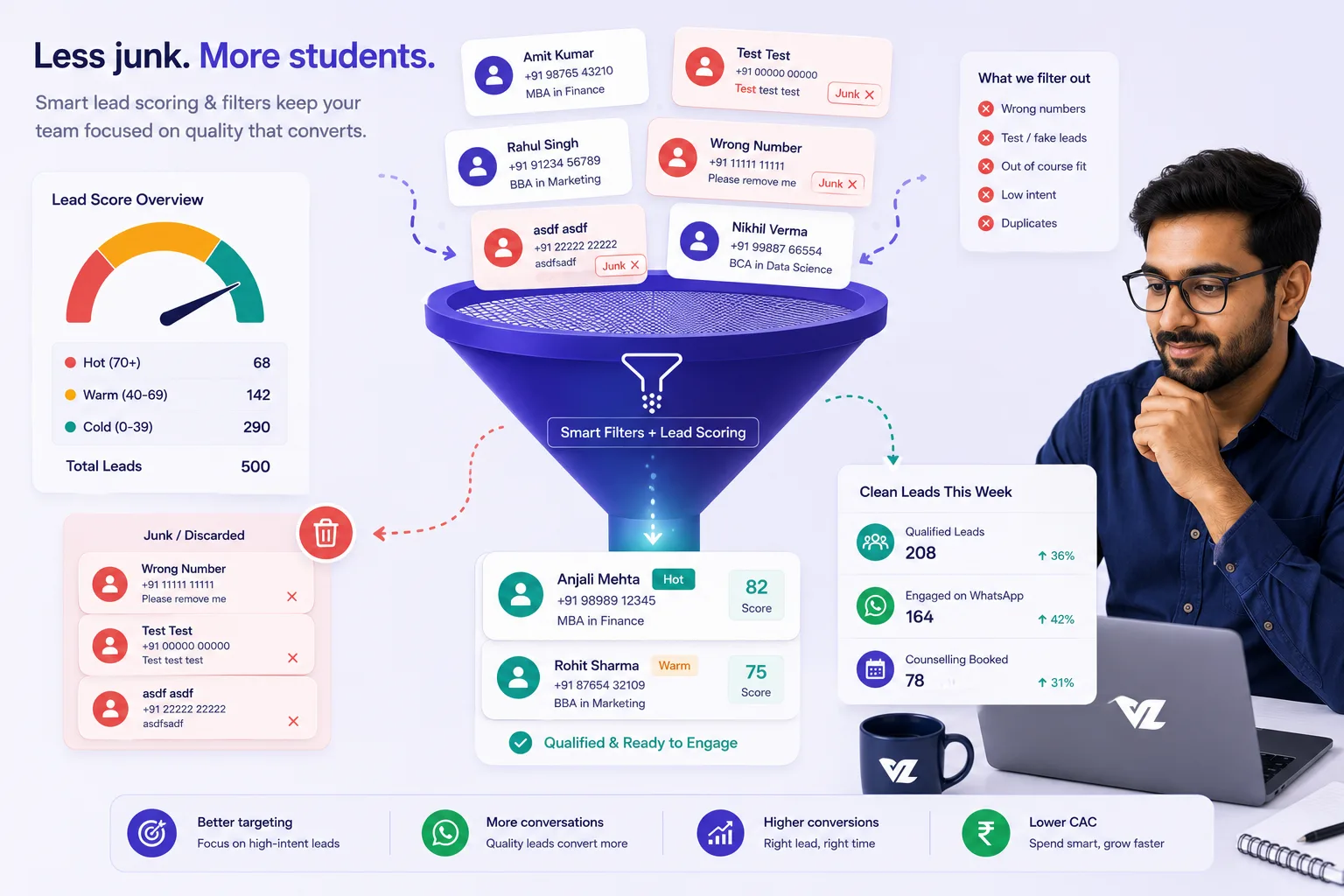
Reduce Junk Leads in EdTech Without Killing Your Pipeline
How to reduce junk leads from EdTech Meta ads: score, filter, route, and kill the bad source. Stop counting CPL, start …
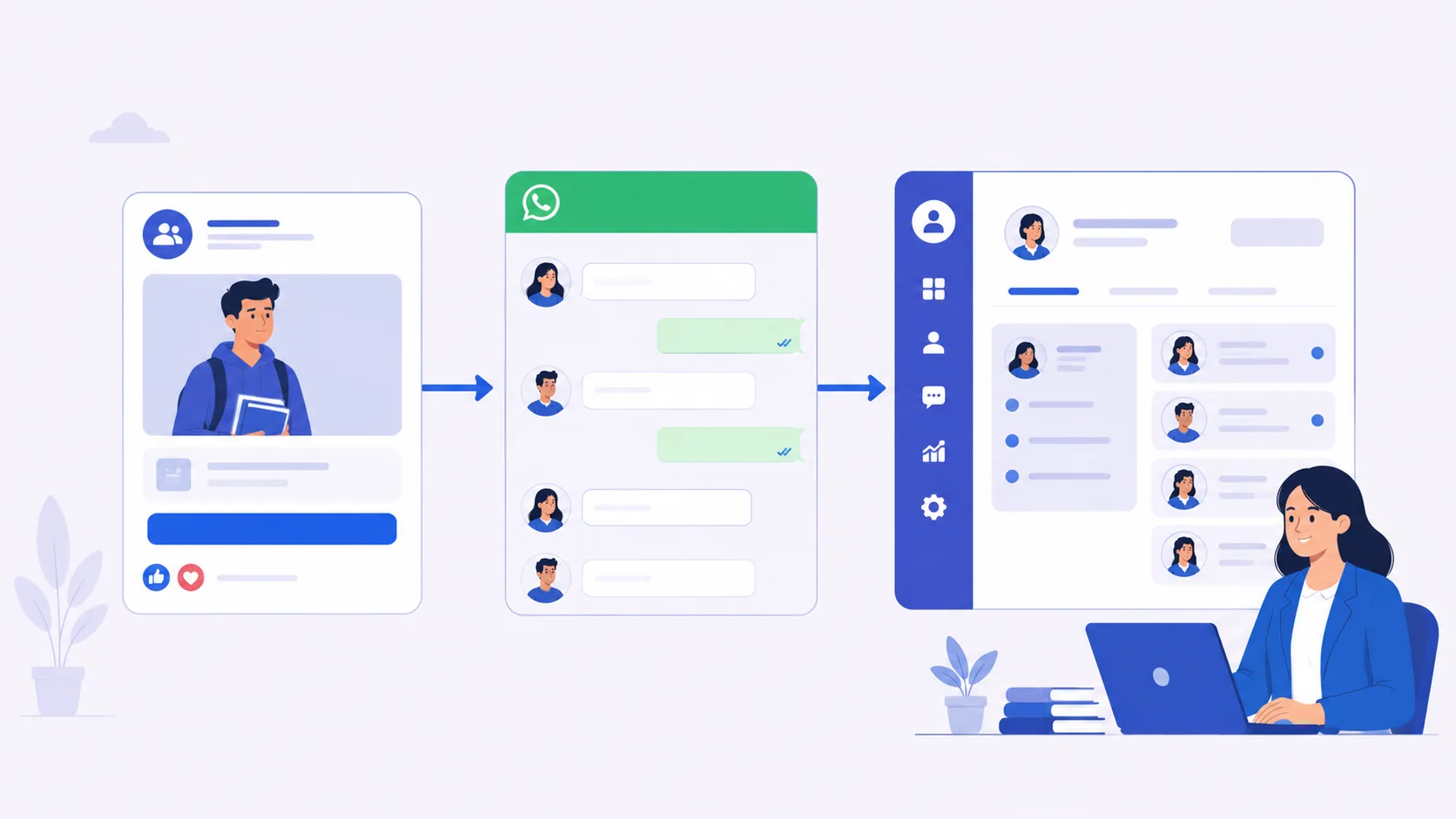
Sync Meta Lead Ads to WhatsApp CRM Natively | ViveLead
Sync Meta lead ads to a WhatsApp CRM the right way: native capture, no BSP markup, own your WABA. India and EdTech …
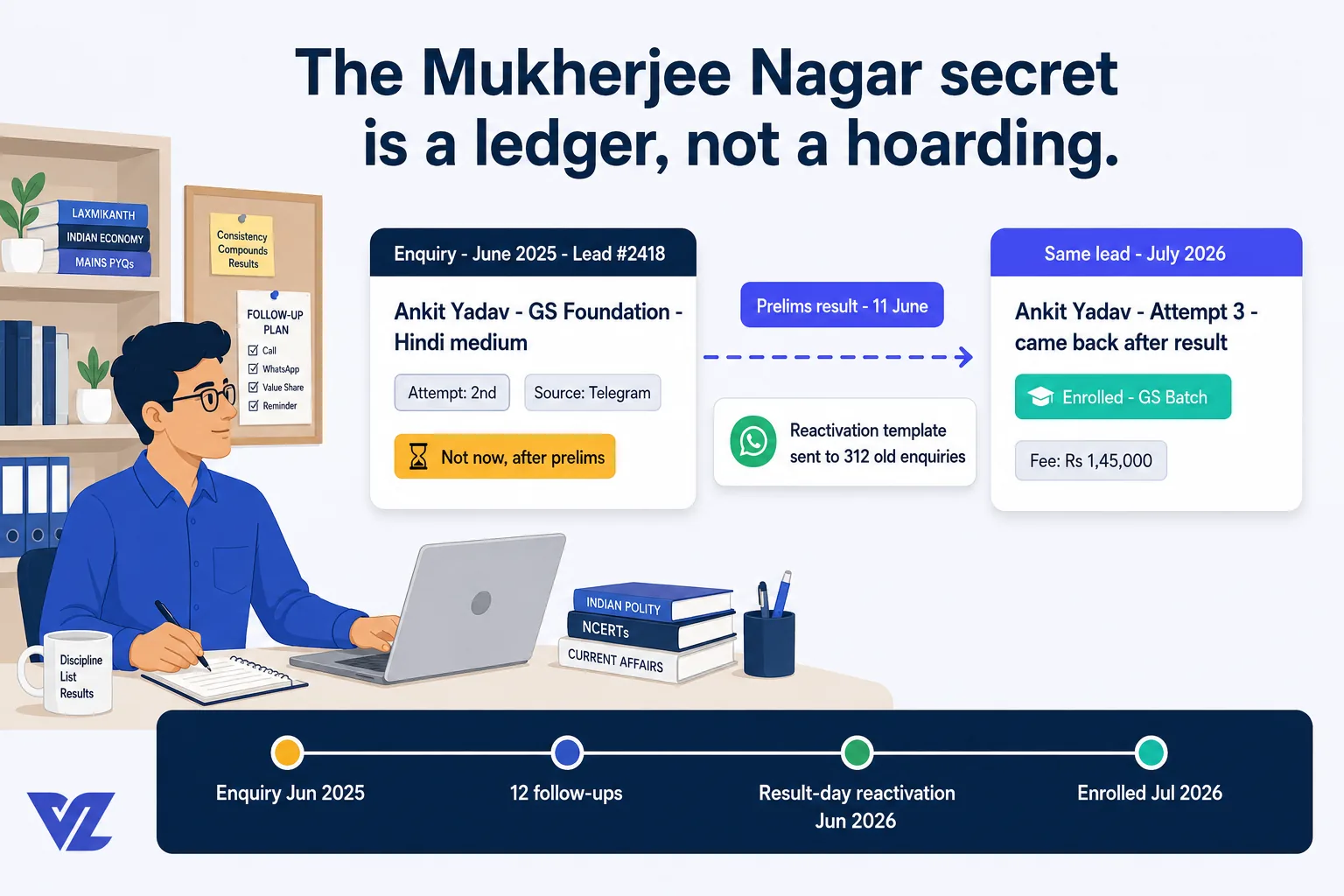
Mukherjee Nagar Secret: UPSC Coaching Center CRM
UPSC coaching center CRM Delhi: 90% of selections take multiple attempts. The follow-up ledger, not topper ads, fills …