Reduce Junk Leads in EdTech Without Killing Your Pipeline
How to reduce junk leads from EdTech Meta ads: score, filter, route, and kill the bad source. Stop counting CPL, start counting cost-per-qualified-lead.

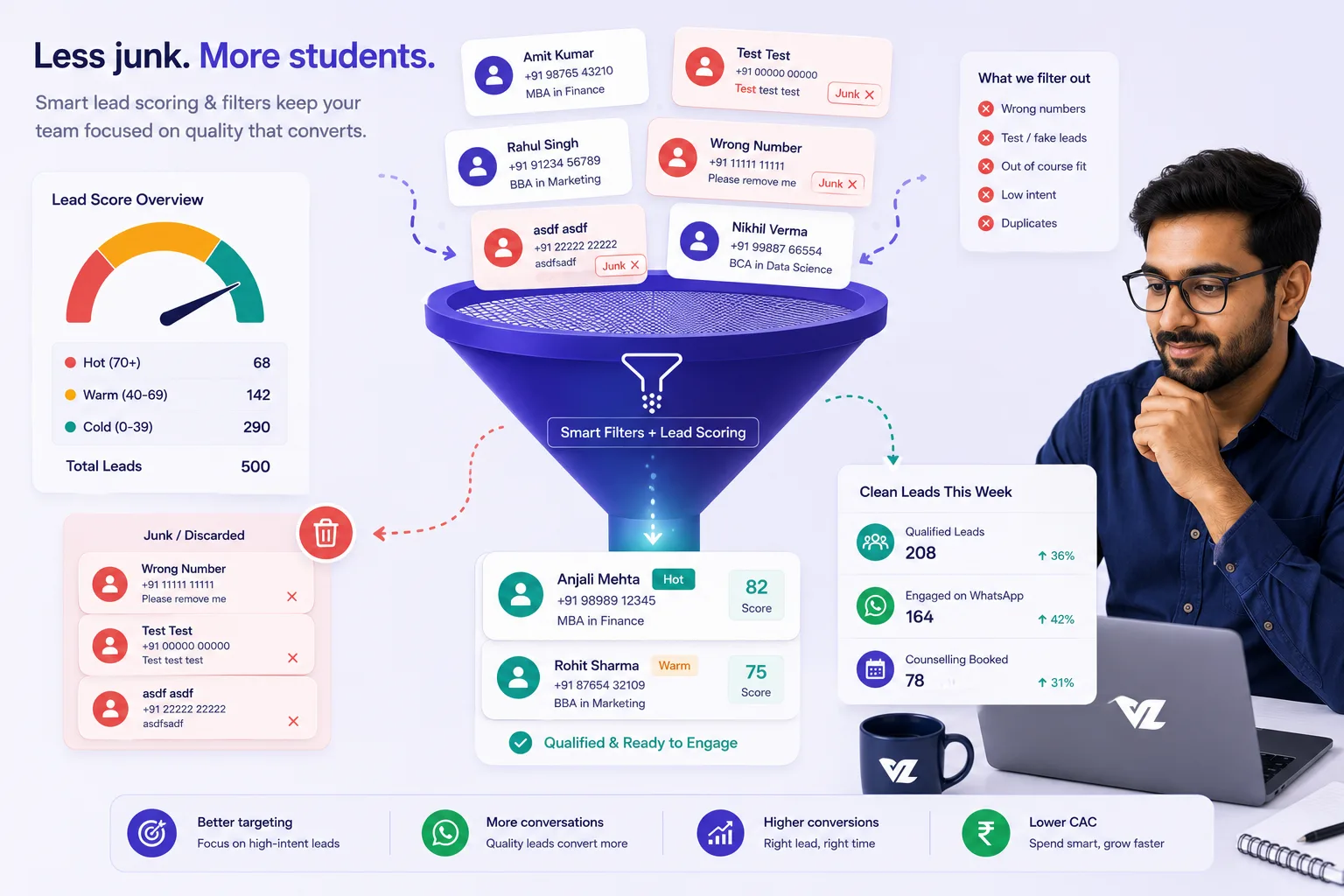
The dashboard says “leads.” The counsellor floor says “ghosts.”
It is 10am at a coaching institute. The Meta dashboard glows green: 34 fresh leads overnight, cost-per-lead under Rs 120, the agency is thrilled. Then the counsellor opens the list and starts dialling. Switched off. Wrong number. “Bhai galti se ho gaya tha.” Not interested, never was. A 14-year-old who filled the form because the ad had a meme. Five dead calls before one genuine parent picks up. By lead 20 she has stopped trying, and by next week she has stopped trusting the list at all.
That is the real cost of junk. It is not just wasted ad spend, it demoralises the floor and trains your best counsellors to ignore the very leads you paid for. A common texture from Indian agencies, illustrative and not an audited figure: Rs 10,000 spent, 800 clicks, three WhatsApp replies, two of them just price-askers. Four junk types poison every EdTech pipeline: wrong numbers, not-interested taps, accidental two-tap fills, and bored teenagers.
Here is the thesis, and I will repeat it because it is the whole blog. You will never hit zero junk. The fix is not more leads and not one clever trick, it is a five-layer pipeline plus measuring the right number. A realistic target is cutting junk from around 40 percent down to roughly 15 percent, not to zero.
Why your Meta “lead” is junk before it ever rings
The instant form is two taps, so junk is the default
A Meta instant form is two taps, profile-prefilled, no typing. That is brilliant for volume and terrible for intent. A mis-scroll or a bored teenager becomes a “lead” they do not even remember sending, so a wrong number is not a glitch, it is the default output of a zero-friction form. I am not going to re-teach instant-form versus Click-to-WhatsApp mechanics here. We covered that in depth in how to sync Meta lead ads to a WhatsApp CRM. This blog assumes you have already proven it is the leads, not your follow-up speed, and you want the junk-reduction machinery.
Advantage+ and Audience Network is where cheap accidental fills are born
When an agency says “I put you on Advantage+ automatic placements, it’s cheaper,” that cheapness has a source. Audience Network pushes your ad into third-party apps and games, where a reward-click or a fat-thumb tap on a game becomes a form-fill. One industry estimate puts invalid traffic and placement fraud on these placements as high as 67 percent. Treat that as directional, not gospel: the source is not independently named, so it is an estimate, not an audited figure. The fix most owners have never heard: switch to manual placements, uncheck Audience Network, and keep Facebook and Instagram feed, Stories, and Reels. This lives inside Meta Ads Manager. ViveLead does not and cannot do this for you. That is an honest boundary, and I will draw it again later.
Even 15 to 20 percent fake is enough to poison everything
You do not need a flood of junk to break your model. Practitioners (ClickFortify among them) point out that even a 15 to 20 percent fake-lead rate bends your whole campaign, because you are now optimising both ad spend and counsellor hours against poison data. Worked example: 60 leads a week, 12 of them fake, is a 20 percent fraud rate quietly distorting every decision you make about budget and staffing.
Stop optimising the wrong number: CPL vs cost-per-qualified-lead
This is the section no rival tool talks about, and it is the wedge. Most institutes optimise cost-per-lead because that is the number Meta shows them. That number lies.
There is a well-travelled story from a digital-marketing manager, illustrative and your numbers will differ: he proudly reported a 2.50 dollar cost-per-lead, then sales could not reach 80 percent of those leads, so the real cost-per-qualified-lead was 87 dollars. A 35x gap between the number on the dashboard and the number that pays salaries. Localise it honestly. An institute proud of a Rs 120 CPL, once you strip out the wrong numbers and the not-interesteds, is really paying many multiples of that per reachable, interested lead.
For grounding, India EdTech cost-per-lead anchors as researched ranges, label them and check your own: roughly Rs 80 to Rs 250 is typical, Rs 180 to Rs 450 for competitive service-style or higher-education leads, and higher still for tier-1 JEE and NEET (sources cited around this topic include DigitalMarketingSage and AdLabs). The mindset shift is the entire game: a Rs 250 lead that enrols beats fifty Rs 5 leads that never answer. Stop celebrating the cheap number.
So compute cost-per-qualified-lead from your own data: spend divided by leads that are reachable and interested, not spend divided by every form-fill. To see CPQL per source instead of one blended average, you need source-wise conversion analytics, which on ViveLead comes with every plan, from Starter at Rs 499/user/month. That visibility is what makes Layer 5 possible.
The five-layer junk pipeline
Every rival tool does one layer well. A BSP gives you a WhatsApp auto-reply. A point tool gives you a scoring rule. An ad agency tweaks the form. None of them connect all five layers for the Indian coaching reality, where the lead, the score, the WhatsApp reply, the counsellor routing, and the source report have to live in one place or the loop never closes. Here is the full pipeline.
Layer 1: Tighten the ad so less junk gets created (this one is on you)
The cheapest junk reduction happens before the lead exists, and it happens in Meta Ads Manager, not in any CRM. Switch the campaign objective from more-volume to higher-intent, and add exactly one qualifying question: which class is the student in, which exam are they targeting, which city. That single question makes a bored teenager bounce and makes a serious parent self-select.
Now pre-empt the objection I hear every single time: “I added qualifying questions and my leads dried up.” Yes, they did, on purpose. Switching from more-volume to higher-intent typically drops raw volume by roughly 20 to 30 percent (a range agencies and practitioners like AdLabs and ClickFortify commonly cite). You are losing the mis-taps, not the buyers. Quality climbs, cost-per-qualified-lead falls even as cost-per-lead rises. Tell your team this in advance, or they will panic at the lower number and switch the question back off, and the junk returns the next morning. And again: uncheck Audience Network, use manual placements. ViveLead cannot do any of this for you. This is your job inside Meta Ads Manager.
Layer 2: Catch every lead instantly and auto-tag its source
The moment a form is submitted, the lead must land in the CRM tagged with its exact campaign and source, automatically. If you do not capture the source at the instant of creation, you can never kill the bad source later, because by the time you notice a campaign is junk, you will not be able to prove which leads came from it. In ViveLead, website-form capture is on the Starter plan at Rs 499/user/month and Meta lead-ad capture on Professional at Rs 999, and source tagging is automatic.
One honest line so this does not sound like a silver bullet: catching junk fast still leaves you holding junk. Capture on its own does nothing to reduce junk, it just files it neatly. That is precisely why layers 3, 4, and 5 exist.
Layer 3: Score hot, warm, cold so junk auto-separates from real
This layer has two halves, and together they are where junk quietly sorts itself out.
First, lead scoring. Configurable hot, warm, and cold buckets on the ViveLead Professional plan at Rs 999/user/month separate likely-real from likely-junk on signals you define, so a counsellor is never staring at an undifferentiated wall of 34 names again.
Second, the WhatsApp auto-acknowledgement, used as a filter, not a greeting. Pre-empt the objection: “WhatsApp auto-reply is just spam.” Reframe it. When a lead lands and instantly gets “Hi, thanks for your enquiry about the NEET batch, which class is the student in?”, a real parent replies. A fake number, a mis-tap, a bored teenager never replies. The non-reply is the signal. That silence auto-tags the lead cold and pulls it out of your counsellor’s queue without anyone lifting a finger. Speed matters here: the auto-acknowledgement has to be instant, because the widely cited MIT Lead Response Management study found a lead contacted within five minutes is far likelier to qualify than one contacted at thirty (we unpack that speed argument fully in the Meta lead ads to WhatsApp CRM guide).
The WhatsApp here is the official Meta WhatsApp Business (Cloud) API: you connect your own WhatsApp Business Account, with templates, broadcasts, and a shared team inbox, on Professional at Rs 999/user/month. Meta bills you per delivered message directly to your own account (the per-message model live since July 2025), and ViveLead adds no markup. One honest cost note that becomes the bridge to Layer 5: a junky campaign makes you pay Meta per message to text numbers that never answer.
Layer 4: Route only qualified leads to counsellors
Here is the counsellor-floor reality. One tele-calling vendor (TeleCRM) frames it bluntly: a counsellor managing 100 leads manually will drop half of them. Add peak intake-season flooding and the floor simply dials top to bottom through junk until morale dies. Lead-distribution rules plus conversion config on the ViveLead Professional plan at Rs 999/user/month send only scored-qualified leads to counsellors, split by territory or course, so nobody grinds through ghosts. The human payoff is the whole point: she now calls 8 real leads instead of 34, and because the list is finally trustworthy, she stops ignoring it.
Now the honest calling boundary, because Layer 4 is about phones and this is the easiest place to over-claim. If you want to verify counsellors actually called the leads you flagged, the ViveLead Android app logs calls made from the rep’s own phone SIM, with recording, so every call ties back to the lead automatically. That is Android only, since iOS restricts call-log access, and it is logging and verification, not dialing. ViveLead does not auto-dial through the rep’s SIM. If you want cloud calling, that is Twilio click-to-call (not a power dialer), billed per use, on the Business plan at Rs 1,699/user/month, your number or ours, billed accordingly. The dialer is cloud telephony, not a SIM-based background dialer. Keep those two ideas separate or you will set the wrong expectation with your team.
Layer 5: Kill the source that only brings junk
This is the loop that actually pays you back. Source-wise conversion analytics, on every ViveLead plan, shows conversion by source and campaign, so you can see the campaign that brings volume but zero enrolments and switch it off, instead of buying more WhatsApp credits to keep messaging dead numbers.
Remember the per-message economics from Layer 3. A junky source is double-expensive: you pay for the ad, and then you pay Meta per message to chase numbers that never reply. So the real fix when a source goes bad is to kill the source, not to top up credits and dial harder. That is the difference between a pipeline that compounds and one that just leaks faster.
Why a chatbot-only or scoring-only tool does not fix this
The whole field is weak in the same way: each rival owns one layer and leaves you to stitch the rest.
WhatsApp BSPs like Wati, Interakt, and AiSensy give you Layer 3’s auto-reply, but in a silo. You pay a monthly platform fee (AiSensy is free, or from Rs 1,500 a month, on its own pricing page in September 2026; check Wati’s and Interakt’s current pages for theirs) plus Meta’s per-message pass-through, and the qualification that happens in WhatsApp does not flow into the counsellor’s pipeline without yet another integration. You end up paying a platform fee to message numbers that never answer.
LeadSquared is the EdTech-junk incumbent, with strong scoring and high-velocity tele-calling, but it is priced as a heavy sales-execution platform: Sales Pro at Rs 2,500 and Sales Super at Rs 5,000 per user per month, billed annually plus 18 percent GST (read from India on their pricing page, 27 September 2026). A 10-seat single-branch institute on Pro is around Rs 3 lakh a year plus GST for a machine most coaching SMBs over-buy. We go deeper on that in the EdTech CRM fatal flaws breakdown. Zoho CRM is cheap (roughly Rs 800 to Rs 1,400) but stitching Meta to WhatsApp to scoring across modules and Zoho Flow is a DIY project. Salesforce and HubSpot Professional start around Rs 7,500 per user, with junk control buried in marketing-automation tiers no coaching SMB licenses, the textbook wrong tool.
| Layer | BSP (Wati/Interakt/AiSensy) | LeadSquared | Zoho CRM | ViveLead |
|---|---|---|---|---|
| Lead capture + auto source tag | Partial | Yes | Yes (DIY across modules) | Yes (Starter Rs 499) |
| Lead scoring hot/warm/cold | No | Yes | Add-on/DIY | Yes (Professional Rs 999) |
| WhatsApp official-API auto-ack | Yes (siloed) | Add-on | DIY | Yes (Professional Rs 999) |
| Route only qualified leads | No | Yes | DIY | Yes (Professional Rs 999) |
| Cost-per-qualified-lead by source | No | Yes | DIY | Yes (Professional Rs 999) |
| All five in one system | No | Yes (heavy) | No | Yes |
| India entry price per user/mo | ~Rs 1,699 to 3,200+ fee | Rs 2,500 to 5,000 +GST, annual | ~Rs 800 to 1,400 | Rs 499 / Rs 999 |
Prices above are researched 2026 ranges, check current vendor pages. To be clear about what ViveLead is: a CRM that captures, scores, routes, and reports on leads as one connected system. It is not an LMS, an ERP, or a marketing-automation suite, and it does not replace them. The claim is “one connected system for the junk pipeline,” not “one tool for everything in your institute.”
What this still will not do
I am ending on the honesty spine, because the credibility of everything above depends on it.
First, you cannot hit zero junk. The realistic target is around 15 percent, not 0 percent. Anyone selling you zero is selling you a fantasy.
Second, ViveLead does not block junk at Meta. You still set the higher-intent form, add the qualifying question, and turn Audience Network off inside Meta Ads Manager yourself. ViveLead is the system that catches, scores, filters, routes, and reports what gets through, and that tells you which source to kill.
Third, the Android SIM call logging verifies that calls happened, with recording. It does not auto-dial. ViveLead’s cloud calling is Twilio click-to-call on the Business plan, not the rep’s SIM, and it is not a power dialer either.
On data handling, since you are storing parents’ and students’ phone numbers: lead data is handled per Indian norms, with SSL and AES-256 encryption and role-based access control, and the DPDP Act 2023 is the Indian law that governs this. We do not claim SOC 2, ISO 27001, or FERPA.
The goal was never fewer leads on a dashboard. It was a counsellor floor that trusts the list again, and a lower cost-per-qualified-lead. Count that number, build the five layers, and kill the source that keeps feeding you ghosts.
Reducing Junk Leads in EdTech: FAQs
Cost-per-qualified-lead, lead scoring, WhatsApp filtering, source-kill, and ViveLead pricing for Indian coaching and EdTech teams
Related reading
- Sync Meta lead ads to a WhatsApp CRM natively: the instant-form mechanics, the five-minute rule, and the BSP markup behind Layer 1 and Layer 3.
- Turn an EdTech enquiry into an enrolment in India: what happens to the qualified lead after Layer 4 routes it to a counsellor.
- The shared WhatsApp inbox for EdTech teams: how the team inbox in Layer 3 keeps counsellors from stepping on each other.
- Best EdTech CRM fatal flaws: why the LeadSquared-class platforms get over-bought by single-branch institutes.
- ViveLead pricing: Starter Rs 499, Professional Rs 999, Business Rs 1,699 per user/month, with a 3-day free trial and no credit card.
Build a junk pipeline your counsellors trust
Lead scoring, WhatsApp filter, and routing on Professional at Rs 999/user/month, with source-wise analytics on every plan. Capture on Starter at Rs 499. No credit card required.
Continue Reading
Sync Meta Lead Ads to WhatsApp CRM Natively | ViveLead
Sync Meta lead ads to a WhatsApp CRM the right way: native capture, no BSP markup, own your WABA. India and EdTech …
Increase Student Enrollment in EdTech: Math, Not Ad Spend
Increase student enrollment without more ad budget: six conversion levers, the enrollment-lift math, and the ViveLead …
The Hidden HubSpot for Education Middleware Tax | ViveLead
HubSpot for education hides a middleware tax: Data Hub flat fee, a second WhatsApp tool, SIS connectors and onboarding. …