How to Optimize Speed to Lead for Coaching Centers
How to optimize speed to lead for coaching centers: the 8:30 pm self-audit, the results-season capacity math, and a 5-layer under-5-minute system in INR.

Fill Your Own Enquiry Form Tonight at 8:30 pm
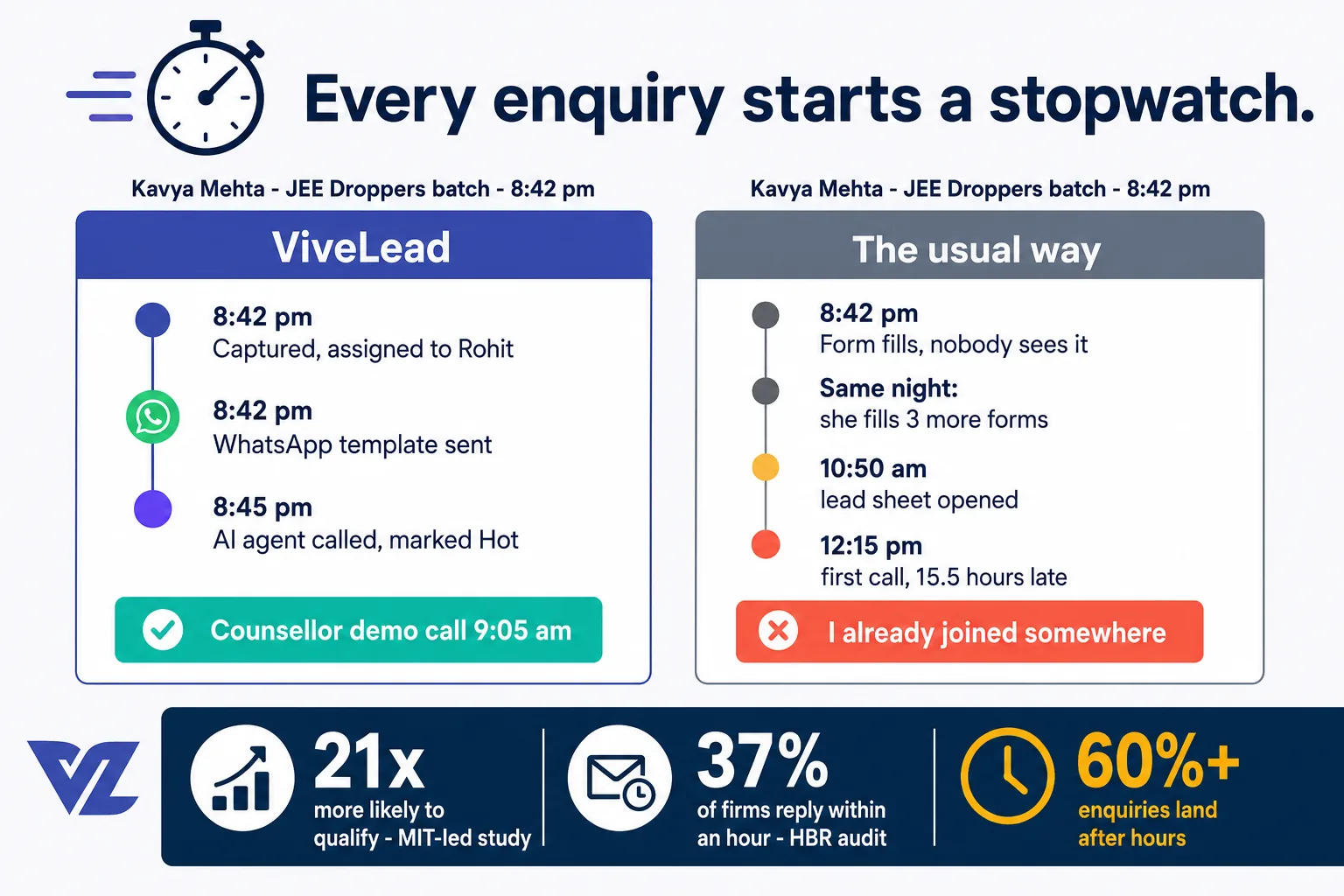
Tonight at 8:30 pm, open the enquiry form you pay to run, your Meta lead ad or the form on your website, and fill it from a family member’s number. Use a believable story: a Class 11 science student, a parent asking about the NEET dropper batch. Note the time, keep the phone nearby, and see how long the first reply takes to arrive, a call, a WhatsApp, anything human.
Most coaching owners have never run this test on their own institute. Harvard Business Review ran it at scale in a March 2011 study, “The Short Life of Online Sales Leads”: researchers sent a test web lead to 2,241 companies and timed the responses. Only 37 percent replied within an hour. 23 percent never replied at all. Vendor surveys in this industry like to claim the average Indian institute takes 8 to 12 hours to respond; that figure has no traceable primary source, so ignore it and measure your own number instead.
Owners who run the 8:30 pm test stop arguing about whether they have a speed problem. A reply that lands at 11:20 the next morning ends the debate better than any consultant. So here is the claim this article defends: speed to lead, the gap between an enquiry landing and your first real response, is the highest-leverage number in your admissions funnel. Not the brochure, not the hoardings, not one more counsellor. The clock.
What Five Minutes Is Worth in Hard Numbers
The foundational research here is the Lead Response Management study, run by Dr. James Oldroyd, then at MIT, with InsideSales.com in 2007. Two findings matter at an admissions desk. Contact a new lead within five minutes and you are roughly 21 times more likely to qualify them than if you first call at the 30-minute mark. And your odds of making contact at all are around 100 times better in those first minutes than if you wait a day, because the person is still holding the phone, still thinking about your course.
Velocify’s analysis of roughly 3.5 million leads (vendor research, so read it as vendor research) puts a number on the extreme end: responding within one minute lifted conversion by up to 391 percent. The same white paper found 93 percent of leads that eventually converted were reached by the sixth call attempt, which quietly indicts the standard counsellor habit of dialling once, hearing no answer, and moving on forever.
Now map that onto your desk. A parent who fills your form at 8:47 pm is sitting with a shortlist, and admissions blogs describe the behaviour plainly: a student who fills one form often fills three or four more in the same hour. The institute that responds while the family is still comparing gets a conversation. Everyone else gets “we have already decided”. On a Rs 1 lakh to Rs 3 lakh enrolment decision, the difference between four minutes and four hours is not a service metric. It is the admission itself.
If you buy leads from Justdial or Sulekha, it is starker still, because those enquiries are not exclusive. The same parent’s number goes to several institutes at once. You are in a literal race with rivals holding the identical lead, and the fastest first call wins an enquiry all of you paid for.
Your Counsellors Are Not Lazy. Your System Has No Clock.
The default diagnosis is discipline. The owner sees enquiries answered late, calls a Monday meeting, and delivers the speech about seriousness. Three weeks later nothing has changed, because the diagnosis was wrong. Look at the capacity maths before you look at the people.
Results season multiplies enquiry volume 3 to 8 times for six to eight weeks. Those figures come from vendor content in this market, so treat them as directional, but any owner who has lived a results week knows the shape: an institute doing 50 enquiries a day wakes up the morning after JEE Main results to several hundred. Class 11 admissions stack up through April and May, dropper-batch enquiries pile in through June and July, and your counsellor headcount, hired for November volume, does not change.
A counsellor juggling 50 to 100 enquiries a day drops half of them. Not the weak half, just half. She is mid-call at 6:10 pm when four new forms land; by the time she finishes, two more. No amount of sincerity survives that arithmetic.
Then the clock problem. Over 60 percent of education enquiries arrive outside standard business hours, a figure attributed to ICEF Monitor in industry roundups, and it will match what your own form timestamps show. Families discuss coaching after dinner. Your desk closes at 7 pm. The enquiry peak starts at 8. Scolding your team at 10 am about a lead that went cold at 9:15 the previous night is theatre, not management.
Which brings us to the second claim, the one that changes what you should buy: slow response is a capacity and plumbing problem, not a discipline problem. You cannot scold your way to a five-minute first response during results season. You build a system that does not depend on anyone remembering.
The Under-5-Minute System, in Five Layers
This is how you optimize speed to lead for a coaching centre: five layers, mapped to what ViveLead actually ships, none of which requires a counsellor to remember anything.
Layer 1: Capture the enquiry the second it exists
The first leak happens before anyone could even call: Meta leads sitting inside Ads Manager until somebody remembers to download a CSV at 11 pm. In ViveLead, Meta lead ads land in the CRM through a real-time webhook (with a cron fallback behind it), website forms post straight in, and Forms Desk gives you hosted public enquiry forms for the front desk. The moment the parent hits submit, the lead exists in the CRM with its source and timestamp. Nobody downloads anything. If your current process involves a CSV, start here; the wiring is covered step by step in Meta lead ads to WhatsApp.
Layer 2: Give every lead an owner within seconds
A lead nobody owns is a lead nobody calls. Lead distribution rules assign every new enquiry automatically the moment it arrives, round-robin across your counsellors. “I thought Priya was handling the Justdial ones” dies as a sentence. There is no unowned pool where enquiries quietly rot; every lead lands with a name attached, in seconds, at 2 pm or 2 am.
Layer 3: Say something at hour zero, on WhatsApp
You cannot staff 11 pm. You can still answer it. On ViveLead, WhatsApp Business runs on the official Meta API against your own WhatsApp Business Account, and a workflow automation fires an approved template the instant a lead lands: batch details, a fee range, a brochure link, and “a counsellor will call you shortly”. One honesty note the category skips: templates need Meta’s approval before they can send, so write and submit yours before results week, not during it. On cost, Meta bills its message charges per delivered message directly to your account, and ViveLead adds no markup. The acknowledgment does not sell the seat. It buys you minutes and holds the family’s attention while a human gets free. The full playbook is in WhatsApp CRM for coaching institutes.
Layer 4: Make the first-call SLA visible
An SLA nobody can see is a wall poster. In ViveLead the Follow Ups queue puts a first-call task on every new lead, so the morning screen shows exactly which calls are overdue and whose they are. Lead scoring sorts enquiries into configurable hot, warm, and cold buckets, so the dropper-batch parent asking about fees outranks a vague “maybe next year”. And source-wise conversion analytics settle the question owners usually argue from gossip: which source’s leads rot. If Justdial leads convert at a third the rate of Meta leads, the report says so in numbers, and the Follow Ups queue shows exactly which enquiries are still waiting for their first call. Counsellor accountability turns into a dashboard instead of a lecture, and if half a source’s leads are junk, triage that source rather than letting it bury the real ones.
Layer 5: When every human is at capacity, the AI makes the first call
Results week, 9:40 pm. Every counsellor is home, and four enquiries just landed. This is the layer built for exactly that moment: through a workflow automation, ViveLead’s AI voice agent places the first call itself within minutes of capture. The delay is configurable, which makes it your speed-to-lead SLA knob. Nobody can honestly promise a guaranteed response in X seconds, and we will not, but “within minutes, at any volume, on any evening” is a promise a machine can keep and a human roster cannot.
The agent speaks Hindi and English, asks the qualification questions you define (class, target exam, preferred batch timing, city), and writes the answers plus the full call transcript onto the lead record. Lead scoring and routing then run on the result, so your counsellor opens a lead that reads “Class 12, NEET dropper, evening batch” instead of a bare phone number. And to be clear about the boundary: it qualifies and hands over to your counsellor; it does not close admissions, and you should not want it to. Each call is billed from an in-app AI wallet: the AI model’s usage plus the phone line at Rs 4.75 per minute.
The Layers, Mapped to Plans and Prices
| Layer | What it kills | Where it lives in ViveLead | Plan |
|---|---|---|---|
| 1. Instant capture | The 11 pm CSV download | Website forms, Forms Desk; Meta lead ads real-time webhook | Starter, Rs 499/user/month (Meta lead ads on Professional, Rs 999) |
| 2. Auto-assignment | The unowned lead pool | Lead distribution rules, round-robin | Professional, Rs 999/user/month |
| 3. Hour-zero acknowledgment | Silence while the family shops | Approved WhatsApp template fired by workflow automation | Professional, Rs 999/user/month |
| 4. Visible first-call SLA | “I was going to call them” | Follow Ups queue, hot/warm/cold lead scoring, source-wise analytics | Professional, Rs 999/user/month (Follow Ups and source analytics on Starter) |
| 5. AI first call | The 9:40 pm capacity wall | AI voice agent, Hindi and English, transcript on the lead record | Business, Rs 1,699/user/month, plus per-call usage from the AI wallet |
Read the table honestly, because most vendors will not say this part plainly. Starter at Rs 499/user/month captures instantly and runs Follow Ups, but it has no workflow automations and no WhatsApp, so on Starter you get Layer 1 and a manual version of Layer 4, and your speed still depends on humans noticing. The under-5-minute machine really starts on Professional at Rs 999/user/month, because that is where automations, WhatsApp Business, lead distribution rules, and lead scoring all live. AI calling comes with the Business plan at Rs 1,699/user/month, with per-call usage billed from an in-app wallet on top.
Founder maths for a five-counsellor institute: Professional costs Rs 4,995 a month billed quarterly (Rs 14,985 a quarter), or Rs 47,940 a year on yearly billing at Rs 799 per user. If the machine saves two admissions in one results season, at a Rs 45,000 average fee it has paid for itself and the chai. Full tier detail is on the pricing page.
Where This Machinery Does Not Fit
Three cases where you should not buy this, stated plainly. If your institute gets 15 enquiries a month and you personally reply within minutes from your own phone, you already are the system; automation would be jewellery, and the honest advice is to keep doing exactly what you are doing. If your admissions are overwhelmingly walk-in, the tuition centre where parents arrive via hoardings and word of mouth, your bottleneck is the front desk and the paper register, which is a different problem from web-lead response time. And no speed system fixes a weak demo class: speed to lead gets you the conversation, but the teaching closes the admission. If families attend your demo and do not enrol, fix the demo before the dialler; the enquiry-to-enrolment playbook covers that back half of the funnel.
Run the Test, Then Build for Results Week
Back to tonight, 8:30 pm. Fill your own form, start the clock, and let the result argue for you. If the reply comes within minutes, take the team out for dinner; you are ahead of the 63 percent that HBR’s audit caught sleeping. If it lands tomorrow morning, you now know exactly what that family knew when they enrolled elsewhere, and you know it is not because your counsellors are lazy. Their system has no clock. ViveLead’s trial runs 7 days with no credit card: wire in one Meta form, switch on one acknowledgment template and one distribution rule, then run the same test again on Friday. The stopwatch will tell you whether to keep it.
Frequently Asked Questions
Speed to Lead for Coaching Centres FAQs
The questions owners and admissions heads actually ask about first response time
Related reading
- The AI voice agent that makes your first calls
- EdTech enquiry-to-enrolment playbook
- WhatsApp CRM for coaching institutes
- WhatsApp CRM with AI auto-reply
- LMS vs lead management system
- How to reduce junk leads in EdTech
- Meta lead ads to WhatsApp, wired end to end
- CRM for EdTech and coaching institutes
- Pricing
EdTech CRM by city: Delhi NCR, Mumbai, Bangalore, Hyderabad, Chennai, and Pune.
Your 8:30 pm Enquiry Is Still Waiting
Run the self-audit tonight, then build the machine that answers within minutes: WhatsApp acknowledgment at hour zero, auto-assignment, follow-up queues, and AI first calls, starting on the Professional plan at Rs 999/user/month. No credit card required.
Continue Reading
Mukherjee Nagar Secret: UPSC Coaching Center CRM
UPSC coaching center CRM Delhi: 90% of selections take multiple attempts. The follow-up ledger, not topper ads, fills …
Student Engagement Platforms: Personalized Outreach
Student engagement platforms hide two products. Pre-enrolment personalized outreach automation is CRM work: segments, …
Increase Student Enrollment in EdTech: Math, Not Ad Spend
Increase student enrollment without more ad budget: six conversion levers, the enrollment-lift math, and the ViveLead …