Student Engagement Platforms: Personalized Outreach
Student engagement platforms hide two products. Pre-enrolment personalized outreach automation is CRM work: segments, WhatsApp, timing, from Rs 999.

The Search That Sends You to the Wrong Shop
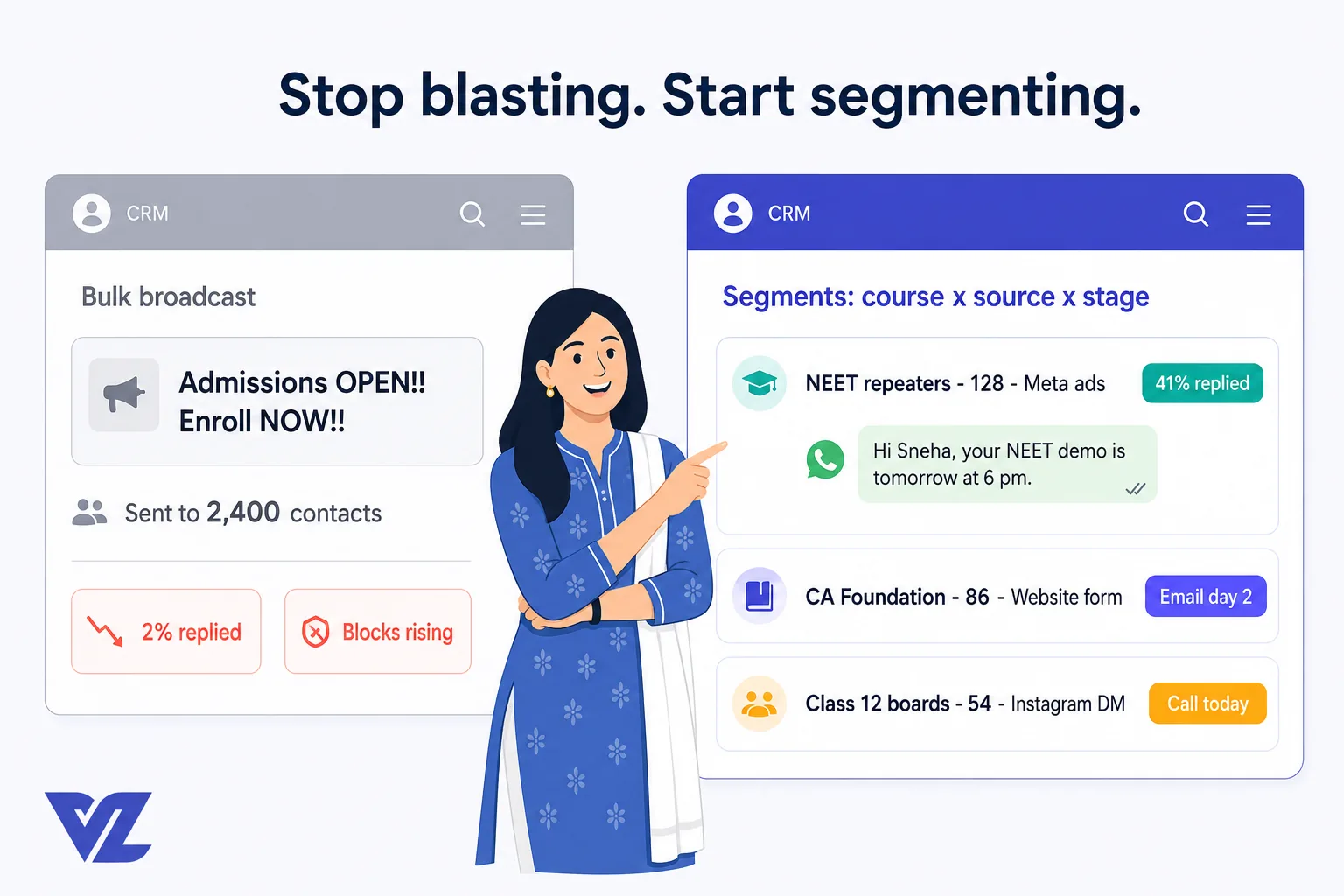
It is 9pm on a Sunday in intake season, and your Meta ads have done their job: 340 fresh enquiries in one sheet, NEET crash course, Class 11 foundation, spoken English, IELTS, all mixed together. Your counsellor selects all of them, pastes one English message into a bulk-sender tool, “Dear Student, admissions are open, limited seats, call now”, and hits send. By Tuesday there are six replies, and two of them say stop messaging me.
So on Monday you google “student engagement platforms”, and the search betrays you. Page one is American campus-life software, clubs and events and badges for students already enrolled at a university, sitting beside enterprise higher-ed suites. Element451 titles itself a “higher ed CRM and student engagement platform”; third-party estimates put it at $20,000 to $40,000 a year, roughly Rs 17 lakh to Rs 34 lakh, and its own pricing page is a calculator that shows nothing until you book a demo (checked Jul 2026, verify on their current page). The big Indian education stacks, Meritto and ExtraaEdge, publish no price at all.
Nobody on that page says the one thing that matters: “student engagement platform” is two different products wearing one name, and buying the wrong one is how an institute spends lakhs while its enquiries keep rotting.
One Phrase, Two Products: The “Already Paying You?” Test
The test costs nothing: is the person you want to engage already paying you?
If yes, you are in post-enrolment engagement: content delivery, live classes, attendance, doubt-solving, gamification, fee reminders. That is LMS territory. Classplus is the textbook Indian example, with subscriptions reported around Rs 19,999 to Rs 50,000 a year plus setup fees and, in many contracts, commission on course sales (third-party teardowns, Jul 2026; the ranges conflict across sources, so treat them as reported figures). Nothing wrong with these tools. They are built for students you have already won.
If no, you are in the pre-enrolment window: the days between “filled a form” and “paid the first instalment”. That is CRM territory, and the job is different: capture the enquiry with its context intact, segment it, reach it on the right channel within minutes, follow up on a schedule, book the demo class, close the admission. Institutes keep buying one category to fix the other, which is why we wrote LMS vs lead management system as its own piece.
| Question | Post-enrolment engagement | Pre-enrolment engagement |
|---|---|---|
| Who are you engaging? | Students already paying you | Enquiries who may never pay you |
| What “engagement” means | Content, attendance, community, badges | First reply, demo booked, admission closed |
| What “personalization” means | Learning paths, performance nudges | Course interest x source x stage deciding message, channel, hour |
| Tools that live here | LMS and campus-life suites (Classplus and similar) | CRMs (ViveLead, Meritto, LeadSquared, ExtraaEdge) |
| Typical price | Classplus reported Rs 19,999 to Rs 50,000/yr plus setup and commissions (third-party, verify) | ViveLead Rs 499 to Rs 1,699/user/month, public; most rivals demo-gated |
| The buying signal | Retention and completion problems | Ghosted enquiries, empty demo classes |
ViveLead lives in the right-hand column only. It is a CRM. Hold that sentence; the rest of this piece depends on it.
Why the Generic Blast Dies in the Enquiry Window
Students multi-apply within the hour. Indian admissions marketers keep describing the same pattern: a student who fills your form fills three or four more in the same sitting, and the family makes 8 to 12 research touchpoints before shortlisting (practitioner-reported figures from Indian education-marketing agencies). The MIT Lead Response Management study (Oldroyd) found that contacting a lead within five minutes versus thirty makes qualification roughly 21 times more likely. Your Tuesday broadcast answered a question asked on Sunday and settled by Monday.
Enquiries arrive when nobody is at the desk. One vendor-compiled roundup of admissions statistics puts over 60% of enquiries outside office hours, against an average coaching-institute reply time of 8 to 12 hours (Hyperleap’s 2026 education statistics page; vendor-compiled, treat as directional). The 11pm NEET enquiry does not wait for your 10:30am shift.
English-only outreach dies in tier-2 and tier-3 India. The largest new pool of students prefers Hindi, Tamil, Telugu, Marathi, or Bengali, and industry analysts keep naming language as the adoption barrier. One English blast to a Marathi-medium parent in Nashik is not outreach. It is noise.
The parent pays, the student chooses. An admission is a two-audience decision on one thread. The 17-year-old DMs you on Instagram at midnight; the parent wants the fee structure as a document to forward to the family group. One generic message serves neither. And the receiving side has had enough: ASCI has ranked education among the top three sectors for objectionable ads, and a 2022 Rest of World investigation documented aggressive EdTech calling after a single form-fill with no way to opt out. That is what your blast looks like from the student’s phone.
The evidence for the alternative is education-specific. In the Castleman and Page summer-nudging study (a 2012 experiment, published 2015), personalized, task-specific text messages to college-intending students lifted actual enrolment from 64.9% to 68.0%, and by 5.7 percentage points for the lowest-income families; later scaled follow-ups showed no degree-completion effect, so claim the enrolment lift and nothing grander. McKinsey’s Next in Personalization 2021 report found 71% of consumers expect personalized interactions and 76% get frustrated without them. Students are consumers with better group chats.
What Personalization Actually Means Before Enrolment
Not “Dear {first name}”. A wrong message with the right name is still a wrong message. Real pre-enrolment personalization runs on three signals your front desk already collects and your spreadsheet promptly loses: course interest, source, and stage. Those three decide the message, the channel, and the hour. Here is the machinery in ViveLead.
Capture the three signals at hour zero
A lead that arrives as “Rahul, 98xxxxx105” cannot be personalized. Custom fields make course interest, preferred medium, and city part of the enquiry form itself, and every lead carries its source automatically: Meta lead ads land in real time through a webhook (with a cron fallback), website forms arrive tagged as website, walk-ins get logged on the mobile app, and legacy data comes in through bulk CSV import, or through Google Sheets import on Professional, which is an import flow, not a live two-way sync. Instagram DMs become leads too, and counsellors reply from the CRM inside Meta’s 24-hour window, which matters because a 17-year-old will DM you long before they email you.
Score it, then segment it
Personalization across 340 enquiries is a segmentation problem, not a memory contest. Lead scoring is configurable: you define what makes an enquiry hot (walk-in, NEET crash course, exam eight weeks out), warm (Meta ad, Class 11 foundation), or cold (portal lead, two failed call attempts). Lead distribution rules then route the Marathi-speaking enquiry to the Marathi-speaking counsellor and the IELTS lead to the study-abroad desk. “Personalized” stops meaning heroic counsellor memory and starts meaning the system sorted 340 rows before anyone typed a word.
The right channel for the right job
WhatsApp carries the first touch. On the Professional plan you connect your own WhatsApp Business Account through the official Meta API: templates with variables (student name, course, demo slot) that Meta approves before you can send a single one, broadcasts that go to a segment (NEET crash course, Hindi medium, enquired in the last 48 hours) instead of the whole sheet, and a shared team inbox so replies land with whoever is on shift instead of dying inside one counsellor’s personal phone. We unpacked that failure mode in the shared WhatsApp inbox piece. On open rates, honesty: the 90-98% figures quoted everywhere come from WhatsApp BSP vendors selling the channel, against roughly 20-35% for email (Mailchimp puts education email near 35% opens and 3% clicks, with opens inflated by Apple’s privacy features). Directionally real, self-interested at the decimal level, and not a number ViveLead will promise you.
Email carries the documents: fee structures, brochures, batch timetables, the things a parent forwards and reads twice. Email engage tracks opens and clicks, so your counsellor calls the parent who opened the fee email three times, not the one who never opened it. A call carries the close: demo-class day and fee negotiation are phone conversations, so save them for the moment they earn.
The right hour, automatically
Timing is the part humans fumble at volume, so hand it to workflow automations, the engine behind enrolment marketing automation. Hour zero: an enquiry lands at 11pm, the approved template goes out with the course variable filled and a public booking link for the demo class (reschedule and cancel built in), and a task waits in the right counsellor’s queue for 10am. Day 2: a scheduled nudge goes out, a different template, same segment. Day 7: one last touch before the lead moves to the cold bucket and stops eating counsellor time.
That is the whole personalized outreach automation loop: signals in, segment chosen, template filled, clock respected. Note the direction: this is fewer messages than the blast, not more. Three relevant segments beat 340 identical rows, and the demo-to-admission stretch that follows has its own playbook in the enquiry-to-enrolment guide.
The Fastest Way to Lose Your WhatsApp Number
The bulk-sender from the opening scene deserves its own warning. Cheap blast tools mostly automate WhatsApp Web or run on unofficial APIs: your number jumps from 200 messages a day to 10,000 identical ones, nobody opted in, a handful of recipients press block and report, and the account dies. Meta’s enforcement is not hypothetical. Its India compliance report for September 2023 alone records over 7.1 million WhatsApp accounts banned, around 2.5 million of them proactively, before any user complained, and unofficial bulk-messaging tools are a stated trigger in WhatsApp’s ban policy. When the number goes, it takes every mid-negotiation admission conversation with it.
The official path is slower on day one and alive in month twelve: your own WhatsApp Business Account on the official Meta API, templates approved by Meta before any send, broadcasts to opted-in segments only. And billing with the lights on: Meta bills its message charges per delivered message, directly to your account, and ViveLead adds no markup. If a vendor is vague about whose API they run on or how Meta’s charges reach you, the vagueness is your answer.
Where ViveLead Does Not Fit
Read this before the pricing, because the fastest way to waste Rs 499 is to buy the wrong category. ViveLead is not a student engagement platform in the enrolled-student sense, and it is not an LMS: it does not deliver course content, run live classes, mark attendance, manage batches as a learning product, or gamify anything. For enrolled-student engagement you need an LMS; ViveLead handles the window before enrolment and coexists with your LMS, handing over the day the admission closes. Second boundary: the personalization described here is template variables plus segmentation plus timing, and no AI is composing a bespoke essay for each student. Third: a university processing tens of thousands of applications with student-information-system integrations is Meritto and Ellucian territory, built and priced for that scale. And we will not guarantee a WhatsApp open rate. Nobody honest can.
What This Costs, With the Doors Open
Most of the named competitors in this piece do not publish a price. LeadSquared is the exception. Element451: third-party estimates of $20,000 to $40,000 a year, demo-gated calculator on its own site (Jul 2026). Meritto: no published pricing; one competitor comparison claims it charges per application, and that is exactly what it is, a competitor-sourced claim. ExtraaEdge: quote-gated annual contracts. LeadSquared: Sales Pro at Rs 2,500 and Sales Super at Rs 5,000 per user per month plus GST, both billed annually and both published on their own pricing page (read from India on their pricing page, 27 September 2026), with education deployments commonly quoted mid-tier and up. Verify every figure on the vendor’s current page; pricing moves.
ViveLead’s numbers are public on the pricing page:
- Starter, Rs 499/user/month: core CRM, custom fields, website form capture, bulk import from CSV and Excel, follow-ups, pipelines and quotations, appointments, mobile app (Android and iOS). Capture and context, but no automation or WhatsApp yet. Google Sheets import is on Professional.
- Professional, Rs 999/user/month: the personalization stack in this piece: WhatsApp Business via the official Meta API (templates, segmented broadcasts, shared team inbox), email engage with open and click tracking, workflow automations, lead scoring, lead distribution, and public booking links for appointments.
- Business, Rs 1,699/user/month: adds cloud telephony for the calling desk, the AI agents, and payment collection.
- HRMS and payroll: optional add-on at +Rs 99/user/month (Rs 79 on yearly billing) on any plan.
- Billed annually, Professional lands at Rs 999. Seven-day free trial, no credit card, free data migration and onboarding.
If you run a coaching institute, training academy, or EdTech sales floor, the EdTech CRM page shows this stack assembled for admissions end to end.
The Bottom Line: Three Relevant Segments Beat 340 Identical Messages
The phrase “student engagement platform” will keep sending institute owners to campus-life software and Rs 17-lakh suites, because nobody on page one profits from clarity. Keep the test. Already paying you: LMS. Not yet paying you: CRM. Inside the window that decides your year, personalization is relevance on a clock: course interest, source, and stage deciding which template, which channel, which hour.
Run the Sunday-night scene again with that machinery: 340 enquiries arrive, scoring sorts them, three segments each get an approved template in their own language with a demo booking link at 9:04pm, and every reply lands in a shared inbox someone is watching. Prove it on the trial: import last month’s sheet, build three segments, send one broadcast each, and count demo classes booked by Friday.
Frequently Asked Questions
Student Engagement Platform FAQs
The questions admissions heads ask before buying, answered honestly
Related reading
Stop Blasting. Start Segmenting.
Start the 7-day trial, import last month's enquiries, and send one segmented broadcast through the official Meta API instead of a blast. WhatsApp, automations, lead scoring, and booking links are on the Professional plan at Rs 999/user/month. No credit card required.
Continue Reading
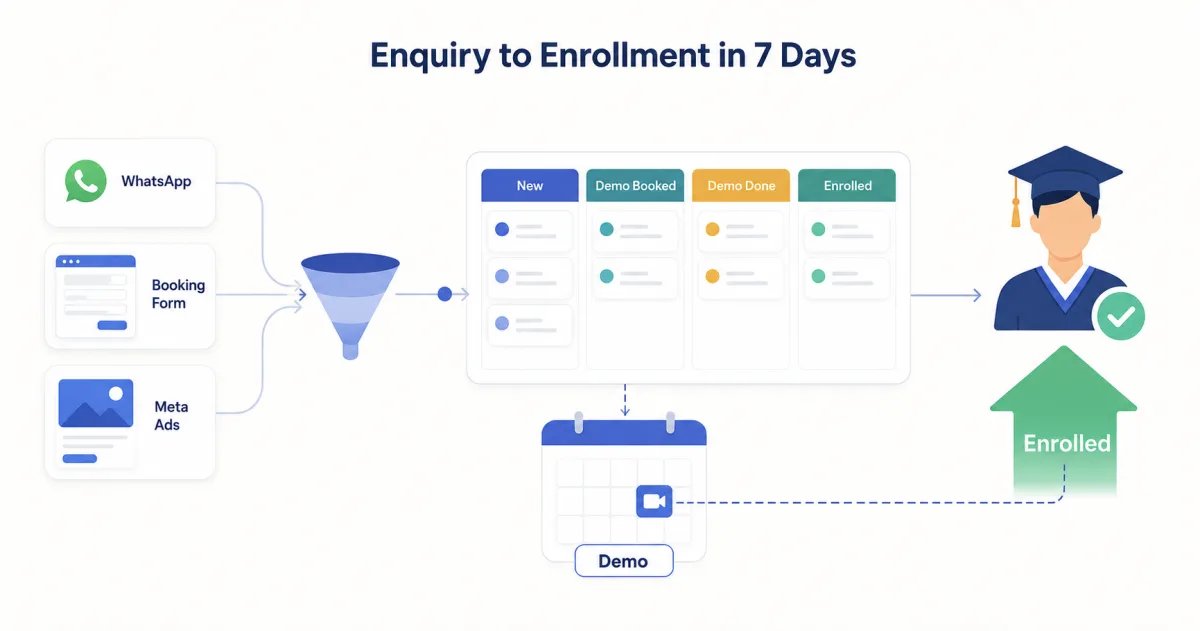
EdTech Lead to Enrollment: The 7-Day Funnel (India 2026)
Move a coaching enquiry from demo booking to enrollment in 7 days: the follow-up cadence, counsellor productivity, and …
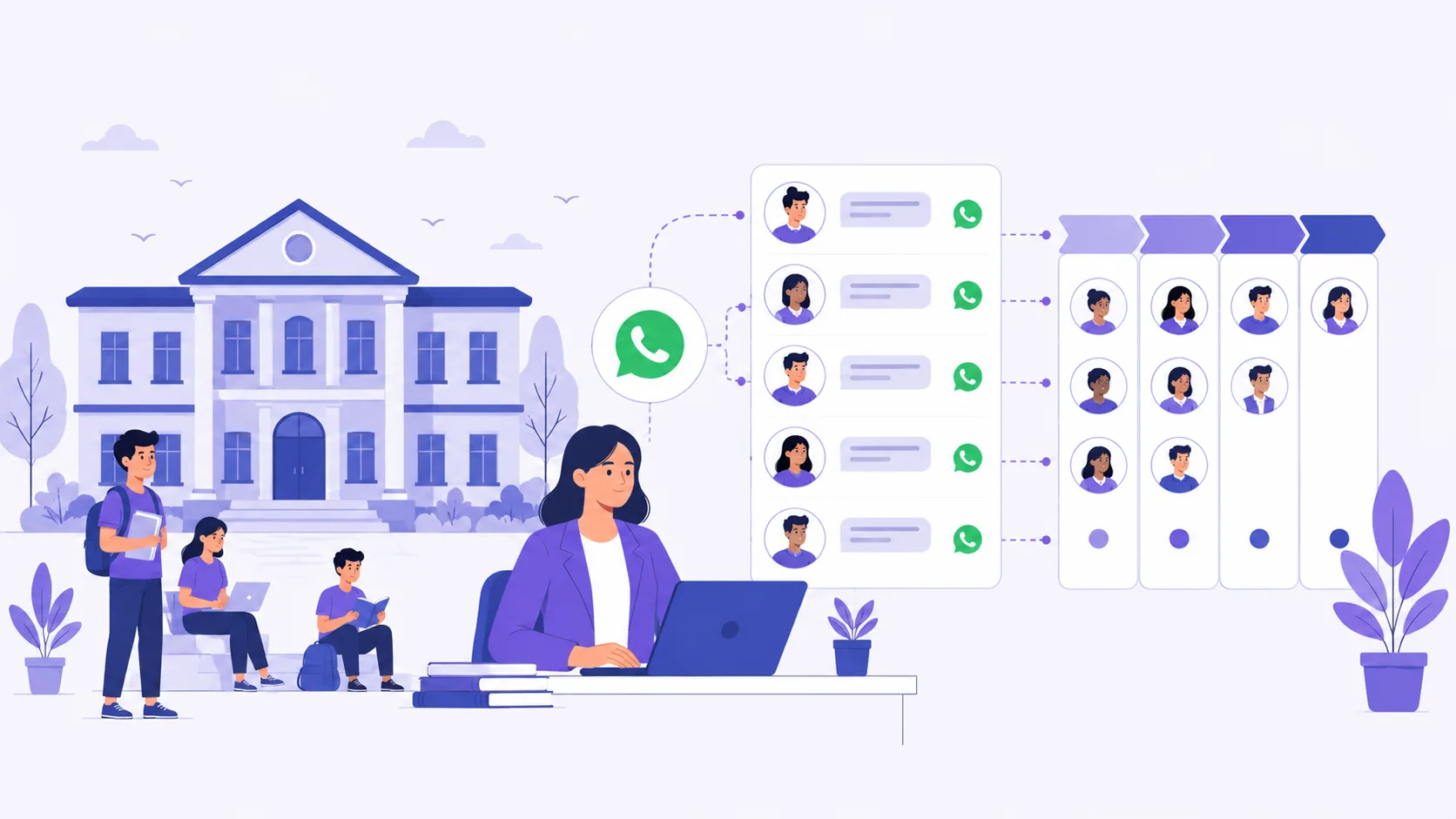
WhatsApp CRM Guide for Indian Coaching Institutes | ViveLead
WhatsApp CRM for coaching institutes in India: stop WhatsApp number bans, decode the Meta bill, meet DPDP on student …
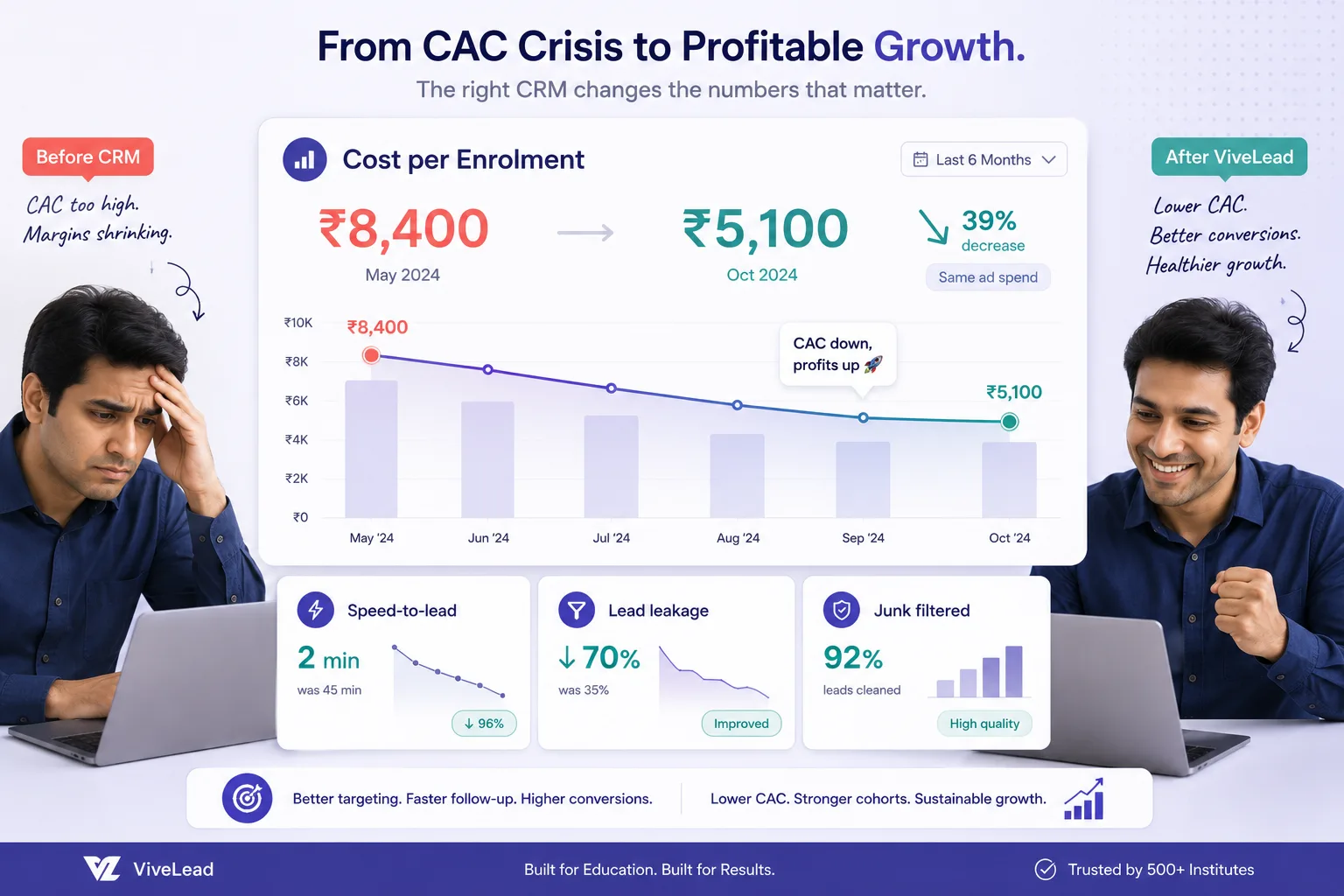
The EdTech CAC Crisis: Buying More Leads Won't Save You
CRM software for education industry that cuts your real cost per enrolled student: speed-to-lead, less leakage, cost per …