Mukherjee Nagar Secret: UPSC Coaching Center CRM
UPSC coaching center CRM Delhi: 90% of selections take multiple attempts. The follow-up ledger, not topper ads, fills July batches in Mukherjee Nagar.

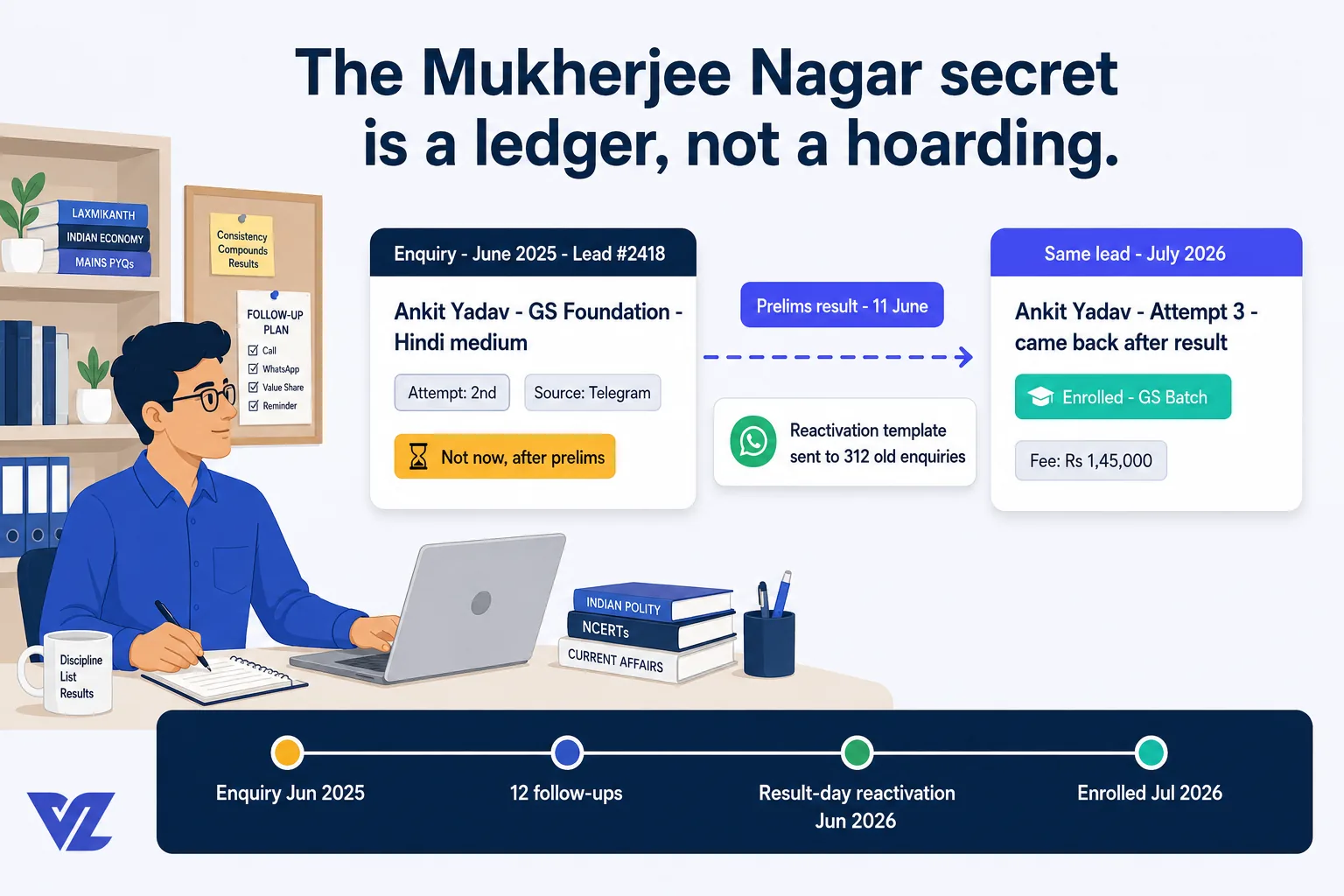
The Enquiry That Comes Back Eleven Months Later
Picture a 40-seat institute in Mukherjee Nagar, third week of June. The prelims result dropped a few days ago. An aspirant who sat in your GS Foundation demo last July, collected the fee PDF, and said he would decide after his attempt has just paid Rs 1.5 lakh to the institute two lanes over. Their faculty is not better than yours. Their counsellor messaged him the morning the result came out, because their system still remembered he existed. Yours forgot him in August, somewhere between an Excel sheet and a counsellor who resigned and took the context with him.
That is UPSC admissions in one lane. The demo gets attended because of faculty. The fee gets paid because of follow-up. And in this market, follow-up is not a week of calls. It is a ledger that must survive eighteen months, a result cycle, and at least one staff resignation.
One housekeeping note before the argument: if you want the straight product pitch for Delhi institutes, plans, onboarding, features, it lives on our Delhi coaching CRM page. This piece stays on the UPSC problem itself, because this funnel behaves like nothing else in Indian education, and generic coaching-CRM advice quietly breaks against it.
UPSC Admissions Are a Memory Business, Not an Ads Business
Start with the pool every Delhi institute fishes in. UPSC CSE 2025: 9,37,876 applied, 5,76,793 appeared in prelims on May 25, and 14,161 cleared to mains when the result landed on June 11, per UPSC’s published result figures. More than nine lakh people wanted this exam. About 2.5% of those who sat crossed stage one.
Now the number that should redesign your admissions desk. ClearIAS analysed the attempt data of successful candidates: only about 6% cleared on their first attempt, roughly 90% reached the final list only after multiple attempts, and the fourth attempt carries the highest success share, around 22%. The average selected candidate is about 26.9 years old.
Read that as an owner, not a mentor. Your buyer does not buy once. They evaluate you at 23, again at 24, again at 26. The enquiry you marked “not interested” last August is not a dead lead; it is a customer between purchases. Every June, when the result publishes, a large share of last year’s no-thank-yous walks straight back into the market with sharper urgency and a clearer sense of what went wrong last time.
JEE and NEET coaching never taught anyone this, because that funnel is the opposite shape:
| The funnel | JEE/NEET coaching | UPSC coaching |
|---|---|---|
| Who decides | Parents, mostly | An adult, typically 24 to 27 |
| Consideration window | Weeks, in one admission season | 1 to 3 years, across attempts |
| Re-entry into the market | Rare, one shot per class | Every result cycle; about 90% of final-list candidates took multiple attempts (ClearIAS) |
| Delhi ticket size | Varies by brand | Rs 1.2 to 1.8 lakh for GS Foundation (institute fee documents) |
| What fills batches | Brand, hoardings, parent trust | Whoever still remembers the aspirant when the result drops |
An ads business buys attention every season and starts from zero. A memory business compounds. The institutes that fill July batches in Mukherjee Nagar run the second model, whether or not they use the word CRM for it.
583 Institutes, and an Aspirant Who Trusts None of Them
Delhi is the densest UPSC market in the country: 583 coaching institutes operate in the city, per a Delhi Police status report submitted to the Delhi High Court, as reported by The Tribune. Aggregator pages claim 300 plus in the Karol Bagh pocket alone, a loose estimate, but walk Old Rajinder Nagar once and you will not argue with the direction.
Against that density, watch how the aspirant actually buys. Before parting with Rs 1.2 to 1.8 lakh, they demo-shop three to five institutes, a pattern aspirant forums and coaching-industry write-ups describe consistently. They ask seniors who studied there. They lurk in Telegram groups, watch the faculty’s YouTube lectures, and quiz a test-series student on how fast evaluated copies come back. Hoardings barely move them, and the market earned that scepticism: the Central Consumer Protection Authority has sent notices to coaching institutes over misleading topper advertisements, as reported by ThePrint. When every board in the lane shows the same faces, advertising cancels itself out.
The same ThePrint ground report carries a detail that says more about this industry’s back office than any brochure: some institutes paid staff Rs 100 for every admission they brought in, with no tracking system behind any of it. Sit with that. Rs 1.5 lakh a seat, crores moving through a single centre every season, and the enquiry engine underneath is a register, a stack of visiting cards and petty-cash incentives.
Density plus distrust leaves one honest conclusion: you cannot out-advertise 582 neighbours, and the aspirant will verify you anyway. The only lever fully in your control is what happens after they walk in, and in the days after they walk out.
One more shift makes it urgent: the walk-in itself is thinning. ThePrint reports that Drishti IAS, around 15,000 students and the dominant Hindi-medium institute in Mukherjee Nagar, has announced a permanent move to Noida. Prayagraj institutes, meanwhile, pitch hybrid batches at lower fees. When footfall stops walking past your gate, the Meta lead at 11pm and the WhatsApp message from a Telegram group are the walk-in. A paper register cannot hold them, and Excel drops them quietly the day the sheet rolls over or a counsellor leaves.
The Six-Week Window That Decides Your Year
The UPSC calendar compresses everything above into one violent window. Prelims in late May; the 2025 paper was on May 25. Result about two weeks later; June 11 last cycle. Then foundation batches stack mid-to-late July: last cycle’s published calendars had ForumIAS starting July 15, Drishti on July 17, 24 and 30, and Vajirao & Reddy registering batches on July 6, 15 and 25. The rhythm repeats every year, which means the window is open right now. Between result and batch start sit four to six weeks in which nearly every serious enquiry in Delhi makes a Rs 1.5 lakh decision. In parallel, mains test-series demand spikes, because those who cleared had roughly ten weeks to mains on last cycle’s calendar and switch programmes within days.
Your counsellor’s whole year is decided inside those weeks, which is what makes the standard failure pattern so expensive. The aspirant attends the demo. The counsellor says “let us know.” Then the institute goes silent for three to five days while the aspirant consults seniors and shops two more demos. In that silence a rival makes three calls, answers the fee objection and offers a seat in the Hindi-medium batch. If you run an institute, you have watched this happen from both sides.
Do the arithmetic once and it stops being abstract. At Rs 1.5 lakh a seat and even a modest 10% close rate, ten enquiries mishandled during the spike is one seat gone, Rs 1.5 lakh burned in silence. Not lost to a better institute. Lost to a better-organised one.
The Follow-Up Ledger Behind Consistently Full Batches
So here is the Mukherjee Nagar secret, and it is unglamorous. The institutes that fill July batches keep a ledger: name, attempt number, optional subject, medium, target year, PG locality, what the aspirant objected to at the demo, and the date of the next conversation. The ledger does not forget in August. It does not resign with a counsellor. And it wakes up on result day.
That ledger is what a CRM is. Not “customer relationship software”, a follow-up ledger with an alarm clock. Mapped onto a UPSC admissions desk in ViveLead, concretely:
The record itself (Starter, Rs 499/user/month). Custom fields for attempt number, optional subject, medium (Hindi or English), target year, and hostel or PG locality. “Second attempt, Hindi medium, Sociology optional, staying in Nehru Vihar” becomes a filterable record instead of a memory in one counsellor’s head. Website forms land in the same list automatically (Meta lead ads too, from Professional), and bulk CSV import brings your old enquiry register in over one afternoon.
The silent-window fix (Starter). Follow Ups put a day-2 and a day-7 task on every demo attendee, each with an owner and a date. When a counsellor skips one, you see an overdue task today instead of discovering the loss in July. Counsellor accountability stops being a mood and becomes a list you scan in two minutes.
Batch-shaped pipelines (every plan, from Rs 499/user/month (Rs 399 billed yearly)). Separate pipelines for GS Foundation, Optional, Test Series and CSAT, because a no to Foundation in July is often a yes to Test Series next June. One aspirant, several possible purchases, each moving through its own stages.
Automations for the cadence (Professional). Demo attended triggers the next-morning WhatsApp template and the day-2 task by rule, not by counsellor discretion. In the spike fortnight, when 200 enquiries land at once, the cadence survives precisely because nobody has to remember it.
WhatsApp where the aspirant lives (Professional). WhatsApp Business through the official Meta API: your institute’s own WhatsApp Business Account, approved templates, broadcasts, and a shared team inbox so threads survive staff churn instead of dying on personal phones. Meta bills message charges per delivered message directly to your account; ViveLead adds no markup. There is a full piece on WhatsApp CRM for coaching institutes if that channel is your bottleneck.
Evidence for next season’s spend (every plan). Source-wise conversion analytics show whether Telegram, walk-ins, seniors’ referrals or Meta ads actually filled the last batch. More than one institute has discovered its cheapest admissions came from a source it was about to stop bothering with.
The demo-to-enrolment mechanics under all of this, speed to first call, counselling stages, fee follow-through, are in our lead-to-enrolment playbook. The UPSC version of that playbook simply runs longer and returns more often.
The results-day reactivation play
One play pays for the whole system, and you can circle its date on a calendar. The morning the prelims result publishes, filter last cycle’s enquiries marked not now, went silent or joined elsewhere, and message them within 48 hours. Two templates: one for repeat attempts, with batch dates and timings for their optional; one for those who cleared, offering mains test series while the 80-day clock is loud. Remember the attempt data: with roughly 90% of eventual selections taking more than one attempt, a fat slice of last year’s lost enquiries re-entered the market the moment that PDF published. Most institutes spend that week hunting fresh leads at full ad cost. The organised ones harvest their own archive first, at zero. The template shapes, consent care and sequencing are in revive dead leads with WhatsApp. UPSC is the easiest market in India to run this play in, because the date demand returns is printed on a government calendar.
Where ViveLead Does Not Fit
Three cases where we are the wrong answer, said plainly. If what you actually want is an app that delivers test-series PDFs, video lectures, attendance and batch content to enrolled students, you need an LMS, a Classplus-type product, not a CRM; ViveLead does not deliver course content, and admissions is the only part of your institute we belong in. If you are a two-person operation fielding 20 enquiries a month, a diary and personal WhatsApp genuinely suffice; software would add admin before it adds an admission, so come back when volume makes the diary drop things. And if you are a 50-counsellor multi-city chain that needs enterprise application workflows, the enterprise education CRMs exist for you: LeadSquared publishes Sales Pro at Rs 2,500 and Sales Super at Rs 5,000 per user per month, billed annually (read from India on their pricing page, 27 September 2026), and Meritto and ExtraaEdge sell on quotes; verify on each vendor’s current page, prices move. ViveLead’s slot is the 2 to 15 counsellor institute that needs the ledger, the WhatsApp machine and the automations at under Rs 500 a user, without an enterprise onboarding project.
What It Costs, and When to Start
The full grid is on the pricing page; the UPSC-relevant shape is short. Starter at Rs 499/user/month is the ledger: leads, custom fields, website form capture, bulk CSV import, follow-up tasks, documents, and the mobile app your counsellor carries between the front desk and the demo hall. Professional at Rs 999/user/month is the machine most institutes actually run: WhatsApp via the official Meta API, workflow automations, public booking links an ad can point to so aspirants book their own demo slot, and lead scoring, on top of Starter’s batch pipelines, source-wise analytics, and roles so a junior counsellor sees leads but not fee ledgers. Business at Rs 1,699 adds built-in calling and the AI agents; most UPSC centres do not need to start there. HRMS and payroll for faculty and staff is an optional add-on at +Rs 99/user/month (Rs 79 on yearly billing) on any plan. Billed annually, Professional lands at Rs 999. Seven-day trial, no credit card, free data migration, free onboarding, and ViveSmart AI comes with the Business plan.
The batches will stack in the next fortnight whether your desk is ready or not. The institute across the lane is not smarter than you, and its faculty is probably not better either. It just never forgets an aspirant, because it stopped relying on anyone’s memory to remember them.
Frequently Asked Questions
UPSC Coaching Centre CRM FAQs
What Delhi institute owners ask about running admissions on a system instead of a register
Related reading
- Delhi coaching and EdTech CRM
- Revive dead leads with WhatsApp
- WhatsApp CRM for coaching institutes
- EdTech lead-to-enrolment playbook
- Excel vs CRM for lead tracking
- Education CRM software guide
- Pricing
EdTech CRM by city: Delhi NCR, Mumbai, Bangalore, Hyderabad, Chennai, and Pune.
Your Next Batch Is Sitting in Last Year's Enquiries
Import last cycle's enquiry register before the July batches stack. WhatsApp via the official Meta API and results-week automations are on Professional at Rs 999/user/month, and batch pipelines come with every plan. No credit card required.
Continue Reading
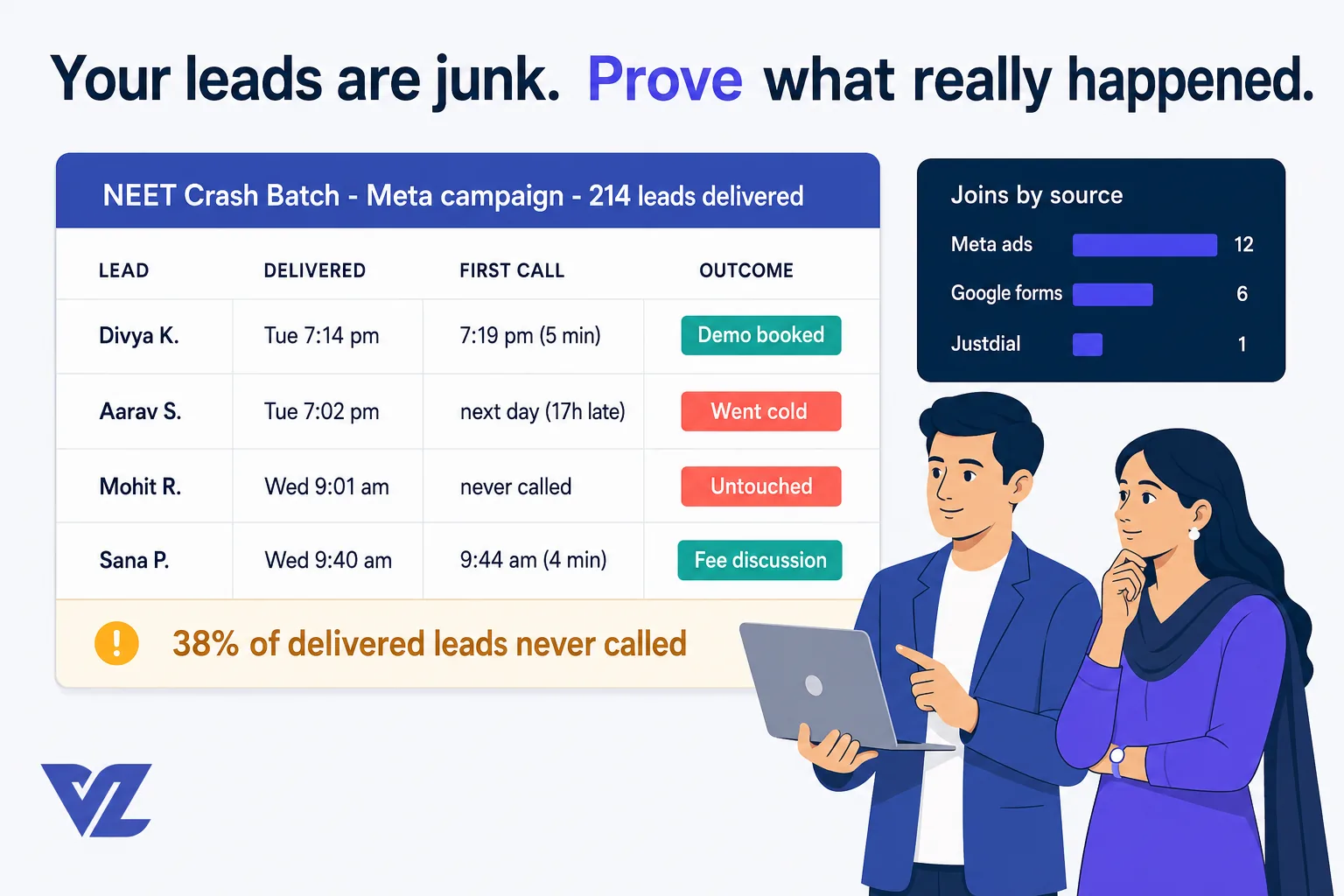
Performance Marketing Agency Lead Quality Proof Guide
Performance marketing agency lead quality proof: evidence that settles the junk-leads fight, with timestamps, …
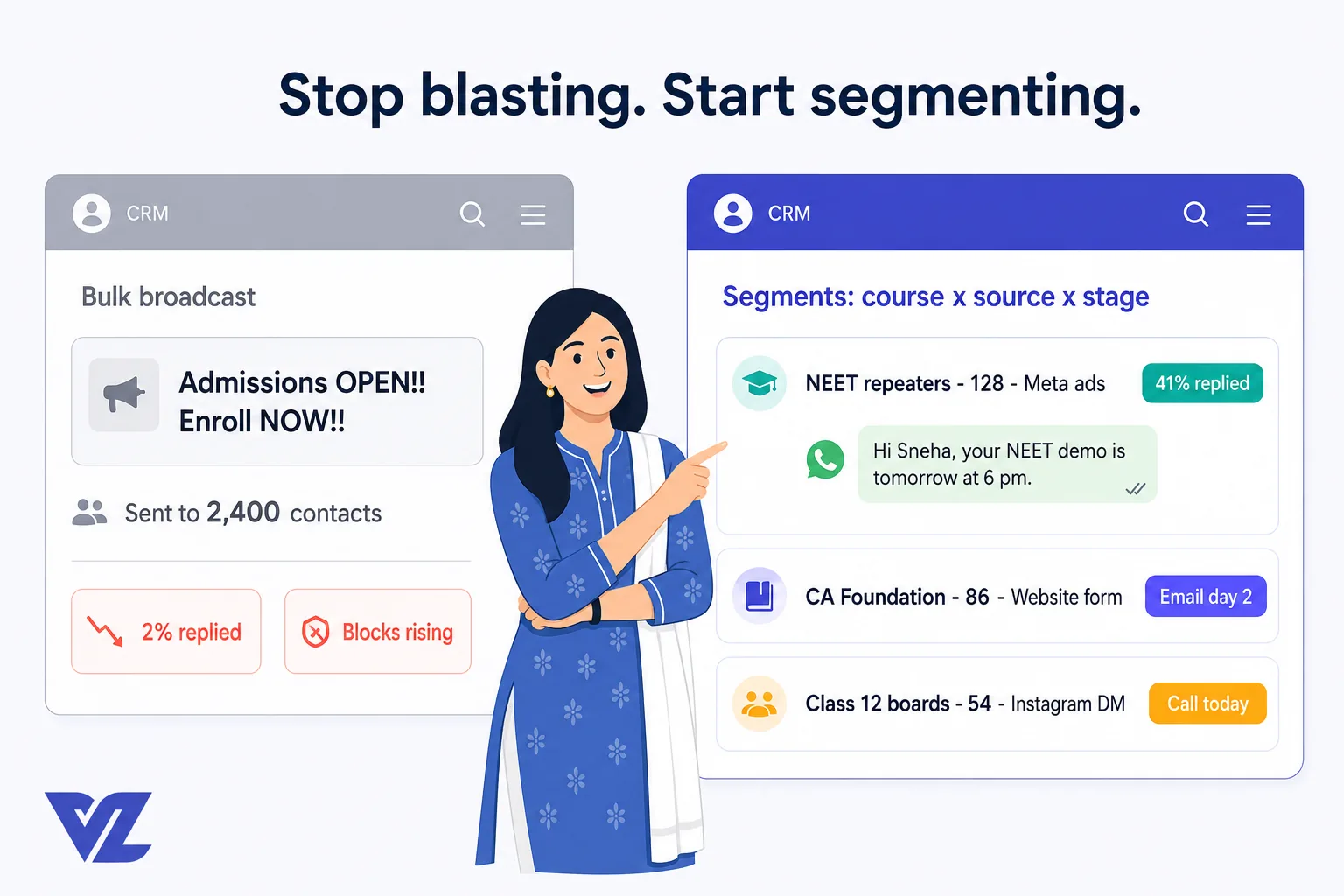
Student Engagement Platforms: Personalized Outreach
Student engagement platforms hide two products. Pre-enrolment personalized outreach automation is CRM work: segments, …
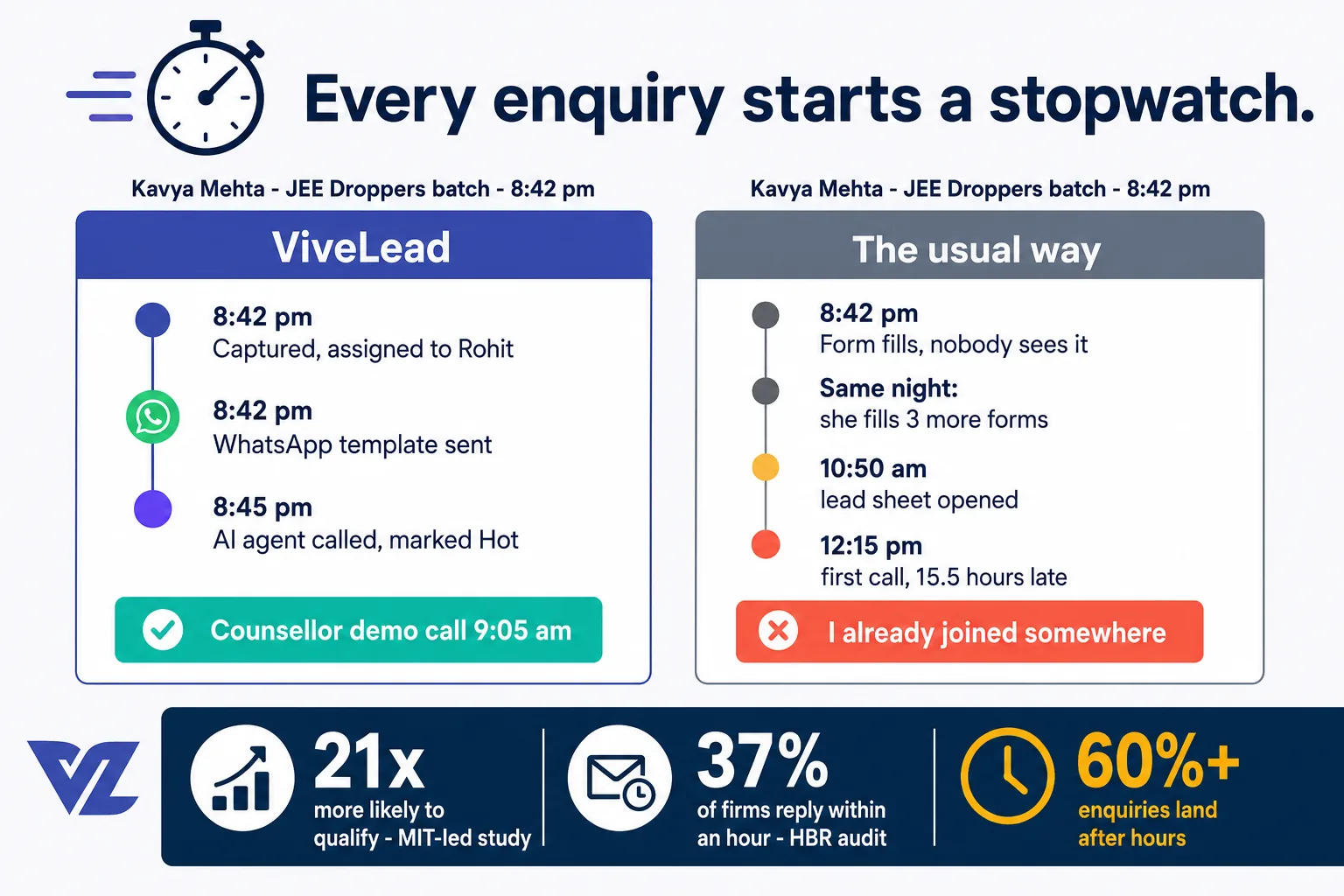
How to Optimize Speed to Lead for Coaching Centers
How to optimize speed to lead for coaching centers: the 8:30 pm self-audit, the results-season capacity math, and a …