WhatsApp Broadcast and SMS Rules India: Send at Volume Without Losing Your Number | ViveLead
The three WhatsApp limits that decide whether a broadcast lands, why retrying a failed message makes it worse, and the DLT chain every Indian SMS must pass before it is delivered.

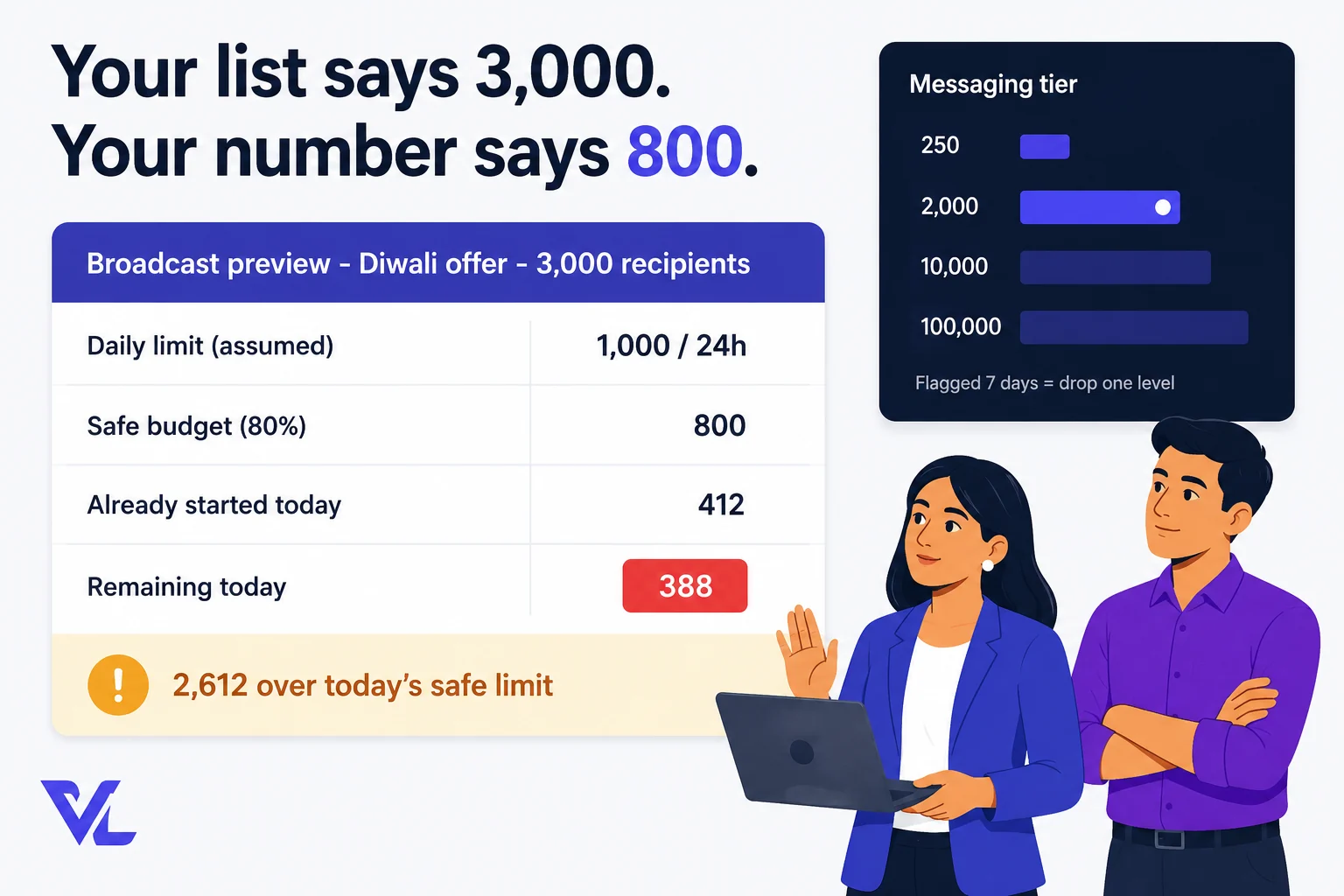
A broadcast is not a send. It is a withdrawal against your number
Ask most teams what happened to a broadcast and you get a binary answer: it went, or it failed. That model is wrong, and it is the reason numbers get throttled by businesses who genuinely believed they were being careful.
Every business-initiated message you send is scored. Not the campaign, the number. WhatsApp watches how people react to what you send and turns that into a rating that decides how many people you are allowed to reach tomorrow. A broadcast that technically delivered to everyone can still be the worst thing you did that month, because delivery is not the outcome being measured. Reaction is.
So the real question a sales head should be asking is not “did it send” but “what did that send cost me”. This article answers that precisely: the three separate limits that decide whether a WhatsApp broadcast lands, the retry behaviour that quietly corrupts your own reporting, and the completely different regime that governs SMS in India. Everything here is sourced from Meta’s and TRAI’s own documentation, linked inline, because this is an area where confident secondhand advice is usually a year out of date.
The three WhatsApp limits, and why knowing one is worse than knowing none
Teams that know exactly one limit are the ones who get surprised, because they optimise hard for the wrong constraint. There are three, they are independent, and any one of them can be the thing stopping you.
Limit one: your messaging limit tier
This is the one everyone knows. It caps how many unique customers you can start a conversation with in a rolling 24 hours.
Per Meta’s messaging limits documentation, newly created business portfolios have a messaging limit of 250. The tiers then run:
| Tier | Unique customers per 24 hours |
|---|---|
| Starting tier | 250 |
| Tier 2 | 2,000 |
| Tier 3 | 10,000 |
| Tier 4 | 100,000 |
| Tier 5 | Unlimited |
You reach 2,000 by one of three routes: verifying your business directly, having a partner verify it, or sending 2,000 delivered messages outside customer service windows to unique WhatsApp user phone numbers within a 30-day moving period, using templates with a high quality rating.
Above that, scaling is automatic, and the rule contains a trap worth reading twice. Meta raises your limit by one level within six hours if you are sending high-quality messages and you have “utilized at least half of your current messaging limit” in the past week.
Read that backwards. A number that never uses half its limit never scales. Teams sitting on the 250 tier, sending carefully to 60 people a week and waiting to be promoted, will wait forever. Under-sending stalls you exactly as effectively as bad quality does. The system rewards consistent, well-received volume, not caution.
Limit two: your quality rating
This is the one that actually decides your fate, and it is scored on a window most teams do not account for.
Meta determines message quality from how WhatsApp users received your messages over the past seven days, weighted by recency. The signals are user feedback: blocks, reports, mutes, archives, and the reasons users give when they block you. The rating surfaces as GREEN, YELLOW and RED, with UNKNOWN before there is enough data.
Two consequences follow, and both are operational rather than theoretical.
First, a bad send does not cost you a day, it costs you a week. Because the window is seven days and recency-weighted, a poorly targeted Monday blast keeps pulling your score down through Friday, while every good send you make in between is fighting that drag. There is no way to flush it. You wait.
Second, the penalty is mechanical, not a warning. If a quality rating has been flagged for the last seven days, the messaging limit is decreased by one level immediately. You do not get to appeal your way back up faster; you drop a tier and then have to earn the tier back under the ordinary scaling rules, which require volume you no longer have the headroom to send.
This is why “we will just be careful next time” is not a recovery plan. The damage and the repair run on different clocks.
Limit three: the per-recipient cap nobody plans for
This is the one that makes experienced operators think something is broken, because it produces failures that have nothing to do with anything you did.
Meta applies a per-user marketing template message limit. The critical property: it applies across all businesses, not per business. WhatsApp may limit the number of marketing template messages a user receives from any business in a given period when they are less likely to be receptive and engage.
What feeds it is the person, not you:
- their recent marketing message read rate
- how many messages currently fill their inbox, counting friends, family and every other business
And it “adapts automatically over time based on a person’s recent engagement levels.”
When you hit it, the message comes back failed with error 131049 in the messages webhook. Not rejected for content. Not blocked for policy. The recipient simply had no room for another marketing message from anyone today.
The practical implication reframes what a failed broadcast means. If 12 percent of your list returns 131049, that is not a verdict on your template, your number or your offer. It is a statement about how much marketing those specific people are already ignoring. Your competitor sending to the same list on the same day gets the same treatment.
The retry that destroys your reporting
Here is the single most expensive mistake in this whole area, and it is committed almost entirely by conscientious teams trying to do better.
A broadcast finishes. Some messages failed. The obvious instinct is to retry the failures, because a failure feels like a transient error and retrying is what you do with transient errors.
Meta’s guidance is explicit. Wait at least 24 hours before attempting to resend a marketing template message to a user that has reached their limit. Resending earlier “will likely result in additional error responses and can reduce the accuracy of campaign delivery reporting.” Push harder and further delivery attempts to those users “may be unavailable for up to 24 hours.”
So the retry does three things, none of them good: it fails again, it can extend the block on those users, and it corrupts the number you are using to judge the campaign.
That last one deserves arithmetic, because it is invisible and it changes decisions. Take 100 messages where 20 fail on the cap:
- True picture: 100 sent, 80 delivered. An 80 percent delivery rate.
- You retry the 20. The cap is still in force, so they fail again.
- Recorded picture: 120 attempts, 80 delivered. Roughly 67 percent.
Nothing about the campaign changed. The template is identical, the audience is identical, the number is identical. But the dashboard now shows a 13-point drop, and the team responds to it. They rewrite a template that was fine. They blame a list that was fine. They conclude WhatsApp is unreliable. One well-meaning retry loop produced a wrong diagnosis and then a wrong fix.
If you build or buy broadcast tooling, this is the behaviour to check first: does a failed message get retried automatically, and does the retry respect the failure code? A generic exponential-backoff retry, the kind every queue library ships with by default, is actively harmful here.
Templates carry their own rating, separately from your number
Your number has a rating. So does each template, and a good number does not protect a bad template.
Meta rates templates GREEN, YELLOW, RED and UNKNOWN, assessed on usage, customer feedback and engagement, specifically negative feedback from WhatsApp users and low read rates.
A template that keeps drawing negative feedback or weak engagement can be flagged, which Meta describes as having “received negative feedback and is at risk of being disabled”, and can eventually be paused or disabled. The enforcement is absolute rather than gradual: if the status changes to anything other than APPROVED, the template cannot be sent at all.
Two habits follow from this.
Retire templates on a schedule rather than on failure. A template that has been sent to your whole list four times is accumulating fatigue whether or not its status has moved yet, and the read rate is the leading indicator that will move first.
Watch read rate, not delivery rate. Delivery tells you the message arrived. Read rate is closer to the signal Meta is actually scoring you on, and it turns before the status does. By the time a template is flagged, the damage to the number has already been recorded in the seven-day window.
What quality control actually looks like
This is the part the original question was really asking. Not the rules, the operating procedure. Eight practices, each one tied to a specific mechanic above.
1. Warm up a new number instead of launching on it. A new portfolio starts at 250. Do not connect a number on Monday and put your 8,000-contact list through it on Tuesday. Build genuine two-way conversations first, because replies open service windows and give the number a real engagement history before you ever send a marketing template.
2. Order the list by engagement, not by upload date. Send to people who replied recently, first. They have the best read rates, which protects your quality score, and they are the least likely to be sitting against their own per-recipient cap. The people who have ignored you for eight months should be the last wave, not part of the first.
3. Send in waves, and read the first one. Release a slice, wait, look at delivered and read counts, then release the next. A single blast gives you exactly one data point and it arrives after the damage. Waves let you stop.
4. Stop below the limit, not at it. Treat roughly 80 percent of your tier as the real daily ceiling and keep the rest in reserve. Two reasons. The limit counts every business-initiated conversation from that number, so the templates your reps send by hand from the inbox spend the same budget your broadcast does, and a campaign sized to the exact limit leaves them nothing. And the cost of being wrong is asymmetric: sending 20 percent fewer messages costs you one day of reach, while a downgrade costs a whole tier for at least seven days and then has to be earned back with volume you no longer have room to send. Work out the headroom before you pick the audience, not after the send fails.
5. Match the template category to the message. Utility and marketing are different categories with different economics and different tolerance. A promotional message sent as a utility template is precisely the thing users report, and reports are the heaviest input into your rating.
6. Make opting out one tap. An opt-out costs you a contact. A block costs you your rating, because blocks are a direct input to the seven-day quality window and the reason given on the block is recorded too. Given the choice between the two, you want the opt-out every single time, so do not hide it.
7. Never retry a 131049 the same day. Covered above. Let it go for 24 hours minimum, and make sure your tooling agrees with you.
8. Treat the seven-day window as a real budget. Because scoring is recency-weighted across seven days, sends are not independent events. Plan a week at a time, not a campaign at a time.
SMS in India is a completely different regime
Teams routinely assume the two channels work alike because the same vendor sells both. They do not. On WhatsApp, a bad broadcast degrades a reputation score over days. On SMS in India, a non-compliant message is rejected at the gateway and never delivered at all. Reputation decay versus hard rejection.
Indian commercial SMS is governed by TRAI’s Telecom Commercial Communications Customer Preference Regulations, with compliance recorded on a Distributed Ledger Technology platform. DLT is mandated for recording preferences, acquiring and verifying customer consent, complaint handling and entity registration.
TRAI’s own advice to senders sets out six mandatory steps:
- Register as a Principal Entity
- Get a header assigned, an alphanumeric string of at most 11 characters, for example
VD-KOTAKB - Register your content templates, with fixed and variable parts declared
- Transmit the PE ID, header and Content ID to the telecom service providers
- Register a consent template, where applicable
- Acquire consumer consent, where applicable
TRAI’s wording on what happens if you skip one is not ambiguous: “Failing to follow any steps will not allow you to send CC.”
Consent itself is now a verified artifact rather than a checkbox you keep in your own database. The Digital Consent Acquisition facility records consent on the DLT platform through the Access Provider after OTP verification with the subscriber. Your CRM’s record of consent is not the record that counts.
The 2025 change that broke a lot of working templates
If your SMS started failing without any change on your side, this is almost certainly why.
TRAI’s 2025 amendment introduced mandatory pre-tagging of variable elements. Variables in a content template must now be categorised and registered upfront by the Principal Entity, making them traceable and accountable. The stated purpose is to stop fraudsters inserting harmful links and call-back numbers into otherwise legitimate registered templates, which was the standard way a compliant template got abused.
Access Providers and Principal Entities were given 60 days to modify existing templates. After that window, messages sent using non-compliant templates are rejected and not delivered.
An approved template from 2023 is therefore not automatically a valid template today. That is the audit worth running this week if SMS matters to your business.
WhatsApp versus SMS, side by side
| WhatsApp Business Platform | SMS in India | |
|---|---|---|
| Governed by | Meta’s platform policies | TRAI TCCCPR, recorded on DLT |
| Pre-registration | Template approval by Meta | PE, header, content template, consent template |
| Consent record | Yours to hold | OTP-verified, recorded on DLT by the Access Provider |
| Failure mode | Rating decays over days | Message rejected at the gateway |
| Recovery | Wait out the seven-day window, rebuild tier | Fix the registration, resume immediately |
| Volume cap | Tiered, 250 to Unlimited | Governed by consent and preference, not tiers |
Note the recovery row, because it inverts most people’s intuition. SMS failures are loud and fast to fix. WhatsApp failures are quiet and slow to fix. The channel that feels more forgiving is the one that punishes you for longer.
The one rule underneath both channels
Strip away the tiers, the ratings, the headers and the templates, and both systems are measuring the same thing from different angles: whether the person on the other end wanted this message.
Meta scores it through blocks, reports, mutes and read rates. TRAI enforces it through registered consent and preference. Neither is checking whether you are a real company or whether your offer is good. They are checking whether the recipient is glad you sent it.
Which means the strategy that satisfies both regulators is also the one that works commercially: message fewer people, more relevantly, more often to the ones who respond. Every mechanic in this article penalises the same behaviour, sending the same thing to everyone because the list was there.
Where ViveLead sits in this
Being concrete about what the product does and does not do.
ViveLead runs native WhatsApp Business on the Professional plan, connected to your own WhatsApp Business Account, with Meta billing your account directly at no markup. Broadcasts go out through a paced queue with a configurable per-second rate limit rather than a burst, and per-recipient results are stored with the actual failure code, so a 131049 is visible as a per-recipient cap and not silently rolled into a single “failed” number on a dashboard. Templates are resolved per sending number, which matters the moment you run more than one.
The composer also checks the audience against the sending number’s remaining 24-hour headroom before anything is created. It counts the unique people that number has already started conversations with today, subtracts that from a deliberately conservative daily budget, and if your list is larger it says so with the arithmetic and asks you to confirm rather than letting you find out at message 800.
Two details in that check are worth stating, because they are the difference between a real guard and a comforting one. First, the budget keeps a fifth of the limit in reserve rather than letting you run to the edge, since the tier is a ceiling and the penalty for touching it lasts a week. Second, when Meta has not reported a tier for your number, which is the normal state for most numbers, the check assumes a low limit and says out loud that it is assuming. A guard that goes quiet whenever it lacks data is worse than no guard, because silence reads as approval.
What it still does not do is make the quality decisions for you. No tool can, because the inputs are your list and your relevance. What it can do is stop you flying blind: warn you before an oversized send instead of after it, show you which contacts actually replied recently so you can order the waves, and show you the real reason each message failed so you do not retry the ones you must not retry.
If you want the mechanics for re-opening old conversations specifically, including the 24-hour window and current India message rates, that is covered in reviving dead leads on the Official WhatsApp Cloud API.
Sources
- Meta, Messaging Limits, WhatsApp Business Platform documentation
- Meta, Per-user marketing template message limits
- Meta, Template quality rating
- Meta, Error codes
- TRAI, Advice to Senders
- TRAI, TCCCPR and the 2025 amendment regulation
Meta and TRAI both revise these rules. Every figure above was checked on 1 September 2026. Verify the tier numbers and the DLT template rules against the linked sources before you build a campaign plan on them.
Broadcast Without Guessing
Native WhatsApp Business, paced broadcasts and per-recipient delivery codes on Professional from Rs 999/user. Meta bills your own WhatsApp Business Account directly, at no markup.
Continue Reading
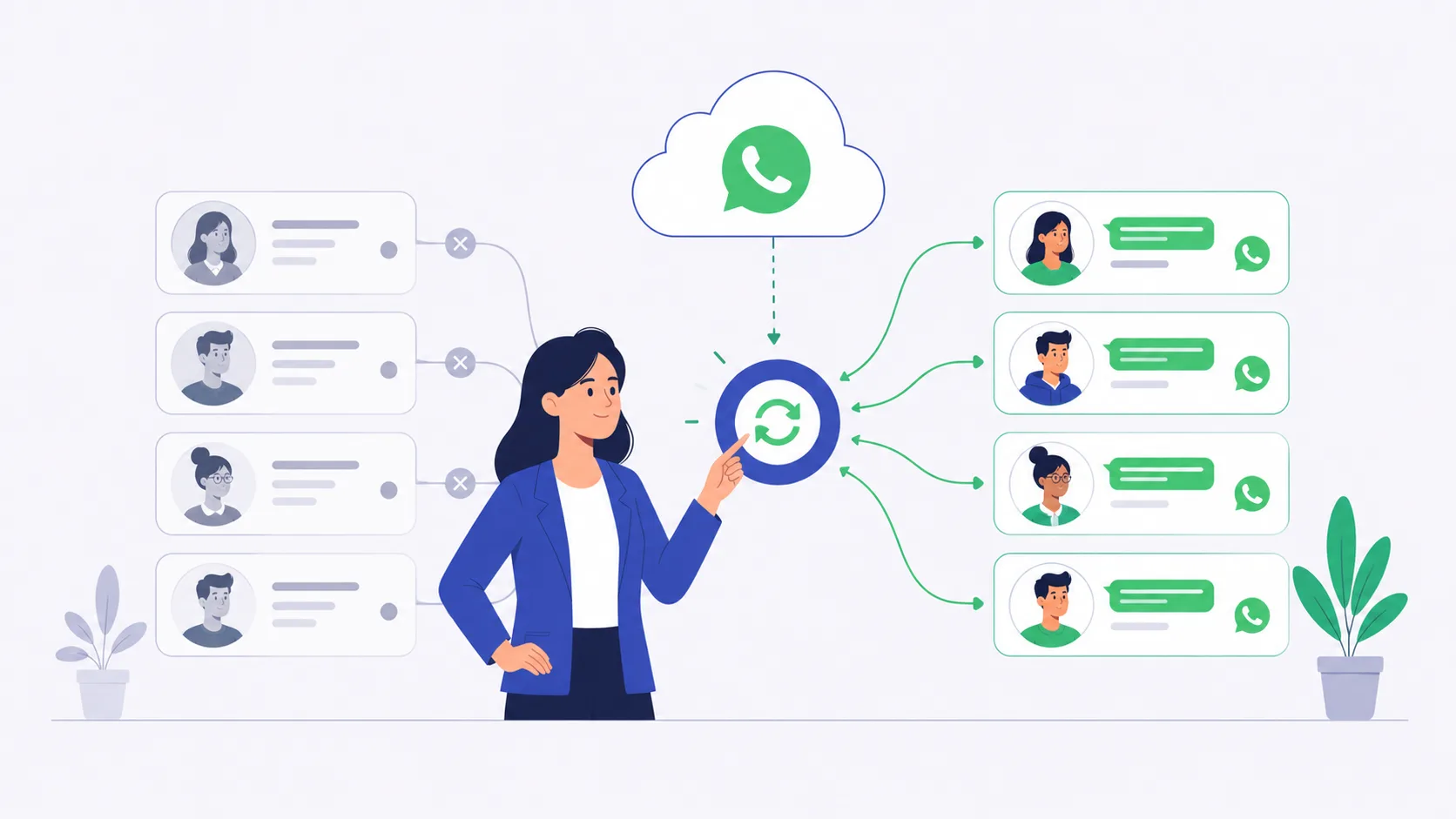
Revive Dead Leads via Official WhatsApp Cloud API | ViveLead
Revive dead leads on the Official WhatsApp Cloud API: the 24-hour rule, current India rates, and how to message old …
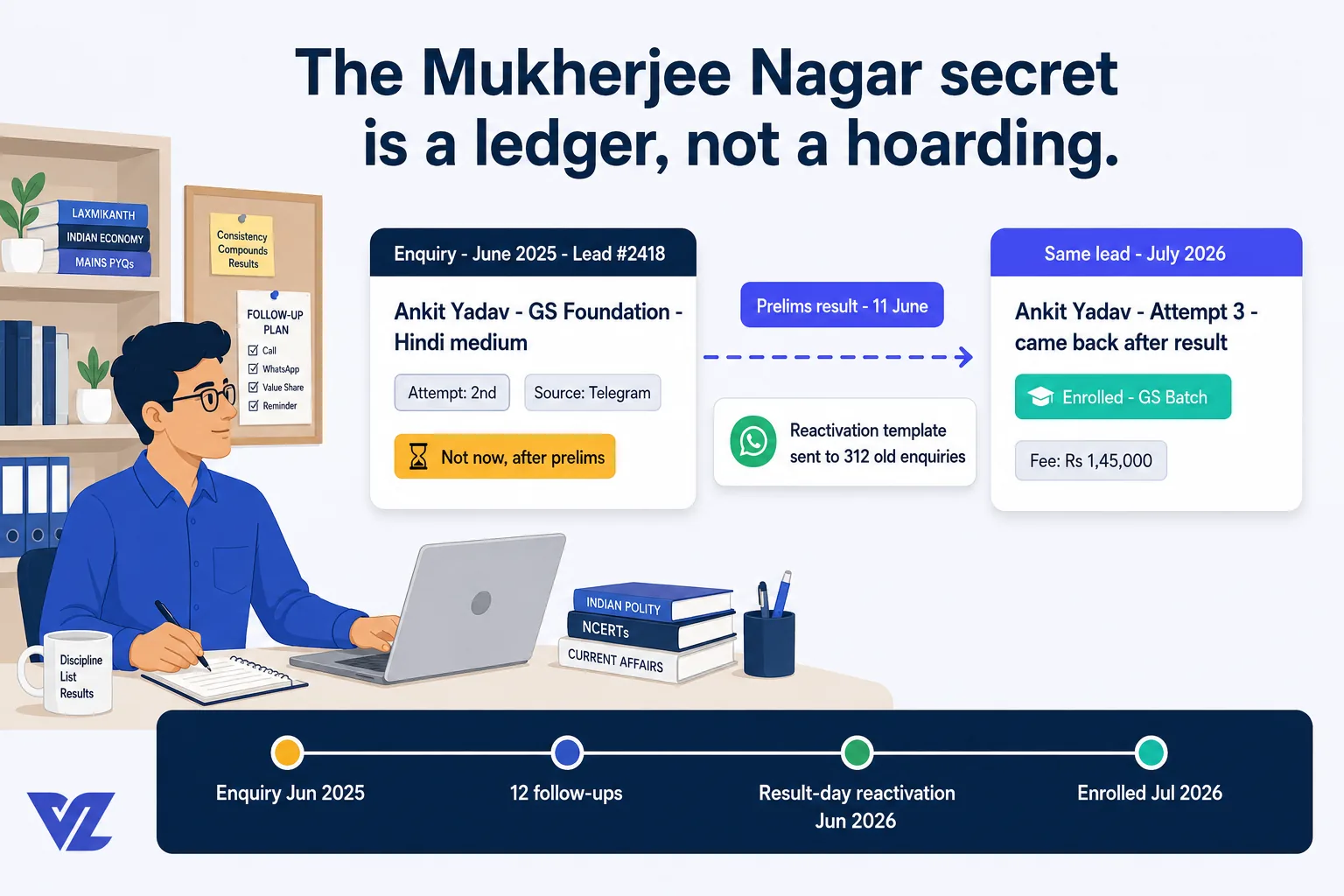
Mukherjee Nagar Secret: UPSC Coaching Center CRM
UPSC coaching center CRM Delhi: 90% of selections take multiple attempts. The follow-up ledger, not topper ads, fills …
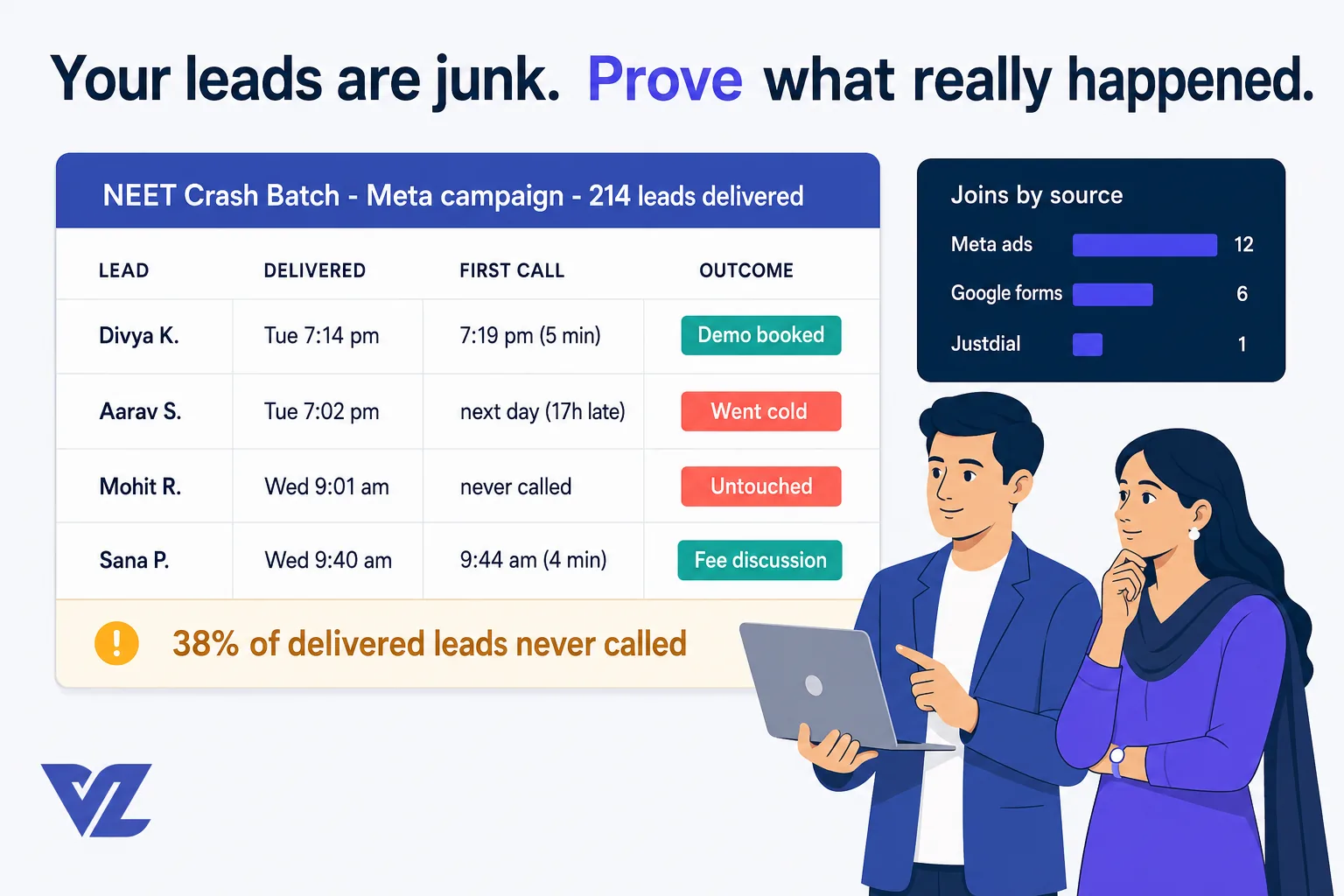
Performance Marketing Agency Lead Quality Proof Guide
Performance marketing agency lead quality proof: evidence that settles the junk-leads fight, with timestamps, …