WhatsApp CRM Guide for Indian Coaching Institutes | ViveLead
WhatsApp CRM for coaching institutes in India: stop WhatsApp number bans, decode the Meta bill, meet DPDP on student data, map enquiry to enrollment.

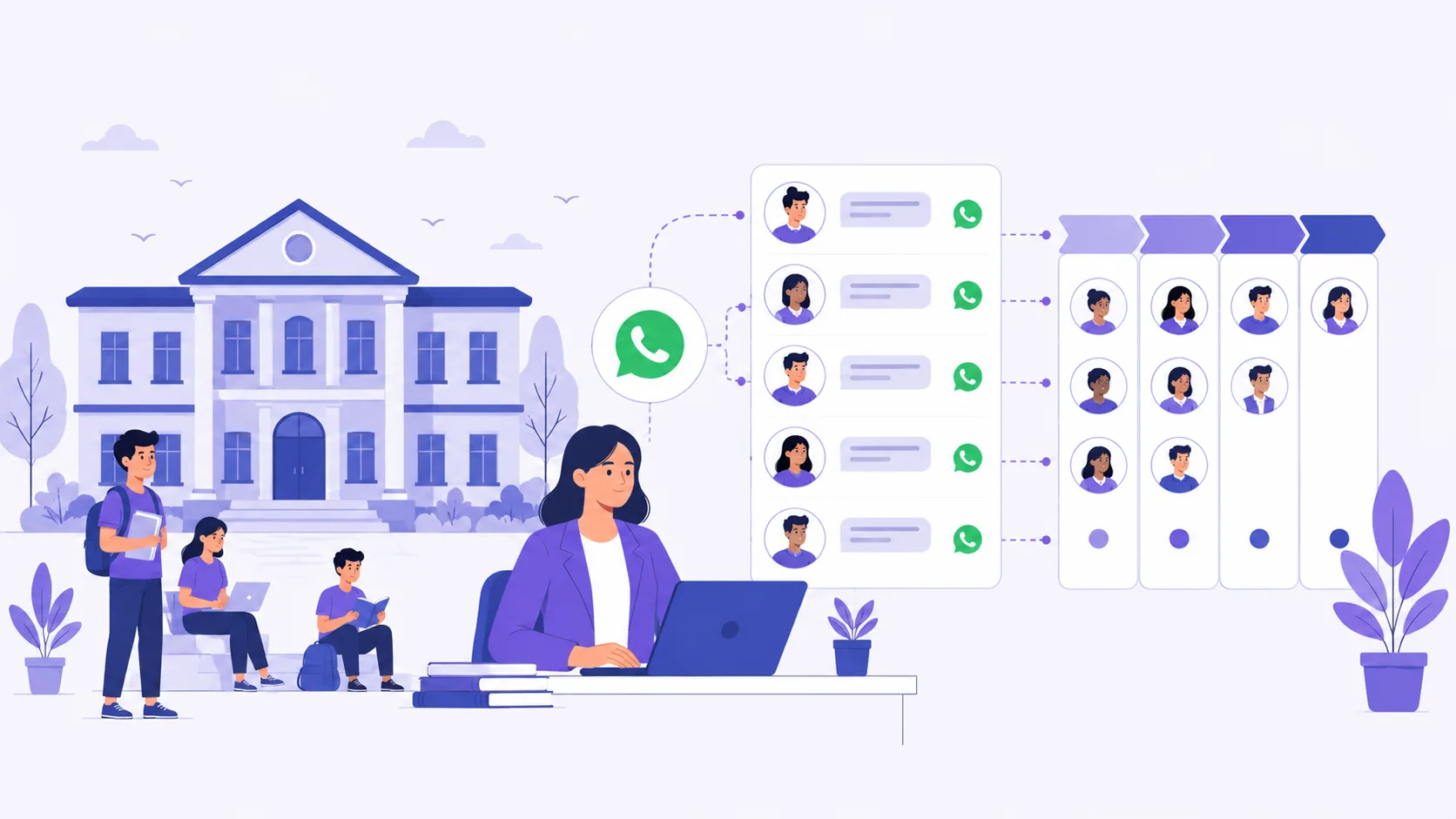
Why WhatsApp keeps banning your coaching number (and what a real WhatsApp CRM fixes)
You saved a SIM as the “Admissions” number and started blasting batch updates and fee reminders to parents from WhatsApp Business on a counsellor’s phone. It worked for a week. Then, around the hundredth message, the number got blocked. No warning, no appeal that went anywhere, and a list of parents you can no longer reach. If that is your story, you are not careless and you are not alone. It is the single most common complaint coaching owners type into the internet, and not one WhatsApp CRM landing page in the search results explains why it happens or how to actually stop it.
This is the guide that does. We will name the ban problem in plain words, separate a broadcast tool from a real coaching CRM, decode the one cost every vendor hides (the Meta bill), and connect something nobody else connects: your students are minors, and your WhatsApp marketing is now a data-protection liability under India’s DPDP Act. Then we map the whole admission funnel, month by month, around the actual Indian academic calendar. Where we mention ViveLead, we describe only what our pricing page ships, at the correct plan; where we mention a competitor’s price, we hedge it and tell you to check their current page.
The 100-message ban and the 256-broadcast cap, in plain words
Personal WhatsApp and the basic WhatsApp Business app were never built to message hundreds of people who have not messaged you first. When you blast a one-way promotional message to a large list, a chunk of recipients tap “block” or “report,” and WhatsApp’s spam detection reads that as abuse. A recurring question owners ask online is, almost word for word, why their number gets blocked as soon as they send the first hundred or so messages. The honest answer is that you are using a one-to-one chat app like a marketing broadcast tool, and the platform is designed to stop exactly that.
The basic app also has a hard wall most owners discover the painful way: a broadcast list tops out at 256 recipients. Want to reach a thousand parents about a board-result-day orientation? You are building four lists by hand, and that is before the second, worse catch below.
Why recipients only get your blast if they saved your number
Here is the rule almost nobody mentions until it has already cost you an admission cycle: a WhatsApp broadcast only reaches a recipient if that person has saved your number in their phone contacts. A parent who enquired last week, did not save “Admissions ViveLead Coaching,” and is sitting in your broadcast list simply never receives the message. You think you reached a thousand parents. You reached the few hundred who happened to save you. The rest got silence, and you got a false sense of having followed up.
Stack the three together and the basic-app approach collapses for any institute past a handful of leads: ban risk after roughly a hundred messages, a 256-contact ceiling, and a save-my-number wall that quietly eats your reach. Owners feel this as “WhatsApp marketing does not work for us.” It is not WhatsApp. It is the tool tier.
Broadcast tool vs WhatsApp CRM: the distinction nobody explains
The fix for ban risk and the save-contact wall is the official WhatsApp Business Platform, often called the Cloud API. Treat that as a general industry concept for now (the next section explains it properly). The short version: it lets a business send pre-approved templates to opted-in contacts at scale, without the basic app’s bans and caps, because it is the channel Meta sanctions for business messaging.
But access to that channel is only half your problem. A pure broadcast tool, the kind that sells you “send to 10,000 contacts,” gives you the messaging pipe and nothing else: no admission pipeline, no way to track which parent is at “demo booked” versus “fee pending,” no counsellor ownership, no funnel report. So your counsellors end up in two apps, the broadcaster for messages and a spreadsheet or separate CRM for everything that actually decides an enrollment. A blaster is not a CRM. And a CRM without native WhatsApp is two logins. That line is the whole argument.
What this guide covers (and what we will not pretend ViveLead does)
We will not invent ViveLead capabilities to fill a section. ViveLead’s WhatsApp is native WhatsApp Business on the Professional plan, with Meta billing your own WhatsApp Business Account (WABA) at no markup, and we will not dress that up with API-architecture claims our pricing page does not make. For the broader buyer’s-guide view of WhatsApp CRMs across vendors, our WhatsApp CRM India guide ranks tools by use case. This article is narrower: it is for coaching institutes specifically, from the number ban through the Meta bill, DPDP on minor data, the admission funnel, the seasonal playbook, the speed-to-lead math, the pricing debate, and a separate section for study-abroad agents.
What a “WhatsApp CRM” actually is for a coaching institute
The phrase “WhatsApp CRM” gets used for three different things, and the confusion is expensive. So let us define it for a coaching institute precisely, because the definition is also the buying criteria.
A WhatsApp CRM for a coaching institute is one system that does three jobs in one login: it captures every enquiry from every source, it lets you have and track WhatsApp conversations with parents and students, and it moves each enquiry through an admission pipeline to an enrolled, fee-paying student. Messaging is one layer. The admission CRM is the other. A tool that only does the messaging layer is a broadcaster. A tool that only does the pipeline layer, with WhatsApp bolted on, is two logins wearing one logo.
WhatsApp Business Platform (Cloud API) explained as a general concept
The official WhatsApp Business Platform, commonly called the Cloud API, is the route Meta provides for businesses to message customers at scale. This is a general industry concept, not a ViveLead feature, and understanding it is what separates owners who get banned from owners who do not.
A few things define it. You message through pre-approved templates: you submit your fee-reminder or demo-confirmation text to Meta, it gets reviewed, and once approved you can send it to many contacts. You message contacts who have opted in, which is both a policy rule and, as we will see, a DPDP issue. And because it is the sanctioned business channel, it is not subject to the basic app’s ban triggers and 256-contact cap. There is also a 24-hour “service window”: when a parent messages you first, you can reply freely and free of Meta charge for 24 hours; outside that window you reach out via a paid template. Hold that detail, it matters for your bill.
Crucially, Cloud API access is sold through providers (Meta calls them Business Solution Providers, or BSPs). Your CRM is, in effect, one of those providers or works through one. That is the layer where money quietly leaks, which is the point of the next section.
The three layers: capture, conversation, conversion
Think of a coaching WhatsApp CRM as three stacked layers, because a tool can be strong at one and useless at the others.
Capture. Where enquiries come in: Meta lead ads (the Facebook and Instagram form ads parents tap), your website’s enquiry form, walk-in registers, referrals, JustDial. The job here is to get every one of these into a single list with the source tagged, so a 9pm Sunday enquiry is not lost on a sticky note.
Conversation. The WhatsApp layer plus calls: confirming the enquiry in minutes, answering fee and batch questions, sending the demo link. This is where the official Business Platform earns its keep, and where a banned personal number kills you. The admission follow-up message pack is this layer written out: eight messages in English and Hindi, each with the moment it goes out and the point a counsellor has to take over.
Conversion. The admission pipeline: New, Contacted, Demo Booked, Demo Done, Negotiation, Enrolled. Plus the money: a quotation for the fee, an invoice, a record of the installment paid. Plus the management view: which counsellor owns which parent, and what is the funnel drop-off.
A broadcaster gives you a thin conversation layer and nothing else. A generic CRM gives you conversion and a weak conversation layer. A coaching WhatsApp CRM has to do all three, or your counsellors paper over the gaps with manual work that breaks the moment you get busy, which is exactly when admissions spike.
Why a coaching admission funnel needs a pipeline, not just broadcasts
Selling a coaching package is not a one-message transaction. An Indian parent does not pay 80,000 rupees for a NEET batch off a single broadcast. The median enrolled lead takes several touchpoints over several days: the enquiry, a qualification call, a demo class, a fee conversation, a seat-hold nudge. A broadcast tool cannot tell you which parent is at which step, so it cannot tell your counsellor what to do next. A pipeline does the opposite: it holds each parent at a known stage, attaches the conversation history and the fee quotation to that record, and surfaces the stuck ones before they go cold. We break down why spreadsheets fail this exact job in Excel vs CRM for lead tracking, and an EdTech-specific version in stop using your EdTech CRM like Excel.
Where ViveLead fits: native WhatsApp Business on the Professional plan
In ViveLead terms, the layers map cleanly to plan tiers. Capture from website forms is on the Starter plan at Rs 499 per user per month, along with core CRM, custom fields, follow-ups, document management, and the mobile app for Android and iOS. Meta lead ads, native WhatsApp Business, invoicing for fees, demo booking links, lead scoring, and workflow automations come on the Professional plan at Rs 999 per user per month; the admission pipeline (deals and stages), quotations, and counsellor roles (RBAC) are on every plan. WhatsApp message charges are billed by Meta directly to your own WABA, with no ViveLead markup. ViveSmart AI comes with the Business plan. That is the honest extent of it, and the rest of this guide assumes that mapping.
What the WhatsApp CRM vendors never show you: the Meta bill
Here is the gap that should change how you shop. Go read the landing page of any coaching-focused WhatsApp CRM. You will find conversion percentages, screenshots, and a “book a demo” button. You will not find a clear statement of who pays Meta for the messages and how much markup the vendor adds on top. That silence is not an accident. It is where a meaningful slice of your monthly spend disappears.
Meta’s 2026 per-template pricing, explained (marketing vs utility/auth vs free service)
First, the part that is the same no matter which CRM you choose, because it is Meta’s, not the vendor’s. Since 1 July 2025 Meta has charged per message for business-initiated template messages, and since 1 January 2026 Indian businesses can be billed in rupees. The categories matter because they are priced very differently (figures below are the published India rates as of early 2026; Meta changes these, so confirm on Meta’s current rate card before budgeting):
- Marketing templates: roughly Rs 0.86 per delivered message (up about 10 percent from the previous Rs 0.78). This is your promotional blast: “New JEE crash batch starting Monday.”
- Utility templates: roughly Rs 0.115 per message. This is transactional: a demo confirmation, a fee-due reminder, a class-rescheduled notice.
- Authentication templates: roughly Rs 0.115 per message. OTPs and logins.
- Service messages: free, when sent inside the 24-hour window after a parent messages you first.
Sit with the gap between Rs 0.86 and Rs 0.115. A utility message costs roughly one-seventh of a marketing message. The practical lesson, which we build the playbook around later: send your demo confirmations and fee reminders as utility templates, not marketing ones, and you cut that line of your bill dramatically. Most institutes never categorise deliberately and overpay for it. (Source for the 2026 India rates: Meta’s WhatsApp Business Platform pricing, as reported across the WhatsApp-pricing cluster in early 2026.)
The invisible 10 to 30 percent BSP markup and Rs 1,699 to 5,000 per month platform fees
Now the part the vendor controls and rarely shows. Because Cloud API access is resold through providers, your CRM can add a markup on top of Meta’s per-message rate, and most do. Across the WhatsApp-pricing cluster, BSP markups commonly land in the 10 to 30 percent range on the per-message rate. To make this concrete with published examples: industry pricing write-ups in 2026 describe Wati adding roughly a 19 to 20 percent markup on conversation rates, and Interakt charging around Rs 0.87 for a marketing message where Meta’s own rate is closer to Rs 0.70, which works out to a markup near 25 percent (as published, verify on each vendor’s current pricing page).
On top of the per-message markup sits the platform subscription. Published 2026 figures put Wati’s Growth plan from around Rs 2,499 per month and Interakt’s entry tier around Rs 999 per month equivalent, with higher tiers running well above that (again, as published, check the vendor pages, they move). So the real monthly cost of “WhatsApp marketing” through a typical BSP is: Meta’s per-message rate, plus a 10 to 30 percent markup on every message, plus a platform fee of roughly Rs 999 to 5,000. For an institute messaging thousands of parents during admission season, the markup alone is real money, and it is invisible because it is baked into a per-message rate you never see itemised against Meta’s published number.
Who actually owns the WABA, and why that matters for a coaching institute
There is a second, quieter question hidden in here: whose WhatsApp Business Account is this? In some setups the provider owns the WABA and you are a tenant on it. In others, you own your WABA and the provider connects to it. For a coaching institute this is not a technicality. Your WABA holds your message history, your template library, your sender reputation, and effectively your relationship with thousands of parents. If you ever want to switch tools, owning your own WABA is the difference between walking out with your asset and starting from zero.
This is also the cleanest, most defensible claim in the whole category, and it is exactly the anxiety owners voice. A recurring question online is, plainly, whether WhatsApp Business API pricing has hidden fees and how it varies between providers. The honest answer is yes, it varies a lot, and the markup is the hidden part.
ViveLead’s model: native WhatsApp on Professional Rs 999, billed by Meta to your own WABA, no markup
Here is where ViveLead’s pricing page is unusually blunt, and it is the reason to lead with this when you compare tools. WhatsApp Business is included on the Professional plan at Rs 999 per user per month: templates, broadcasts, and a marketing inbox. The Meta message charges are billed by Meta directly to your own WhatsApp Business Account. You set up the WABA, you pay Meta, and ViveLead does not mark it up. Our pricing page states this in the “what your plan does not include” section, on purpose, so there is no surprise on your bill.
What that means in practice: you pay your per-seat Rs 999, and your Meta messaging cost is Meta’s published rate, full stop, with no reseller percentage skimmed on top and no separate WhatsApp platform fee layered over the CRM subscription. When you shop other tools, ask the one question their landing page avoids: what is your markup on Meta’s per-message rate, and do I own my WABA? If they cannot answer both in one sentence, you have found the hidden cost.
Your students are minors. Your WhatsApp marketing is a DPDP liability.
This is the section no competitor has written, and the one most likely to bite an institute that ignores it. Every coaching CRM page talks about “nurturing parents on WhatsApp.” None connects that to the uncomfortable fact that the person you are marketing about is a child under 18, and that India now has a data-protection law treating a child’s data as the most sensitive category there is.
To be clear about our lane: nothing here is legal advice, ViveLead does not hold any DPDP certification, and you should run your actual consent flows past a lawyer. What we can do is connect the dots the rest of the category leaves unconnected, and show which technical controls help.
Why under-18 student data is the strictest DPDP tier (verifiable parental consent)
India’s Digital Personal Data Protection (DPDP) Act defines a child as anyone who has not completed 18 years of age, which is a broader bar than many global standards. For a child’s personal data, the Act requires verifiable parental consent before you process it. That is a higher standard than the ordinary consent you would collect from an adult lead. You are expected to confirm the person consenting is genuinely the parent or guardian, not the student, and that the relationship is legitimate. Draft rules have pointed to government-backed identity systems for this kind of verification.
For a coaching institute, almost your entire database is exactly this category: students who are minors, with parents as the decision-makers. So the strictest tier of the law is not an edge case for you. It is your default.
Why a generic “I agree” checkbox is explicitly not enough
The instinct is to slap an “I agree to be contacted” checkbox on the enquiry form and consider consent handled. Under DPDP’s approach to children’s data, that generic checkbox is explicitly insufficient. Consent for a minor’s data has to be verifiable parental consent, which a single unverified tick on a web form is not. This is the trap most institutes are sitting in right now without knowing it: they have a checkbox, they think they are covered, and they are not.
The 22-language notice rule and penalties up to Rs 250 Cr
Two more facts sharpen the stakes. First, DPDP allows the privacy notice (the explanation of what data you collect and why) to be made available in any of the languages listed in the Eighth Schedule of the Constitution, which is 22 languages. For an institute that markets across states, that is a real operational consideration, not a formality.
Second, the penalties are not symbolic. The Act’s penalty bands run up to Rs 250 crore, with breaches involving children’s data and security-safeguard failures sitting near the top of that range. Full substantive enforcement is set to land by mid-2027 (the Act took partial effect in late 2025, with full compliance and enforcement powers slated for around May 2027). That gives institutes a window to get consent and data handling right, not an excuse to wait.
When your WhatsApp chats sync to a CRM, the CRM is a data processor
Here is the link the category never makes. The moment your WhatsApp conversations with parents flow into a CRM, that CRM is processing personal data on your behalf. In DPDP terms it is acting as a data processor, and you, the institute, are the data fiduciary responsible for what happens to that data. So “we just message parents on WhatsApp” quietly becomes “we are collecting and processing minors’ personal data in a third-party system,” which is precisely the activity the law governs. Choosing where that data lives, who can see it, and whether it is logged and access-controlled is now a compliance decision, not just an IT preference.
Controls that help: RBAC, AES-256, India-hosted data, audit logs, consent capture
This is the only ViveLead claim we will make in this section, carefully. ViveLead is not a DPDP certification and does not make you compliant by itself. What it provides are the kinds of controls that support compliance: role-based access control (RBAC) so a junior counsellor only sees the leads they own, not the whole student database; AES-256 encryption for data at rest and in transit; data hosted in India; audit logs that record who accessed what; and form fields to capture and record consent at the point of enquiry. These map to recognised data-protection principles (ViveLead follows GDPR principles and the IT Act 2000), and they are the practical difference between a student database anyone in the office can export and one that is access-controlled and logged.
To be explicit on the boundary, because the category is full of inflated claims: ViveLead does not claim ISO 27001, SOC 2, CCPA, or HIPAA, and FERPA is a US schools law that does not apply to an Indian coaching institute at all. ViveLead gives you controls that help you meet DPDP obligations; you still take your own legal advice on the consent flows themselves. Our security page lays out exactly what is and is not in place.
Blaster vs CRM: an honest map of the coaching admission funnel
Let us resolve the trap both kinds of vendor dodge. Broadcast tools sell you reach with no pipeline. Generic “best CRM” listicles sell you a pipeline with WhatsApp bolted on, so your counsellors copy-paste between two apps. Here is the funnel mapped stage by stage, with the honest capability each stage needs and, where relevant, the ViveLead plan that covers it (grounded strictly in our pricing).
Stage 1: Capture (website forms on Starter Rs 499, Meta lead ads on Professional Rs 999)
Every enquiry, every source, into one tagged list. The realistic source mix for an Indian institute is WhatsApp inbound from an Instagram ad, demo-booking form submissions, Meta lead ads, walk-ins, and the long tail of JustDial and Google. The job is to stop treating these as five separate inboxes. ViveLead’s Starter plan at Rs 499 per user per month captures website forms (Meta lead ads join on Professional), supports bulk import from CSV and Excel for your walk-in register (Google Sheets import joins on Professional), and tags the source on every lead at creation. That source tag is what later lets you answer “did Instagram or Google actually pay back?” We go deep on this in smart lead capture.
Stage 2: Route to the right counsellor by course, location, language
A Python-coaching enquiry should not land with the NEET counsellor, and a Tamil-speaking parent should not get routed to a counsellor who only speaks Hindi. Lead distribution rules assign each enquiry to the right counsellor by course, city, or simple round-robin, so workload is even and the first conversation is relevant. In ViveLead, rule-based lead distribution and territory management are on the Professional plan, and the roles (RBAC) that keep each counsellor scoped to their own leads come with every plan.
Stage 3: Conversation + cadence (native WhatsApp Business, Professional Rs 999)
This is the WhatsApp layer, done the ban-safe way through native WhatsApp Business on Professional. Confirm the enquiry in minutes with a utility template, answer fee and batch questions in the marketing inbox, and run a follow-up cadence that mixes automated touches with human calls. The conversation history lives on the lead record, not on a counsellor’s personal phone, so when that counsellor leaves, the relationship does not leave with them. Remember the cost lesson: confirmations and reminders go out as cheap utility templates, promotions as marketing templates.
Stage 4: Demo booking links and reminders
The biggest leak in a coaching funnel is the gap between “parent wants a demo” and “demo actually happened.” A public booking link lets the parent self-serve a slot, syncs it to the calendar, and triggers a confirmation immediately, a reminder 24 hours before, and a final nudge an hour before. ViveLead’s public booking links (with reschedule and cancel) and Google Calendar and Meet sync for appointments are on the Professional plan, wired to the automations engine. Institutes that turn this on routinely move demo show-up from around 35 percent to roughly 70 percent, simply because nothing gets lost. The full mechanics are in our demo-to-enrollment funnel guide.
Stage 5: Fee tracking with quotation and invoicing
Coaching is sold in fees and installments, so your CRM needs to handle money, not just messages. A quotation captures the fee structure and any sibling or early-bird discount, an invoice goes out, and the installment paid gets recorded against the student. ViveLead’s deals and quotations with line items come with every plan, and record-payment and multi-currency invoicing with the Professional plan. This is the stage broadcast tools simply do not have, and it is why “we will just use a WhatsApp blaster” falls apart the moment a parent asks for a payment plan.
Where a pure broadcast tool leaves you copy-pasting between two apps
Put the stages together and the broadcaster’s gap is obvious: it covers a thin slice of Stage 3 (send messages) and none of Stages 1, 2, 4, or 5. So your counsellor lives in the blaster for messages and a spreadsheet or separate CRM for capture, routing, demos, and fees, copy-pasting between the two by hand. Every copy-paste is a chance to drop a lead, and in admission season you do it hundreds of times a day. One login that does all five stages is the difference between a funnel that holds and one that leaks at every seam.
The admission-cycle WhatsApp playbook (month by month, India)
Generic advice says “respond fast.” Useful advice maps your automation to the real Indian academic calendar, because a coaching institute’s enquiry volume is wildly seasonal and the messages that win in April are not the ones that win in October. Here is a month-by-month playbook. Treat the volumes as illustrative; your numbers depend on your ad spend and city.
Board-result day and NEET/JEE result spikes: speed-to-lead under 5 minutes
The biggest enquiry floods of the year are result days: CBSE and state board results, and the JEE and NEET announcements. A parent’s intent peaks and decays fastest here, with institutes compared in the same hour the result drops. The only thing that matters is speed-to-first-reply. Wire an automated WhatsApp utility template to every new lead so result-day enquiries get acknowledged in minutes with a counselling-call offer, while competitors reply on Monday.
April to July admission rush: capture, route, and demo-booking automation
This is the season the whole year is built on. Enquiry volume can multiply several times over, and the failure mode is not lack of leads, it is leads piling up faster than counsellors can manually triage them. The automation stack that holds: capture every source into one list, auto-route each enquiry to the right counsellor by course and city, and push every interested parent to a self-serve demo-booking link instead of negotiating slots one by one on WhatsApp. Institutes that drown in April do routing and booking by hand; the ones that scale wired it once and let it run.
Demo-class confirmations and reminders (utility templates, the cheap category)
Demo confirmations and reminders are transactional, so they qualify as utility templates at roughly Rs 0.115 each, not marketing templates at roughly Rs 0.86: compliant and about seven times cheaper per message. The cadence that lifts show-up is a confirmation the moment the slot is booked, a reminder 24 hours before, and a final reminder with the meeting link an hour before. This single workflow is the highest-ROI automation a coaching institute can switch on, because it converts warm leads you have already paid to acquire.
Fee-installment reminders and batch class updates without ban risk
Fee due in three days? Batch timing changed? These are exactly the messages owners used to blast from a personal number and get banned for. Sent as utility templates through native WhatsApp Business to opted-in parents, they go out reliably, cheaply, and without ban risk, and they reach parents whether or not they saved your number, because the official Business Platform does not have the basic app’s save-contact wall. Fee reminders in particular pay for the whole CRM: one recovered installment that would otherwise have slipped is worth months of subscription.
Off-season: re-engaging cold leads for the next intake
August to December is quieter for fresh enquiries, which is precisely when most institutes go silent and let last season’s “not now” leads die. The smart play is a light re-engagement cadence to the parents who enquired but did not enroll: a periodic, genuinely useful WhatsApp touch such as a topper interview, a free workshop, or an early-bird window for the next batch. A lead that said “maybe next session” in June is a warm lead in December if you stayed in gentle contact, and a stranger if you did not. Your pipeline’s “nurture” stage exists for exactly this.
A sample 7-day enquiry-to-enrollment cadence (links to the funnel guide)
Within a single enquiry, the cadence that converts is tight and mixes automation with human calls. In short: Day 0, auto-confirm within minutes plus a counsellor qualification call within two hours to book the demo; Day 1, automated reminder before the demo; demo day, run the trial class; Day 2, a personalised human follow-up with the fee structure and a 24 to 48 hour seat-hold offer; Day 3 to 4, a soft automated “any questions” nudge; Day 5 to 6, a human call for the fee or payment-plan conversation; Day 7, decision or move to nurture. We break this down message by message, with the exact stages and triggers, in the demo-booking to enrollment in 7 days guide. Build that one cadence well before you build anything fancier.
Speed-to-lead: the only number that actually moves enrollments
Every vendor waves the “you have 80 to 300 enquiries and your counsellors miss the follow-ups” pain at you, then quotes a suspiciously round “25 percent more conversions” with no methodology. We will keep the pain, drop the fake precision, and ground the one metric that genuinely decides coaching enrollments: how fast you make first contact.
The MIT lead-response study, cited properly (21x within 5 minutes)
The most-cited hard number here is from a study led by Professor James Oldroyd, analysing more than 15,000 leads with InsideSales (work commonly associated with the MIT lead-response research). The finding: you are about 21 times more likely to qualify a lead contacted within 5 minutes than one contacted after 30. On board-result day that is the difference between catching a parent while they are still on your enquiry form and reaching them after two competitors already have. Speed is not a nice-to-have; it is statistically the highest-leverage thing your funnel does.
Why counsellors miss follow-ups: the spreadsheet + personal-WhatsApp trap
Counsellors do not miss follow-ups because they are lazy. They miss them because the system makes missing easy: the demo time is on a sticky note, the conversation is on one counsellor’s personal WhatsApp nobody else can see, the enquiry list is a spreadsheet already a day stale, and when a parent replies at 9pm nothing reminds anyone to follow up at 9:05. “Speed-to-lead” and “lead leakage” are vendor phrases, but the underlying failure is mechanical: with no single system holding the next action, the next action depends on memory, and memory loses to volume every admission season.
Illustrative ROI arithmetic (clearly labelled, not a fake case study)
Let us do the math honestly, with numbers clearly labelled as illustrative, not a real customer’s results. Suppose an institute gets 300 enquiries in a month and currently converts 10 percent to enrollment, so 30 students, at an average fee of Rs 60,000. That is Rs 18,00,000 in enrolled fees. Now suppose that systematising capture, sub-5-minute first response, and a disciplined demo-reminder cadence lifts conversion from 10 percent to 13 percent. That is 39 students, Rs 23,40,000, an extra Rs 5,40,000 in a single month from the same ad spend. Even if your real lift is half that, the arithmetic dwarfs a CRM bill of, say, six counsellor seats at Rs 999, Rs 5,994 a month on Professional. The point is not the exact figures, which will differ for you. The point is that the lever is conversion rate, and conversion rate is mostly speed and follow-up discipline, both of which are CRM problems.
What to actually track: demo show-up rate and per-counsellor conversion
Two numbers tell you more than a dashboard of twenty. First, demo show-up rate: with a confirmation-and-reminder cadence wired up it should sit at 60 percent or higher, and if it drops below 50 percent an automation has broken, go check your templates are still firing. Second, per-counsellor conversion from contacted to enrolled: the variance across your team is the actionable insight. If your average is 25 percent but one counsellor sits at 12 percent, that is a coaching gap, not a hiring gap, and if one sits at 45 percent, copy what they do instead of just handing them more leads. ViveLead surfaces both in its reports, with a per-counsellor breakdown, on every plan.
Per-user vs flat-fee pricing: the honest break-even for institutes
Flat-fee CRMs have a favourite weapon: “per-user pricing balloons as you hire, so pay one flat fee for unlimited users.” It is a genuinely good argument for some institutes and a genuinely bad one for others, and the vendors pushing it never show you the break-even because the break-even is the whole truth. Here it is, done honestly.
How flat-fee CRMs pitch “unlimited users”
The pitch is simple and not wrong: a 5-counsellor team and a 50-counsellor team pay the same flat monthly fee, so you never face escalating per-seat costs as you grow. In the Indian market the headline flat-fee names are Groweon and Kylas. As published in 2026 pricing write-ups, Groweon’s flat unlimited-user plans are quoted around Rs 9,999 per month (with higher suite tiers above that), and Kylas is quoted around Rs 12,999 per month for unlimited users (some sources cite Rs 15,000). Treat both as “as published,” and verify on the vendors’ own current pricing pages, because these numbers move and tiers cap things like records and storage even when users are unlimited.
The break-even math: 3 to 8 counsellors vs 25 to 30+ counsellors
The honest comparison is just division. Take ViveLead Professional at Rs 999 per user per month. Against a roughly Rs 9,999 flat fee, the break-even is about 10 seats (Rs 9,999 divided by Rs 999 is about 10). Against a roughly Rs 12,999 flat fee, it is about 13 seats. So below roughly 20 to 26 counsellors, per-user is cheaper; above it, flat-fee is cheaper. For WhatsApp-capable comparisons the line shifts further in per-user’s favour, because flat-fee CRMs often bolt WhatsApp on through a paid third-party integration that adds its own monthly fee, whereas ViveLead’s WhatsApp is native on Professional with no extra platform charge.
Why a small institute usually pays less per-user (Rs 999 x 6 = Rs 5,994/mo)
Most coaching institutes are not 50-counsellor operations; a typical setup is 3 to 8 counsellors. At six, ViveLead Professional is Rs 999 times 6, roughly Rs 5,994 per month, still under a Rs 9,999 or Rs 12,999 flat fee, and that price already includes native WhatsApp, the admission pipeline, quotation and invoicing, and demo booking. Paying a flat Rs 9,999 for “unlimited users” you do not have is paying for seats you will never fill. If budget is the deciding factor, our CRM under Rs 500 in India guide is built for exactly this segment.
When flat-fee genuinely wins (be upfront about it)
Now the part the per-user vendors leave out and we will not: above roughly 25 to 30 counsellors, the flat-fee math flips and a flat fee can be the cheaper, more predictable choice. If you are a large multi-branch institute with 40 admission staff and growing fast, a flat unlimited-user fee may well beat per-seat, and you should price both. The honest rule is: count your actual seats, divide the flat fee by Rs 499, and if your headcount is below that number per-user wins, above it flat-fee wins. Anyone who tells you one model is universally cheaper is selling, not advising. We do a full head-to-head in ViveLead vs Kylas if flat-fee is on your shortlist.
Study-abroad and overseas-education agents: a different CRM problem
If you place students in universities abroad, the coaching-CRM advice above is only half-right for you, and the SERP’s habit of folding you into “coaching” does you a disservice. Owners in this space search for an “overseas education CRM” because their workflow genuinely is a different shape.
Why “overseas education CRM” is its own category
A coaching institute runs an enquiry-to-enrollment pipeline that closes in days or weeks. An overseas-education agency runs an application-to-admission-to-visa pipeline stretching across many months, multiple destination countries, and a chain of partners (student, agency, university, sometimes a sub-agent network). The “deal” is not one fee payment, it is a multi-stage application with documents, deadlines, and intakes that vary by country. That is a real category difference, not a marketing label, and treating it like a coaching funnel will frustrate you.
Application-stage pipeline vs coaching enquiry pipeline
For a coaching institute the pipeline stages are New, Contacted, Demo Booked, Demo Done, Negotiation, Enrolled. For an overseas agent they look more like Enquiry, Profile Evaluation, Shortlist, Application Submitted, Offer Received, Visa, Departed. You are tracking documents and deadlines per application, often several applications per student across different universities and countries, each at its own stage. A generic pipeline can model this with custom stages, but you have to set it up deliberately as an application pipeline, not a sales pipeline.
Document management, quotations, and multi-currency invoicing
The document and money side is where this persona is heaviest. Transcripts, statements of purpose, recommendation letters, passports, and offer letters pile up per student, so document management is core, not optional. Fees are charged in different currencies depending on destination, so multi-currency invoicing matters. In ViveLead terms, document management, the deals pipeline, and quotations are available from the Starter plan, and multi-currency invoicing is on Professional, which covers a meaningful chunk of an agent’s workflow, with WhatsApp follow-up working the same way it does for coaching.
Where ViveLead fits and where a niche tool might be the better call
Honestly: ViveLead fits an overseas-education agent who wants one affordable system for capture, WhatsApp follow-up, a configurable application pipeline, document storage, and multi-currency invoicing, and who is comfortable setting the pipeline up to mirror application stages. Where it is not the obvious pick is if your operation is deeply application-centric and multi-partner: heavy sub-agent commission tracking, university-specific application portals, or visa-document workflows so specialised that a purpose-built overseas-education platform earns its keep. If that is you, evaluate a niche tool alongside ViveLead and pick on fit, not on brand. The cleanest way to decide is to run your real workflow through ViveLead’s 3-day no-card trial and see where it bends.
Choosing a WhatsApp CRM for your coaching institute: a buyer’s checklist
You have the full picture now. Here is the decision-stage checklist that turns every gap above into a question you can ask any vendor. Score them on all six.
Does it own your WABA, and is Meta billing marked up?
The most revealing question, because most landing pages avoid it. Ask: do I own my WhatsApp Business Account, and what markup do you add on top of Meta’s published per-message rate? If they own your WABA, switching later means starting from zero; if they mark up Meta’s rate, you pay that invisible premium on every message forever. ViveLead’s answer is on its pricing page: your own WABA, billed by Meta directly, no markup.
Is there a real admission pipeline and fee/quotation tracking, not just broadcasts?
A blaster is not a CRM. Confirm the tool has an actual admission pipeline with stages, plus quotation, invoicing, and payment tracking for fees. If it cannot tell you which parent is at “fee pending” or generate a fee quotation, it is a broadcaster, and your counsellors will end up in a second app.
Does it help you meet DPDP obligations on minor data?
Your students are minors, so this is not optional. Look for RBAC so staff only see their own leads, encryption at rest and in transit, data hosted in India, audit logs, and a way to capture and record consent. No honest vendor will claim to “make you DPDP compliant,” but the right controls help you meet your obligations. Be wary of anyone claiming certifications like ISO 27001 or SOC 2 without proof, and ignore any FERPA claim, which is a US schools law irrelevant to an Indian institute.
Counsellor RBAC, routing, and funnel reporting
For anything past two or three counsellors, you need role-based access (each counsellor scoped to their leads), lead distribution rules (route by course, city, language), and funnel reporting with a per-counsellor conversion view. These are what let you manage a team rather than just a list. In ViveLead they are on the Professional plan.
Mobile app, free migration, and a no-card trial
Counsellors work from their phones, so a real Android and iOS app is non-negotiable. Free data migration from your current spreadsheet or tool saves you the most painful part of switching. And a no-card free trial lets you test against your own workflow before paying. ViveLead includes a mobile app on every plan, free migration, and a 3-day trial with no credit card.
How ViveLead maps to this checklist (Starter Rs 499 / Professional Rs 999)
To close the loop: website-form capture, core CRM, document management, the admission pipeline, quotations, RBAC, funnel reports, and the mobile app are on Starter at Rs 499 per user per month. Meta lead ads, native WhatsApp Business, invoicing for fees, demo booking links, rule-based lead distribution, and lead scoring are on Professional at Rs 999 per user per month, with WhatsApp billed by Meta to your own WABA at no markup. ViveSmart AI comes with the Business plan. If you want the broader vendor landscape first, the WhatsApp CRM India buyer’s guide and the best CRM software in India 2026 round-up put us next to the alternatives, and the EdTech CRM hub goes deeper on the coaching use case. When you are ready to test it on your own admissions workflow, start the free 3-day trial. No card, free migration, and you will know inside a week whether it holds your funnel together.
WhatsApp CRM for Coaching Institutes: FAQs
Number bans, the Meta bill, DPDP on minor data, pricing, and study-abroad fit
Related reading
- Demo booking to enrollment in 7 days: the exact coaching follow-up cadence.
- WhatsApp CRM in India: buyer’s guide: WhatsApp CRMs compared by use case.
- Why generic CRMs fail EdTech: where a non-education CRM breaks for admissions.
- Smart lead capture: getting every enquiry source into one pipeline.
- WhatsApp AI auto-reply: what answers an enquiry first when no counsellor is online, and how it hands off.
- LMS vs lead management system: which tool handles enquiries and which delivers classes.
- CRM under Rs 500 in India: budget picks for small institutes.
- Pricing: plans, what is and is not included, and the no-card trial.
Coaching CRM by city: Delhi NCR, Mumbai, Bangalore, Hyderabad, Chennai, and Pune.
Start Your Free CRM Trial
CRM from Rs 499/user/month, native WhatsApp on Professional. No credit card required.
Continue Reading
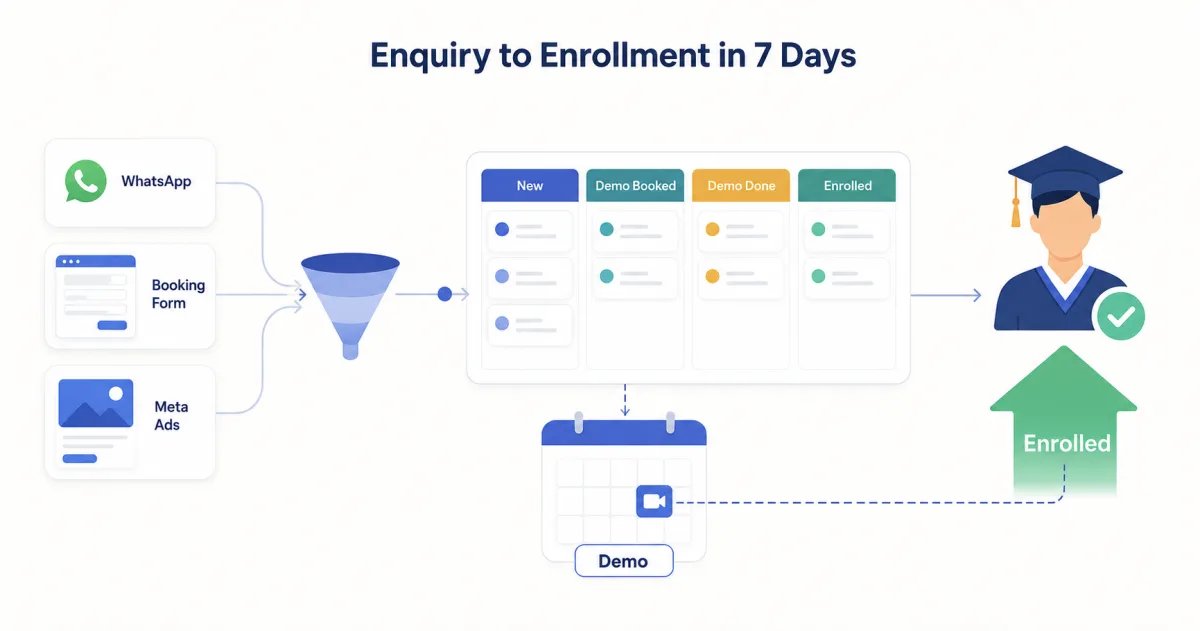
EdTech Lead to Enrollment: The 7-Day Funnel (India 2026)
Move a coaching enquiry from demo booking to enrollment in 7 days: the follow-up cadence, counsellor productivity, and …
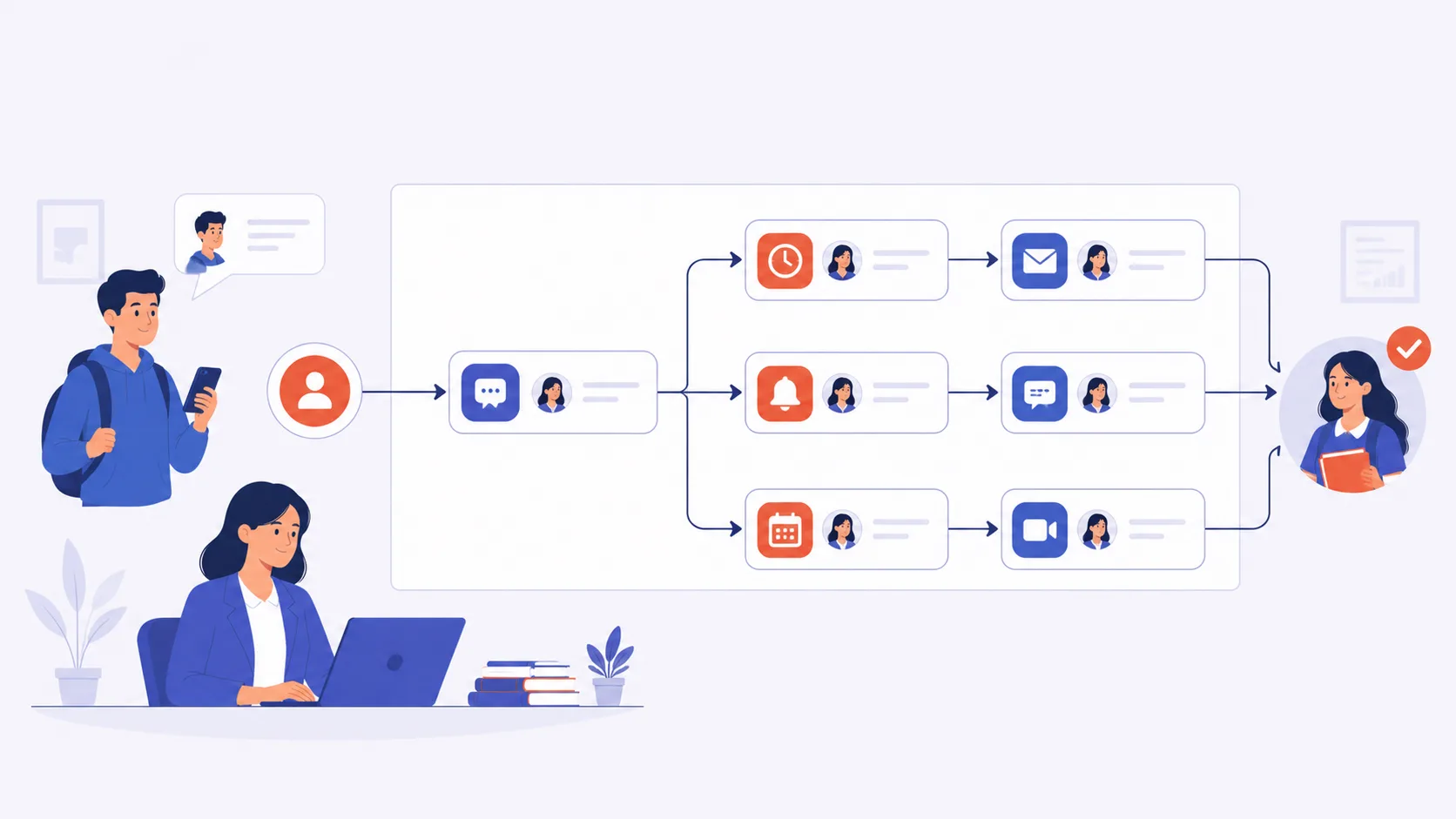
Enrollment Marketing Automation That Wins Clicks | ViveLead
Enrollment marketing automation for Indian coaching, EdTech & study-abroad: the inquiry-to-admission trigger map, honest …
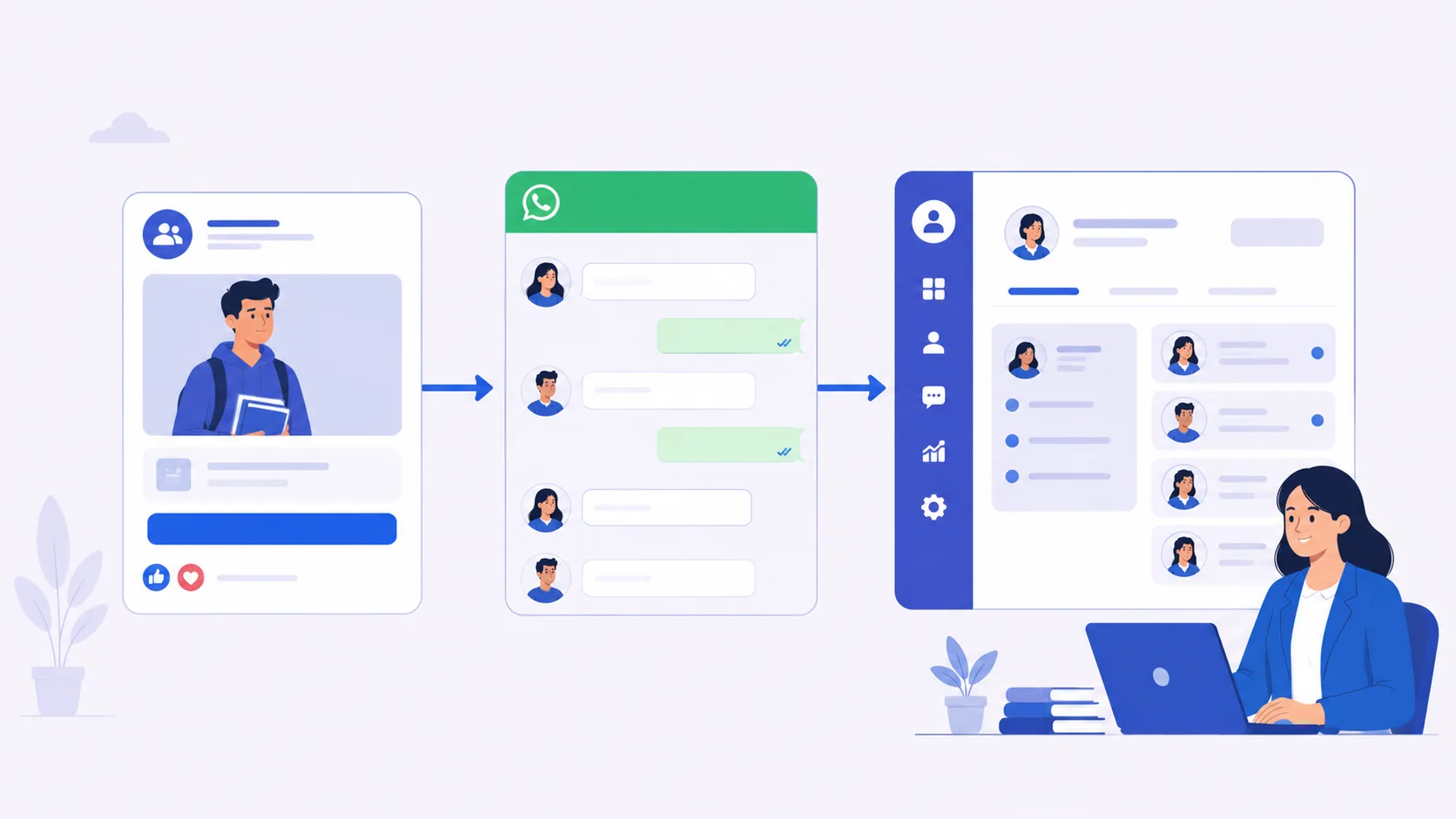
Sync Meta Lead Ads to WhatsApp CRM Natively | ViveLead
Sync Meta lead ads to a WhatsApp CRM the right way: native capture, no BSP markup, own your WABA. India and EdTech …