Save Thousands: Use a WhatsApp CRM Without Zapier
A WhatsApp CRM without Zapier kills the per-task meter and broken-zap dread. Native official-Meta WhatsApp on ViveLead, Rs 999/user. Honest math inside.

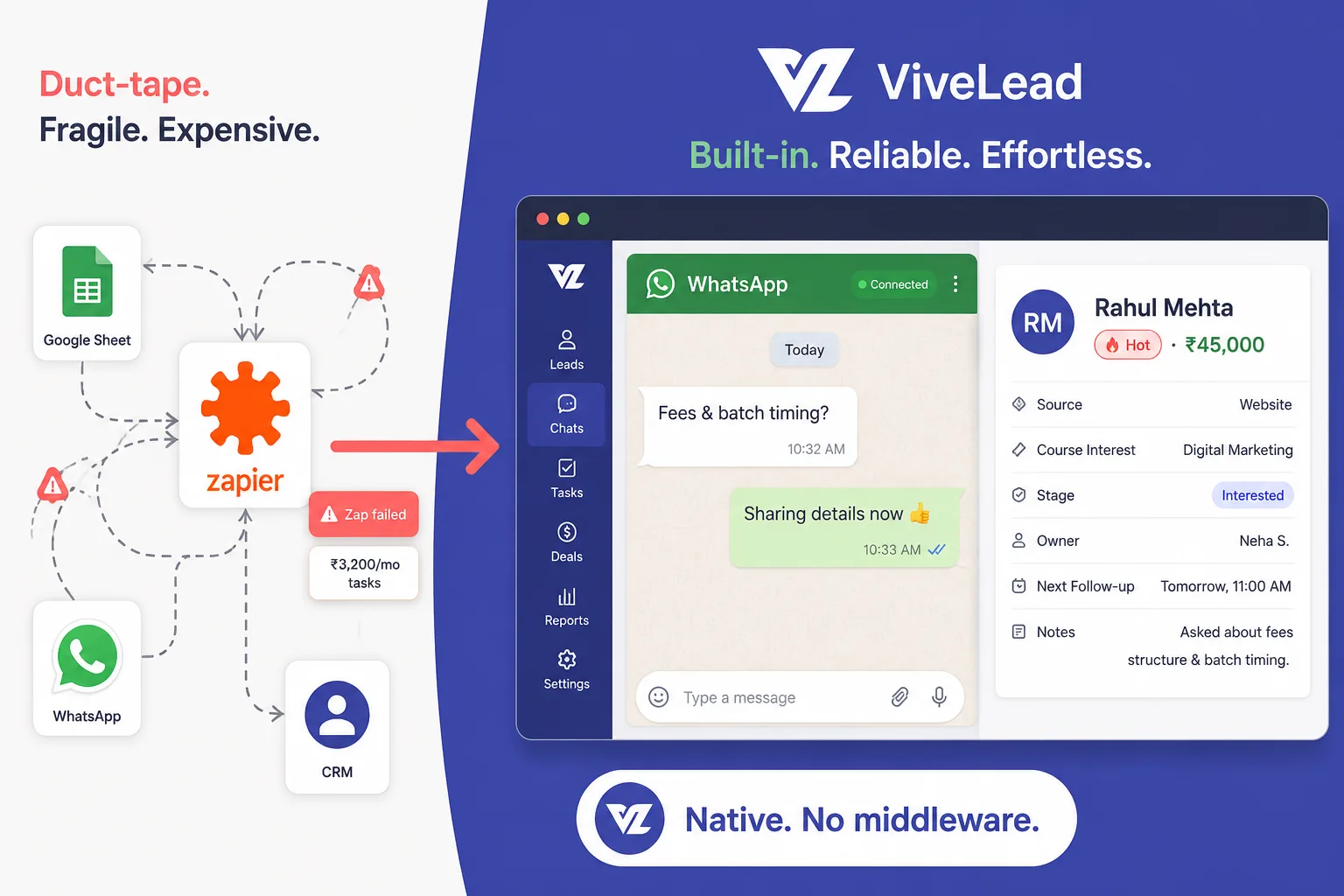
It is 2am and you are checking Zap History again. Not because you want to, but because the last time you did not, a parent called the next morning and said, “I filled your form last Tuesday, nobody called me.” You wired this thing yourself off a YouTube tutorial: Meta lead ad, then Zapier, then WhatsApp and your CRM. You are not a developer. You run an admissions desk. And now you open the dashboard every morning like a heartbeat monitor, hoping the green ticks are still green.
Here is the thing nobody told you when you set up a WhatsApp CRM without Zapier was even an option. For the one job you do fifty times a day, where a Meta lead lands, the CRM logs it, WhatsApp fires, and a rep replies, the connector is the problem, not the solution. You are paying a metered, fragile middleman to forward a row. Mujhe ek aur subscription nahi chahiye, you are thinking, and you are right. But let me be honest up front, because the whole argument falls apart without it: going native does not make Meta’s messages free. It deletes the middleware tax sitting on top of them.
What “WhatsApp CRM without Zapier” actually means
The phrase has a precise meaning, and it is worth setting out before anything else, because most of what gets sold under it is not this.
Native means the CRM talks to the official Meta WhatsApp Cloud API directly. You connect your own WhatsApp Business Account, the BYO-WABA model, and incoming and outgoing messages route through a shared team inbox that lives inside the CRM. There is no Zapier, no Make, no connector sitting in the path forwarding data. The lead and the conversation live in the same place from the first second.
Contrast that with how the big names handle it, as of 2026, and verify on their own sites before you quote me: HubSpot needs a third-party WhatsApp connector (the 360dialog or MessageBird style) to do official WhatsApp. Pipedrive routes you to a marketplace connector. Zoho has you bring your own provider and wire it up. None of them has no WhatsApp, that would be false. What they lack is native official-Meta WhatsApp without a connector bolted on.
ViveLead does it inside the CRM on the Professional plan at Rs 999/user/month. Native removes four specific things: webhook babysitting, polling lag, per-task billing, and the three-vendor blame game where the CRM, the connector, and the messaging tool each point at the other two while your lead goes cold.
The Zapier task tax: you pay per row moved, not per result
This is the load-bearing fact, so slow down here.
How Zapier actually bills
Zapier charges per successfully completed action step. Triggers, Filters, Paths, Formatter, and Delay are free. But every action that does something, create a record, send a message, post a notification, eats one task. So “one lead” is almost never one task.
Walk through a normal admissions zap: capture the Meta lead, create the CRM record, send the WhatsApp message, notify the counsellor, log the activity. That is four or five tasks per single lead. Run that 100 times a day and you are at roughly 15,000 tasks a month for one workflow.
Now line that up against the 2026 tiers from Zapier.com pricing (USD-billed, so the rupee figure moves with the dollar): Free is 100 tasks. Professional is 19.99 USD/month (around Rs 1,700) for 750 tasks. Team is 69 USD/month (around Rs 6,000) for 2,000 tasks. Go over your limit and overage runs at 1.25x the base rate, capped at 3x your plan limit. That cap is not a safety feature, it is the surprise-invoice mechanism: it lets the bill triple before anything stops.
The receipt nobody shows you
One user reported an 847 USD/month invoice (around Rs 70,000) on lead-capture zaps, a figure surfaced on Reddit and cited by eesel.ai. They had ended up optimizing their workflows for Zapier’s meter instead of for their business. Take that as one user reported, not as typical, and results vary wildly with volume. But the shape of it is real, and it bites hardest at exactly the wrong time.
Think about intake season. Your lead volume spikes when admissions open. That is precisely when the per-task meter costs the most and when a broken zap costs you the most enrolments. The pricing model and your busiest month are on a collision course by design.
The 15-minute hole in your funnel
Cost is the slow leak. This next part is the fast one, because it loses you leads even when everything is technically working.
What polling means on the plan you actually buy
Per the Zapier Help Center, polling triggers check the source app on a schedule that depends on your plan: Free and Starter poll every 15 minutes, Professional every 2 minutes, Team and Company every 1 minute. The higher tiers are genuinely faster, so this is not “Zapier is always slow.” The point is narrower and worse: the cheap plan a coaching owner actually buys can sit on a hot admission enquiry for up to 15 minutes before WhatsApp even fires.
Why 15 minutes is already too late
The MIT 5-minute rule settles this. Dr. James Oldroyd at MIT Sloan, working with the InsideSales.com Lead Response Management Study in 2007 (6 companies, more than 15,000 leads, over 100,000 call attempts), found that contacting a web lead within 5 minutes versus 30 minutes made you about 21 times more likely to qualify the lead and about 100 times more likely to connect at all. The study is old and it was about calling, but it is the standard speed-to-lead anchor and it applies cleanly to response speed.
In your language: by the time your zap polls and your rep replies, the parent has already joined the institute down the road that answered in two minutes. Native fires in real time off the inbound webhook. There is no polling interval for the lead to fall into.
Why it silently breaks at 2am
Cost and lag you can at least see coming. Fragility is the one that wakes you up. These are real failure modes documented in the Zapier Community and Meta developer forums, not invented horror stories.
The silent break. You edit a Meta lead form. Facebook assigns a new form ID. Your zap is still pointed at the old ID, so it just stops, with no alert. You find out days later from an angry parent. In a referral-driven admissions market, that is a lost enrolment plus a reputation hit that travels.
Works in test, dead live. The zap passes the editor’s test step, so you assume it is fine and move on. Meanwhile a Facebook token expires or a Business Manager permission changes, and the live connection silently drops while the test still looks green.
The babysitting tax. Zapier’s own recommended fix is to install Zapier Manager so it sends you a Slack or email alert when a zap errors. Read that again: you build a second automation whose only job is to tell you the first automation died. You bought this to stop doing IT work, and now you are doing meta-IT work.
The sync lag you feel but cannot name. A lead WhatsApps you at 9:05pm. The rep sees it the next morning, because the polling interval and the manual CRM check never quite line up. Nothing errored. The lead just aged twelve hours in the gap between two systems.
Native collapses all four into one inbound path, real-time, inside the CRM, with nothing to re-authenticate at 2am.
“But Zapier connects everything” and other fair objections
I am not going to pretend the connector has no use. Here are the honest counterpoints.
Native is locked to one CRM, Zapier connects everything. True. If you need to wire a genuine long-tail integration, push a row to a Google Sheet, ping an accounting tool, trigger something niche, Zapier or Make is great at that. The argument here is narrow on purpose: for the WhatsApp-leads-to-CRM job you do fifty times a day, native wins outright. Native and a connector are not either-or. Keep the connector for the weird one-offs, just stop paying it to do your core flow.
Switching is a pain. This switch removes work. You turn off the zaps that forward Meta leads and fire WhatsApp, and the CRM does it natively instead. You are not learning a new tool or migrating historical data, you are deleting a layer you were maintaining.
Is native really free of per-message cost? No, and I will keep repeating this because it is the whole basis of trust. Meta still bills per delivered message directly to your own WABA, under the per-message model live since 1 July 2025. What you delete is the Zapier, Make, or BSP middleware tax on top, not Meta’s own charge. Indicative rates, set by Meta and billed to your account, run around Rs 0.86 per marketing message and Rs 0.11 to Rs 0.12 per utility or authentication message, subject to change. ViveLead is the tech provider and adds zero markup on that.
What it costs three ways: connector glue vs flat-rate vs native
Here is the money laid out side by side. Prices are 2026 public figures, in rupees, subject to change.
| Approach | What you pay monthly | Per-task or per-message meter? | Who you call when it breaks |
|---|---|---|---|
| Zapier + separate CRM + WhatsApp tool | ~Rs 1,700 to 6,000+ Zapier, plus CRM, plus BSP | Metered per task, overage 1.25x | Three vendors blaming each other |
| Make + separate CRM + WhatsApp tool | ~Rs 800 to 2,500 Make (9 to 29 USD), plus CRM, plus BSP | Metered per operation, every step counts | Multiple vendors, still your problem |
| Indian flat-rate WhatsApp CRM (Kylas ~Rs 12,999, Groweon ~Rs 9,999, unlimited users) | Rs 1.2L to 1.5L per year regardless of team size | No per-task meter | One vendor, but you overpay at 3 to 5 seats |
| BSP (AiSensy ~Rs 1,500 to 3,200, Wati ~Rs 2,499 to 14,799) + separate CRM | Platform fee on top of Meta pass-through, plus CRM | Platform fee plus Meta per message | Messaging vendor, not your CRM |
| ViveLead Professional, native | Rs 999/user/month | No per-task meter, no ViveLead markup on Meta | One vendor: ViveLead |
A few honest notes on that table so the contrast is fair, not a strawman. Make is the SERP’s “cheaper Zapier” and deserves the credit, commonly cited as 5 to 20 times cheaper per equivalent volume, but every step (trigger, filter, action) counts as an operation, so it is still metered glue you babysit. The Indian flat-rate CRMs (Kylas, Groweon) are solid products, they are just the wrong shape for a 3-to-5-seat admissions desk: unlimited users is a great deal at 40 seats and a tax at 4. The BSPs (AiSensy, Wati) are single-channel messaging tools, not CRMs with a pipeline, and their fee sits on top of Meta’s pass-through, so you still need a CRM and still need glue between them.
Now the five-seat math, spelled out. ViveLead Professional at five seats is 5 x Rs 999 = Rs 4,995/month, and billing yearly costs the same per user. That is well under the Rs 9,999 to Rs 12,999/month flat-rate floor, and unlike the Zapier stack it does not creep upward with every extra task during intake season. You add only Meta’s own per-message charge to your own WABA. That is it.
One more middleman is one more processor to trust
Worth a short, factual note, because data law in India is no longer theoretical.
Under the DPDP Act 2023 (MeitY, No. 22 of 2023), a Data Fiduciary decides the purpose and means of processing and carries the penalty, while a Data Processor acts only on the fiduciary’s instruction. You are the fiduciary for your students’ and leads’ data. Every extra middleman that data flows through, Zapier, Make, a BSP, is one more processor in your chain that you have to trust, contract with, and account for. A native single-vendor path shrinks that chain to one. The DPDP Rules were notified in November 2025, with compliance expected around 13 May 2027, so this is a clock that is already running.
To be precise about what ViveLead is and is not: there is no such thing as a DPDP certification, so nobody can hold one, including us. What ViveLead does carry is GDPR principles, alignment with the IT Act 2000, SSL/AES-256 encryption, RBAC, and Razorpay for payments. The structural argument stands on its own: fewer middlemen means fewer processors in your chain.
What native actually gives a 5-person admissions desk
Mapped to the plans, claiming only what ViveLead ships.
- Lead capture starts on Starter at Rs 499/user/month with website forms; Meta lead-ad and Click-to-WhatsApp capture are on Professional at Rs 999. (Starter captures leads, it does not send native WhatsApp.)
- The native WhatsApp job, this whole blog’s point, is Professional at Rs 999/user/month: WhatsApp Business via the official Meta API, connect your own WhatsApp Business Account, templates, broadcasts, and a shared team inbox. Meta’s message charges are billed by Meta to your account with no markup from us.
- Also on Professional, so you stop reaching for Zapier at all: workflow automations inside the CRM, lead distribution rules, and lead scoring (hot, warm, cold). Source-wise conversion analytics and Teams plus Roles (RBAC) come with every plan.
- ViveSmart AI (ask your CRM from ChatGPT, Claude, or Perplexity) comes with the Business plan.
- Trial is a 3-day free trial, no credit card.
One honest scope line, because I will not oversell this: ViveLead is a CRM, not an LMS, an ERP, or a full marketing-automation suite. It captures leads and follows up natively over WhatsApp and email. It does not replace your course platform, and it is not pretending to.
If capture is where your pain starts, read how Meta lead ads flow into a WhatsApp CRM. If your problem is three counsellors fighting over one phone, the shared WhatsApp inbox for EdTech piece is the one for you.
WhatsApp CRM Without Zapier FAQs
The questions an admissions owner actually asks, answered straight
The honest close
The connector was never the product. The follow-up was. You did not get into this to maintain a zap, you got into it to call the parent back before the institute down the road does.
So delete the middleman and keep the lead. Run native official-Meta WhatsApp inside the CRM on ViveLead Professional at Rs 999/user/month, Rs 4,995/month for five seats, and pay Meta only what Meta charges, nothing extra to us. Start with a 3-day free trial, no credit card. The next 2am, sleep.
Delete the middleman, keep the lead
Native official-Meta WhatsApp inside the CRM on ViveLead Professional, Rs 999/user/month. No credit card required.
Continue Reading
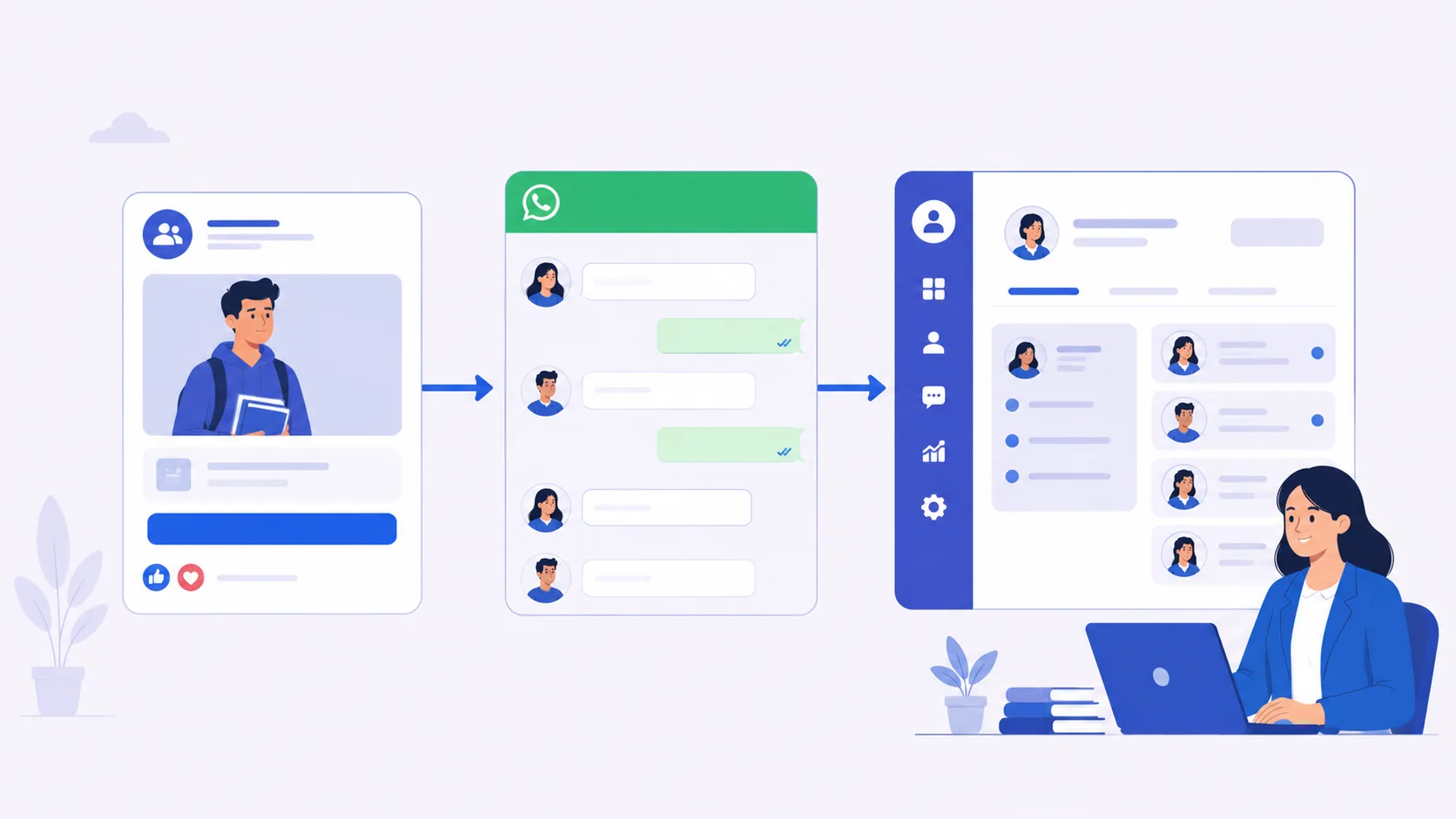
Sync Meta Lead Ads to WhatsApp CRM Natively | ViveLead
Sync Meta lead ads to a WhatsApp CRM the right way: native capture, no BSP markup, own your WABA. India and EdTech …

Why Email Fails: Marketing Automation for Education
Email fails for Indian admissions as a channel, not as copy: Meta-lead-ad junk emails, inbox burial, and the 5-minute …
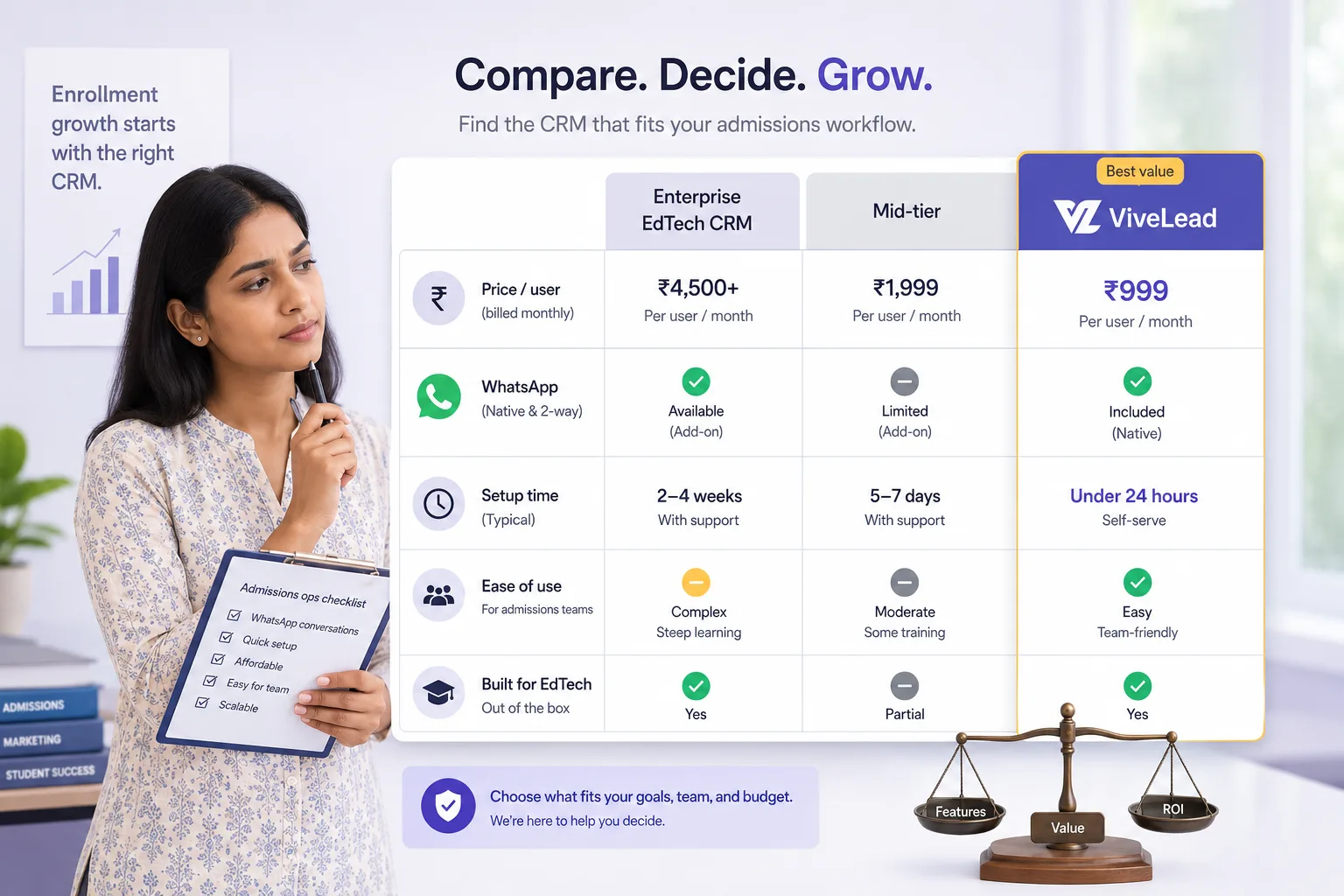
The Brutal Truth About LeadSquared Alternatives
LeadSquared is capable but built for 50+ rep teams. An honest, fit-based look at Zoho, Meritto, ExtraaEdge, TeleCRM and …